Here is the uncomfortable truth about ADCPs: no single frequency does it all. Pick 600 kHz for razor-sharp resolution in a shallow estuary, and you cap out at 70 meters — useless on the continental slope. Pick 75 kHz to punch through 650 meters of water column, and your vertical cells are so coarse that a 5-meter internal wave passes between bins undetected. This is the range-resolution dilemma that has defined acoustic Doppler current profiling since its invention — and it is exactly the problem that Oceantek set out to address with a deliberately engineered, full-spectrum ADCP portfolio spanning 75 kHz, 300 kHz, and 600 kHz.
This article walks through how Oceantek’s multi-frequency ADCP lineup solves the practical profiling problems that surveyors, oceanographers, and offshore engineers face every day — from sub-meter blind zones in 5-meter-deep harbor channels to full water-column current profiles at 650 meters on the outer shelf. We cover the physics, the product matrix, real-world application mapping, and how Oceantek stacks up against the established players.
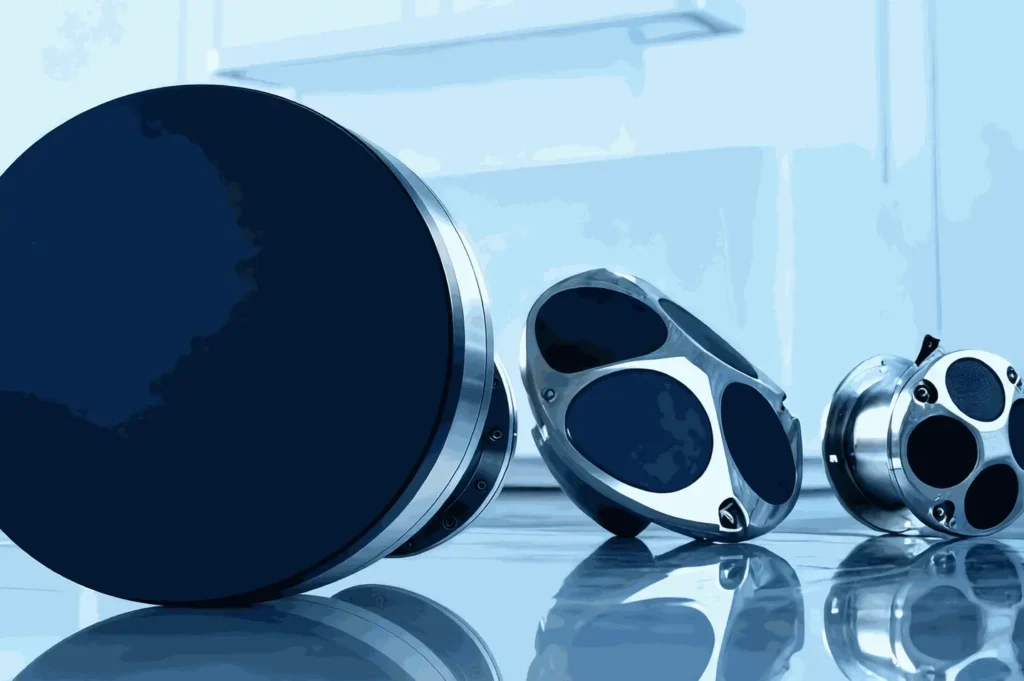
The ADCP Frequency Dilemma: Why One Instrument Cannot Cover Everything
To understand why Oceantek builds three distinct ADCP frequencies — and why that matters for your survey — you need to understand the physics constraint at the heart of every ADCP on the market, regardless of manufacturer.
The Physics: Acoustic Absorption Sets the Rules
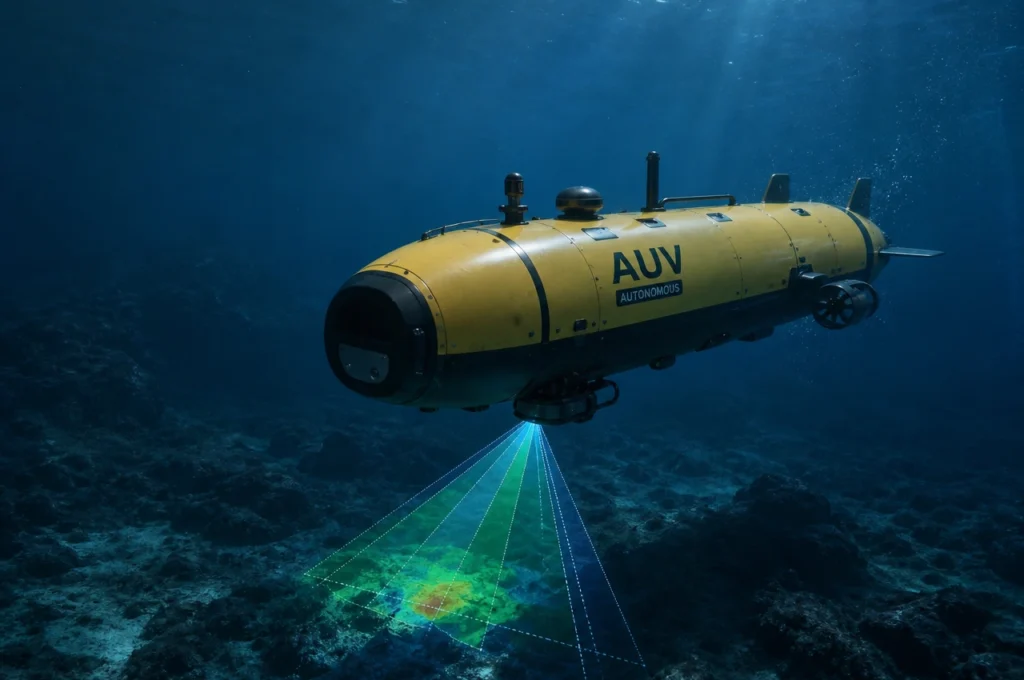
An ADCP works by transmitting acoustic pulses into the water and measuring the Doppler frequency shift of echoes scattered back from suspended particles. The instrument’s acoustic frequency determines everything — range, resolution, and noise floor — through a single physical mechanism: acoustic absorption.
Seawater absorbs sound energy at a rate proportional to the square of the frequency. Doubling your frequency (say, from 300 kHz to 600 kHz) roughly quadruples the absorption rate. This means:
- 600 kHz: High absorption → short range (~55–70 m), but short wavelength → fine vertical resolution (sub-meter cells), low velocity noise (~0.4 cm/s standard deviation)
- 300 kHz: Moderate absorption → mid-range (~120–160 m), moderate resolution (1–4 m cells), good velocity precision (~0.8 cm/s)
- 75 kHz: Low absorption → long range (~550–650 m), coarse resolution (4–8 m cells), higher velocity noise (~3.4 cm/s) requiring longer averaging
This is not a manufacturing limitation. It is a law of physics. No amount of signal processing can make a 600 kHz ADCP profile to 500 meters, just as no amount of averaging can give a 75 kHz ADCP the vertical resolution of a 600 kHz unit. The only solution is to match the frequency to the measurement objective — which means having access to instruments at every relevant frequency.
The Two Pain Points Every Surveyor Knows
The range-resolution dilemma manifests as two concrete field problems:
Pain Point 1 — Shallow Water Blind Zones: In water shallower than 10 meters, a low-frequency ADCP (75 kHz or 300 kHz) produces so few valid depth cells that the velocity profile is essentially useless. The near-field blanking distance — the region immediately in front of the transducer face where valid measurements cannot be made — can consume 1–2 meters of the water column before the first data bin. In a 5-meter-deep channel, losing 2 meters to the blind zone means losing 40% of your profile. A high-frequency instrument (600 kHz or above) with a shorter blanking distance and smaller cell sizes is the only fix.
Pain Point 2 — Deep Water Range Wall: Beyond about 150 meters, a 300 kHz ADCP hits its physical range limit. The acoustic signal attenuates to below the noise floor before it can travel to the seabed and back. For deep-water metocean campaigns — floating wind site assessment, deep-water pipeline route surveys, oceanographic moorings on the continental slope — you need a 75 kHz (or lower) instrument with sufficient acoustic energy to profile the full water column. The trade-off is coarser vertical resolution, which is acceptable for mesoscale current characterization but inadequate for near-bed boundary layer studies.
Oceantek’s Answer: A Purpose-Built Instrument for Every Depth Regime
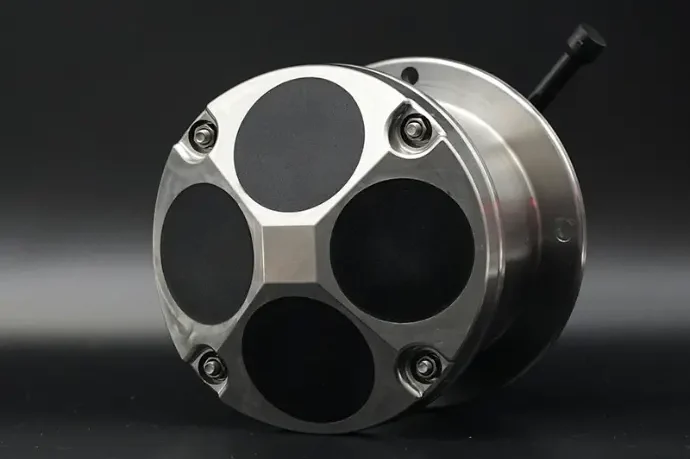
Rather than trying to stretch one frequency beyond its physical limits — or charging a premium for a dual-frequency instrument that compromises on both ends — Oceantek took a three-frequency, six-configuration approach. Each instrument is optimized for its target depth regime, and all share a common technology platform: titanium alloy housing, 4-beam Janus or phased-array transducer, integrated attitude/pressure/temperature sensors, and protocol compatibility with established ADCP systems.
| Model | Frequency | Beam Type | Deployment | Broadband Range | Narrowband Range | Velocity Accuracy | Depth Rating |
|---|---|---|---|---|---|---|---|
| ADCP-600-DR-FA4 | 600 kHz | 4-Beam Convex | Direct-Reading | 55 m | 70 m | ±0.3% ±3 mm/s | 1000 / 3000 / 6000 m |
| ADCP-600-SC-FA4 | 600 kHz | 4-Beam Convex | Self-Contained | 55 m | 70 m | ±0.3% ±3 mm/s | 1000 / 3000 / 6000 m |
| ADCP-300-DR-FA4 | 300 kHz | 4-Beam Convex | Direct-Reading | 120 m | 160 m | ±0.5% ±5 mm/s | 1000 / 3000 / 6000 m |
| ADCP-300-SC-FA4 | 300 kHz | 4-Beam Convex | Self-Contained | 120 m | 160 m | ±0.5% ±5 mm/s | 1000 / 3000 / 6000 m |
| ADCP-75-DR-PA4 | 75 kHz | 4-Beam Phased Array | Direct-Reading | 550 m | 650 m | ±1.0% ±5 mm/s | 1500 m |
| ADCP-75-SC-PA4 | 75 kHz | 4-Beam Phased Array | Self-Contained | 550 m | 650 m | ±1.0% ±5 mm/s | 1500 m |
Table 1: Oceantek’s full ADCP product portfolio — six configurations across three frequencies, covering all depth regimes from shallow estuary to deep ocean. “DR” = Direct-Reading (cable-powered, real-time data); “SC” = Self-Contained (battery-powered, internal logging). Source: Oceantek (oceanadcp.com).
Every instrument in the portfolio shares a common technology backbone:
- Titanium alloy housing — standard on all models, not an optional upgrade
- Velocity range: ±5.0 m/s default, ±20.0 m/s maximum
- Flow direction accuracy: ±2° across all frequencies
- Depth cells: 1–255 configurable, with cell sizes from 1 m to 8 m (frequency-dependent)
- Integrated sensors: Temperature (±0.1°C), pressure (±0.25% FS), attitude/compass (Roll/Pitch ±85°, accuracy 0.2° RMS; Heading 0–360°, accuracy 0.8° RMS)
- Protocol compatibility: Communication protocol compatible with established ADCP systems for drop-in workflow integration
- Continuous operation: Rated for deployments exceeding 180 days
Which Oceantek ADCP for Which Job? A Depth-by-Depth Guide
The table above tells you what each instrument can do. What follows tells you what each instrument should do — mapped to real survey scenarios.
🏞️ Shallow Water (< 30 m): ADCP-600 Series — Resolution First
In water depths under 30 meters — estuaries, harbor entrances, tidal channels, inland waterways, and the nearshore cable landfall zone — vertical resolution is everything. A 600 kHz ADCP with 0.5–4 m cell sizes can resolve the velocity shear across a stratified estuary pycnocline that a 300 kHz instrument with 1-8 m cells would smear into a single bin. The Oceantek ADCP-600-DR-FA4 and ADCP-600-SC-FA4 offer the highest accuracy in the product line (±0.3% ±3 mm/s) — a meaningful improvement over the 300 kHz accuracy class.

Key advantage: The 600 kHz frequency, combined with Oceantek’s compact transducer design, produces a shorter near-field blanking distance than comparable instruments. In water as shallow as 5 meters, a 600 kHz ADCP can still return 5–8 valid depth cells — enough to resolve the vertical current structure. A 300 kHz instrument in the same 5 meters might return only 2–3 cells.
Best for: Harbor engineering surveys, estuary discharge measurements, cable landing site investigations, tidal inlet studies, dredging support, environmental impact assessments in shallow coastal waters.
Choose DR (Direct-Reading) for vessel-mounted real-time transects with immediate data access. Choose SC (Self-Contained) for short-to-medium-duration moored deployments (days to weeks) on a seabed frame or buoy.
🌊 Coastal & Shelf (< 160 m): ADCP-300 Series — The Workhorse
The 300 kHz ADCP is the industry workhorse for a reason: it occupies the sweet spot where profiling range (120–160 m) and vertical resolution (1–4 m cells) are both good enough for the vast majority of continental shelf survey applications. The Oceantek ADCP-300-DR-FA4 and ADCP-300-SC-FA4 deliver ±0.5% ±5 mm/s velocity accuracy — identical to the Teledyne RDI Workhorse 300 kHz — with a broader ±85° attitude sensor range that provides more headroom for vessel-mounted deployments in rough sea states.
Key advantage: The 300 kHz platform is available in depth ratings from 1,000 m to 6,000 m — meaning the same instrument can be configured for a coastal cable route survey at 50 m depth or a deep-water mooring at 3,000 m (where the ADCP is profiling upward from the seabed). This modular depth-rating architecture gives survey contractors a single platform they can specify across diverse projects.
Best for: Offshore wind farm metocean surveys (fixed-bottom, 20–60 m), submarine cable route investigations (20–150 m depth range), continental shelf oceanography, port approach channel surveys, mooring-based current monitoring.
🔵 Deep Water (> 150 m): ADCP-75 Series — Range Is Everything
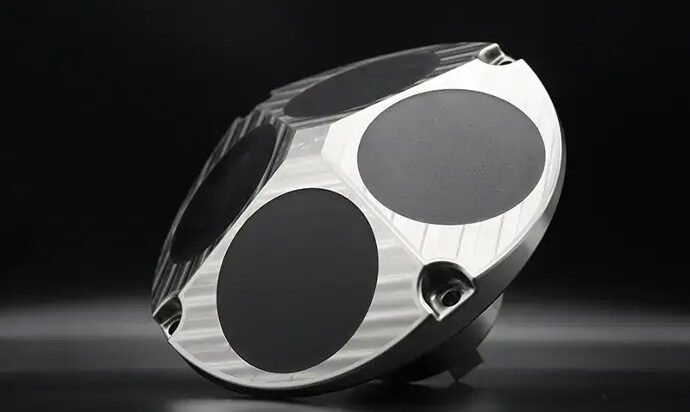
When your measurement target is 400 meters below the surface — a deep-water pipeline route, a floating wind turbine mooring line, an oceanographic mooring on the continental slope — range is non-negotiable. The Oceantek ADCP-75-DR-PA4 and ADCP-75-SC-PA4 deploy phased-array beamforming technology at 75 kHz to achieve 550 m (broadband) to 650 m (narrowband) profiling range — reaching depths that a 300 kHz instrument simply cannot touch.
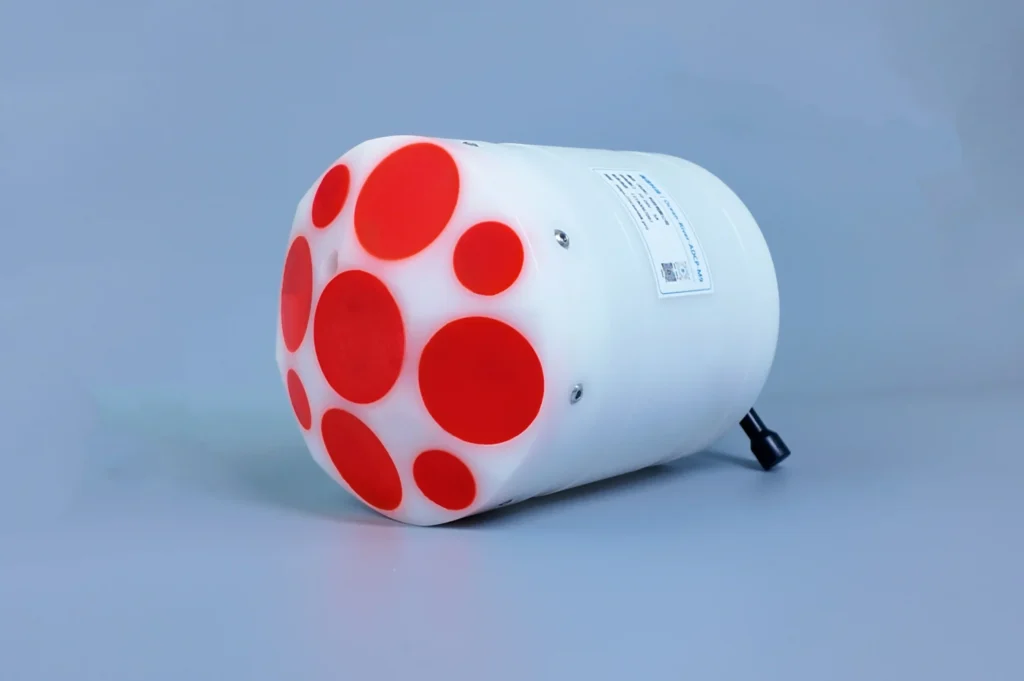
Why phased array? At 75 kHz, a conventional piston-transducer ADCP would be physically large and heavy. Phased-array technology uses electronic beamforming — multiple small transducer elements whose signals are phase-shifted to create a steerable acoustic beam — to achieve the same beam geometry as a much larger piston array in a significantly smaller and lighter transducer head. This is the same approach used by Teledyne RDI’s Ocean Surveyor and Long Ranger series, and it is the enabling technology for deploying a 75 kHz ADCP from anything smaller than a full-size research vessel.
Best for: Deep-water floating wind metocean campaigns, deep-water pipeline and cable route surveys, continental slope oceanographic moorings, basin-scale current monitoring, oil & gas platform site assessment in water depths exceeding 200 m.
Three Technical Differentiators That Make the Oceantek Portfolio Coherent
Having three frequencies is table stakes — Teledyne RDI, Nortek, SonTek, and others all offer multi-frequency product lines. What makes Oceantek’s portfolio coherent rather than just comprehensive comes down to three engineering decisions that carry across the entire range.
1. Titanium Alloy as the Platform Standard
Every Oceantek ADCP — from the shallow-water ADCP-600 to the deep-water ADCP-75 — ships with a titanium alloy housing as standard equipment. This is not the industry norm. Most manufacturers default to aluminum-bronze, hard-anodized aluminum, or engineered plastics, with titanium offered as a cost-added upgrade. The practical implications:
- Galvanic immunity: Titanium does not require sacrificial anodes in seawater — eliminating the most common corrosion-related failure mode in long-duration deployments.
- Biofouling resistance: Titanium surfaces accumulate marine growth more slowly than aluminum-bronze, reducing the frequency of transducer cleaning — a meaningful operational consideration for multi-month mooring deployments.
- Cross-platform consistency: A survey company that owns both an ADCP-600 for shallow-water work and an ADCP-75 for deep-water campaigns has identical housing material, identical maintenance procedures, and identical corrosion behavior across both instruments. No need to track which instrument has which housing option.
2. Protocol Compatibility Across the Full Frequency Range
Switching ADCP vendors typically means switching software — or at least investing significant time in data format conversion. Oceantek engineered communication protocol compatibility into every instrument in the portfolio, meaning that an ADCP-300-DR-FA4 can be integrated into a data acquisition pipeline originally built for a Teledyne RDI Workhorse, and an ADCP-75-SC-PA4 can be configured using command syntax familiar to operators of phased-array instruments from other manufacturers. This is not full plug-and-play — you should verify compatibility with your specific acquisition software (QPS Qinsy, Hypack, WinRiver II) before procurement — but it dramatically reduces the integration overhead of adding an Oceantek instrument to a mixed-vendor fleet.
3. Direct-Reading and Self-Contained Variants at Every Frequency
Oceantek offers both direct-reading (DR) and self-contained (SC) configurations at every frequency — 75 kHz, 300 kHz, and 600 kHz. This is more unusual than it sounds. Many manufacturers offer self-contained variants only at mid-range frequencies (300 kHz, 600 kHz) and restrict deep-water frequencies (75 kHz and below) to vessel-mounted or cabled observatory configurations. Having an SC variant at 75 kHz means you can deploy a battery-powered, internally logging ADCP on a deep-water mooring at 1,500 m depth for 180+ days without a surface cable — a capability that matters for long-duration oceanographic monitoring programs and deep-water metocean campaigns where a surface buoy presents a navigation hazard or a vandalism target.
How to Choose: A Frequency-by-Application Decision Framework
Use this framework to map your project requirements to the right Oceantek ADCP configuration. The decision tree has three branches: water depth determines the frequency; operational mode determines DR vs. SC; deployment environment determines the depth rating.
| Project Type | Typical Water Depth | Recommended Oceantek Model | Why |
|---|---|---|---|
| Harbor / estuary current survey | 3 – 30 m | ADCP-600-DR-FA4 | Highest resolution, smallest blind zone, real-time transect data |
| Tidal channel / inlet study | 5 – 40 m | ADCP-600-SC-FA4 | High resolution + autonomous logging for full spring-neap cycle |
| Cable landing site investigation | 5 – 30 m | ADCP-600-DR-FA4 | Vessel-mounted transects along cable corridor, real-time QC |
| Offshore wind farm (fixed-bottom) | 15 – 60 m | ADCP-300-DR-FA4 or SC | Full water-column coverage, industry-standard frequency for metocean |
| Submarine cable route survey | 10 – 150 m | ADCP-300-DR-FA4 | Continental shelf depth range, continuous vessel-mounted transects |
| Port expansion / dredging support | 10 – 40 m | ADCP-600-DR-FA4 or ADCP-300-DR-FA4 | 600 kHz for <30 m (resolution), 300 kHz for deeper approach channels |
| Deep-water pipeline route survey | 100 – 500 m | ADCP-75-DR-PA4 | Only 75 kHz reaches >300 m; phased array for manageable transducer size |
| Floating wind metocean campaign | 60 – 1,000+ m | ADCP-75-SC-PA4 | 650 m profiling from seabed frame, autonomous 180-day deployment |
| Deep-water oceanographic mooring | 500 – 1,500 m | ADCP-75-SC-PA4 | 1,500 m depth-rated, self-contained for long-duration deployment |
| Multi-instrument fleet for survey company | All depths | 600-DR + 300-DR + 75-DR | One platform family, one maintenance workflow, one software protocol |
Table 2: Application-to-instrument mapping for Oceantek’s ADCP portfolio. All models available in 1,000 m, 3,000 m, or 6,000 m depth ratings (except 75 kHz models at 1,500 m).
Competitive Context: Where Oceantek Fits in the Global ADCP Market
The multi-frequency ADCP space is dominated by Teledyne RDI (Workhorse, Ocean Surveyor, Long Ranger) and Nortek (Signature, AWAC), with SonTek, Rowe Technologies, and a growing cohort of Chinese manufacturers — CHCNAV, South Survey, Hi-Target (中海达), CSSC 715 Institute — competing in specific segments. Oceantek’s positioning within this landscape is defined by three deliberate choices:
- Platform-level differentiation through materials: While competitors compete on signal processing algorithms (Nortek’s broadband-narrowband hybrid, CHCNAV’s intelligent pulse adaptation) or beam count (Hi-Target’s 9-beam iFlow RP9), Oceantek competes on hardware platform quality — specifically, titanium alloy as the standard housing across every instrument in the portfolio. This is a fundamentally different value proposition: it says the instrument will physically survive whatever deployment you subject it to.
- Protocol compatibility as a switching-cost reduction strategy: Oceantek explicitly engineers for drop-in compatibility with established ADCP communication protocols. This is a pragmatic recognition that the biggest barrier to adopting a new ADCP brand is not the instrument price — it is the software integration cost. By reducing that cost, Oceantek lowers the evaluation barrier for survey contractors who already own Teledyne RDI or Nortek instruments.
- 60–90 day lead times vs. 90–180 day industry norms: For project-driven survey companies, instrument delivery time directly impacts revenue. Oceantek’s 60–90 day lead time — roughly half the industry average for premium manufacturers — is a non-trivial competitive factor when a survey campaign has a fixed mobilization window.
It is also worth noting that Oceantek, as a company founded in 2023, does not yet have the multi-decade deployment track record of Teledyne RDI (whose Workhorse series dates to the 1990s) or Nortek (founded 1996). This is the single most significant headwind the company faces, and it is one that only time and accumulated field data can address. The 12-month warranty and 180-day continuous operation rating are credible starting points, but the long-term reliability data that survey companies and research institutions require to commit to a fleet purchase will take years to accumulate.
Beyond ADCPs: Oceantek’s Complementary Marine Instrument Portfolio
Oceantek’s product line extends beyond ADCPs into several categories that complement current profiling in a comprehensive oceanographic survey. If you are building out a survey instrument package, these products share the same titanium-alloy design philosophy and protocol compatibility approach:
- Doppler Velocity Logs (DVLs) — 300 kHz and 600 kHz: Compact dual-mode instruments for AUV, ROV, and USV navigation. Provide simultaneous bottom-track velocity (for dead-reckoning navigation) and water-column current profiles. Titanium housing, compatible with established DVL communication protocols.
- OCEAN-SPCM Single-Point Current Meter: Cost-effective Eulerian current measurement at a single depth (up to 20 m), with velocity accuracy of ±0.15 cm/s. Ideal for environmental monitoring, aquaculture site assessment, and supplemental data collection alongside ADCP moorings.
- Self-Contained Hydrophone: Titanium-alloy pressure housing, sensitivity better than -166 dB, frequency response 10 Hz – 20 kHz. For passive acoustic monitoring, ambient noise surveys, and marine mammal detection.
- Beidou Beacon: Satellite positioning and communication for surface buoy integration.
Visit the Oceantek product center for complete specifications, datasheets, and procurement information across the full product portfolio.
Frequently Asked Questions
Why can’t a single ADCP frequency cover both shallow and deep water?
This is a physics constraint, not a design limitation. Higher frequencies (600 kHz) provide fine vertical resolution but are rapidly absorbed by seawater, limiting range to ~55–70 m. Lower frequencies (75 kHz) penetrate much farther (550–650 m) but have coarser resolution and higher velocity noise. The absorption rate scales approximately with the square of the frequency, so a 600 kHz signal is attenuated roughly 64 times faster than a 75 kHz signal. No signal processing can overcome this fundamental acoustic property — the only solution is to use the right frequency for the target depth.
What is the shallowest water an Oceantek ADCP can operate in?
The ADCP-600 can return valid velocity profiles in water as shallow as 3–5 meters, depending on cell size configuration and transducer mounting depth. The instrument’s compact transducer head design minimizes the near-field blanking distance. Configure with minimum cell size (1 m or less) for maximum vertical resolution in ultra-shallow water.
What is the maximum profiling depth of Oceantek’s deepest ADCP?
The ADCP-75 (75 kHz phased-array) profiles to 550 m in broadband mode and 650 m in narrowband mode, with a depth rating of 1,500 m (i.e., the instrument can be deployed at depths up to 1,500 m and profile 550–650 m upward through the water column).
How does Oceantek’s 300 kHz ADCP compare to the Teledyne RDI Workhorse 300 kHz?
Both instruments share the same core specifications: 300 kHz frequency, 4-beam Janus configuration, ±0.5% ±5 mm/s velocity accuracy, and comparable profiling ranges (120–160 m for Oceantek, 110–165 m for Workhorse). Key differences: Oceantek ships with titanium alloy housing as standard (an optional upgrade on Workhorse), offers ±85° attitude sensor range (vs. ±15° on older Workhorse models — significant for vessel-mounted deployments in rough seas), and provides 255 configurable depth cells (vs. 128 on entry-level Workhorse variants).
What is the difference between phased-array and convex (piston) beam configurations?
A convex (piston) transducer uses four individual ceramic transducer elements, each producing a separate acoustic beam at a fixed angle (typically 20°). This is the configuration used in Oceantek’s ADCP-300 and ADCP-600 series. A phased-array transducer uses a flat array of many small elements whose signals are electronically phase-shifted to steer the acoustic beam without moving parts. Phased arrays achieve the same beam geometry as piston arrays in a smaller, lighter transducer head — critical for low-frequency (75 kHz) instruments where a piston array would be impractically large. This is the technology used in Oceantek’s ADCP-75 series and in Teledyne RDI’s Ocean Surveyor.
Can I use the same topside software with different Oceantek ADCP frequencies?
Yes. Because Oceantek maintains consistent communication protocol compatibility across all frequencies and both deployment modes (DR and SC), the same data acquisition software can interface with an ADCP-600-DR-FA4, ADCP-300-DR-FA4, and ADCP-75-DR-PA4. This simplifies survey logistics when a project requires multiple instruments at different frequencies. However, you should verify compatibility with your specific acquisition software (e.g., QPS Qinsy, Hypack, WinRiver II) before procurement.
Does Oceantek offer dual-frequency or tri-frequency ADCPs?
Currently, Oceantek’s approach is to offer optimized single-frequency instruments at each frequency band rather than combining multiple frequencies into one transducer head. This design philosophy prioritizes acoustic performance and physical robustness over the convenience of a single multi-frequency unit. For projects requiring both shallow-water resolution and deep-water range, the recommended approach is to deploy an ADCP-600 (DR or SC) for the near-surface layer and an ADCP-75 (DR or SC) for full water-column coverage — an approach that yields better data quality than a compromise dual-frequency unit in many deployment scenarios.
Conclusion: The Right Tool for Every Depth
The ADCP market has long been structured around the assumption that surveyors and researchers will commit to one manufacturer and live with the trade-offs that manufacturer’s frequency lineup imposes. Oceantek’s approach is different: build the right instrument for each depth regime, standardize on a premium materials platform (titanium), ensure protocol compatibility across the portfolio, and make the economics work for multi-instrument fleets.
For the survey engineer specifying a cable route investigation in 30 meters of water, the ADCP-600-DR-FA4 provides the resolution and small blind zone that a 300 kHz instrument cannot match. For the metocean specialist planning a floating wind campaign in 400 meters, the ADCP-75-SC-PA4 delivers the range that a 300 kHz instrument cannot reach. And for the survey company building a mixed fleet, the common titanium platform, shared protocol layer, and modular depth-rating architecture mean that adding an Oceantek instrument to an existing workflow is a practical decision rather than a rip-and-replace exercise.
Oceantek is a young company operating in a market where track record matters. The instruments’ specifications are competitive, the materials choices are premium, and the design philosophy is coherent. What remains to be written — by accumulated field data, by third-party validation, by the experience of surveyors who deploy these instruments in anger — is the long-term reliability story. For organizations willing to evaluate a new entrant on its engineering merits, the portfolio deserves a close look.
Disclaimer: This article is written for informational and educational purposes. Specifications are drawn from publicly available manufacturer documentation and should be verified with Oceantek for project-specific requirements. The author has no commercial relationship with Oceantek, Teledyne RDI, Nortek, or any other manufacturer mentioned. All product names and trademarks belong to their respective owners.
Published: June 8, 2026. For the latest product specifications, pricing, and availability across the full ADCP portfolio, visit the Oceantek product center or contact the Oceantek sales team for a project-specific consultation and instrument demonstration.