
DVL — Doppler Velocity Logs for Subsea Vehicle Navigation
Precision bottom-tracking and water-velocity navigation for AUVs, ROVs, and manned submersibles. Three models from 600kHz to 300kHz — piston and phased-array transducer options — delivering navigation-grade velocity accuracy, altitude measurement, and current profiling in a single instrument.
Technology
What Is a Doppler Velocity Log?
A DVL is a navigation sonar — it tells an underwater vehicle exactly how fast it’s moving
and how high it is above the seabed.
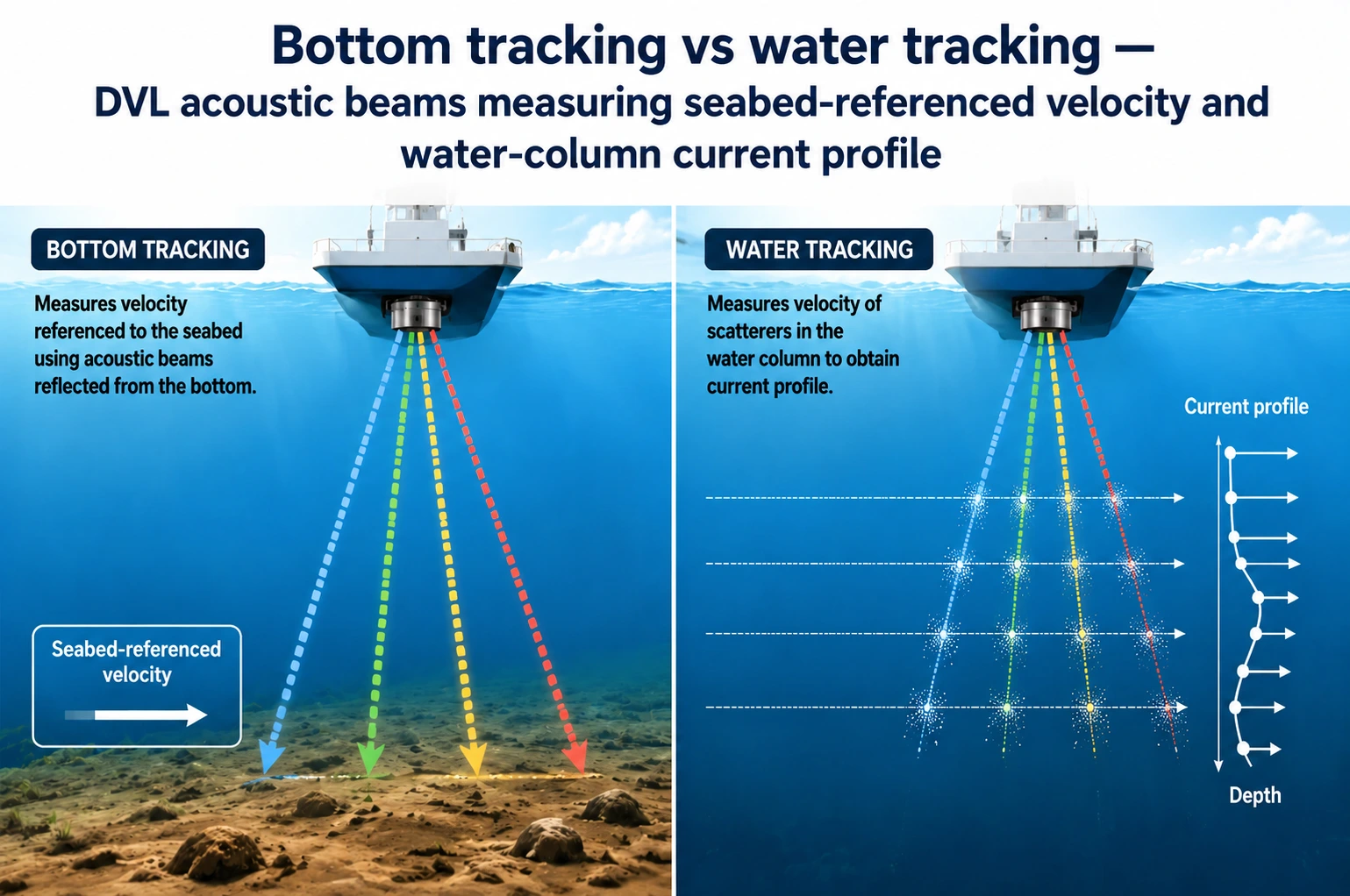
Four Beams. Two Measurements. One Instrument.
A DVL transmits four acoustic beams at a known angle toward the seabed. By measuring the Doppler shift of the returning echoes, it calculates the vehicle’s 3D velocity relative to the bottom — bottom-tracking. When bottom-lock is lost in deep water, it automatically switches to water-tracking, measuring velocity relative to the water column.
Simultaneously, the DVL provides altitude (height above seabed) from the acoustic travel time — critical for terrain-following and obstacle avoidance. All of this fused into a single compact transducer head.
Bottom-Track Velocity
3-axis velocity relative to seabed. The primary input to an AUV/ROV’s INS (Inertial Navigation System).
Water-Track Velocity
Fallback mode when operating beyond bottom-lock range. Also provides current profile data as a secondary output.
Altitude Measurement
Real-time height-above-seabed for terrain following, auto-altitude hold, and landing operations
INS Integration
Standard serial output (PD0 / PD6) compatible with all major inertial navigation systems and vehicle autopilots.
Product Lineup
Three DVL Models. Two Transducer Types.
Choose by operating depth and bottom-lock altitude. Click through for full navigation-grade specifications.
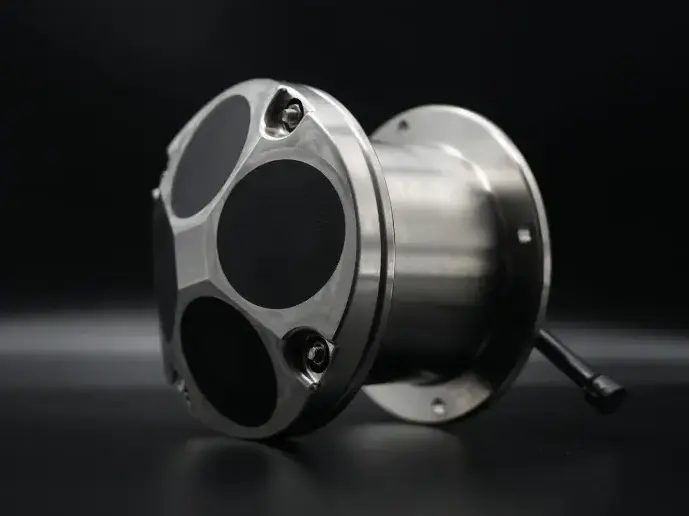
DVL-600-FA4
600kHz0.3%±3mm/s110m Bottom-Lock
4 Beams
Mid-range DVL with piston transducer for AUVs and work-class ROVs operating on the continental shelf. Reliable bottom-lock to 110m altitude with navigation-grade velocity accuracy.
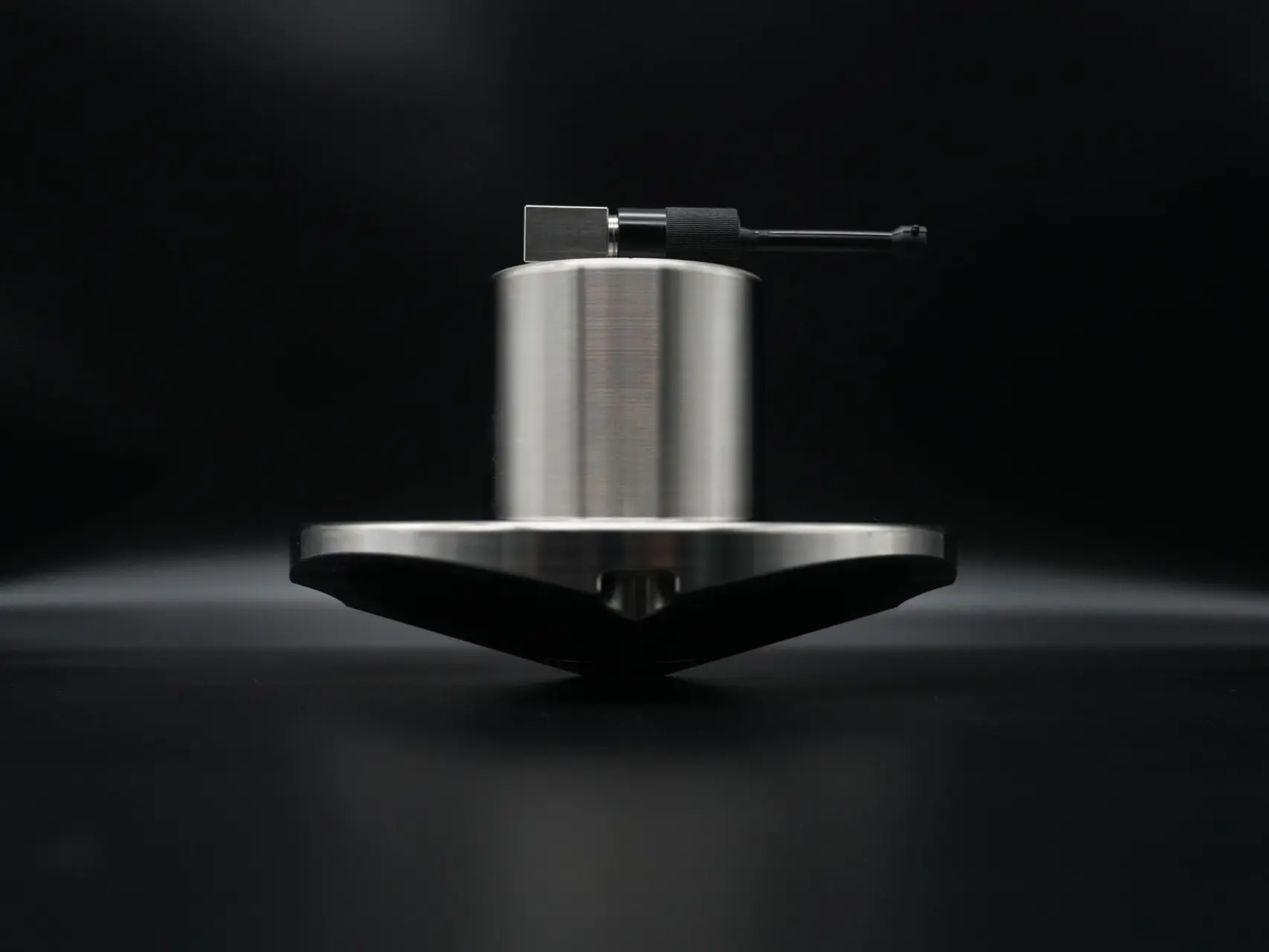
DVL-300-FA4
300kHz0.5%±5mm/s220m Bottom-Lock
4 Beams
Deep-water DVL for large AUVs and work-class ROVs operating beyond the shelf break. 220m bottom-lock range keeps your vehicle navigating accurately in deeper water, with water-track fallback beyond that.
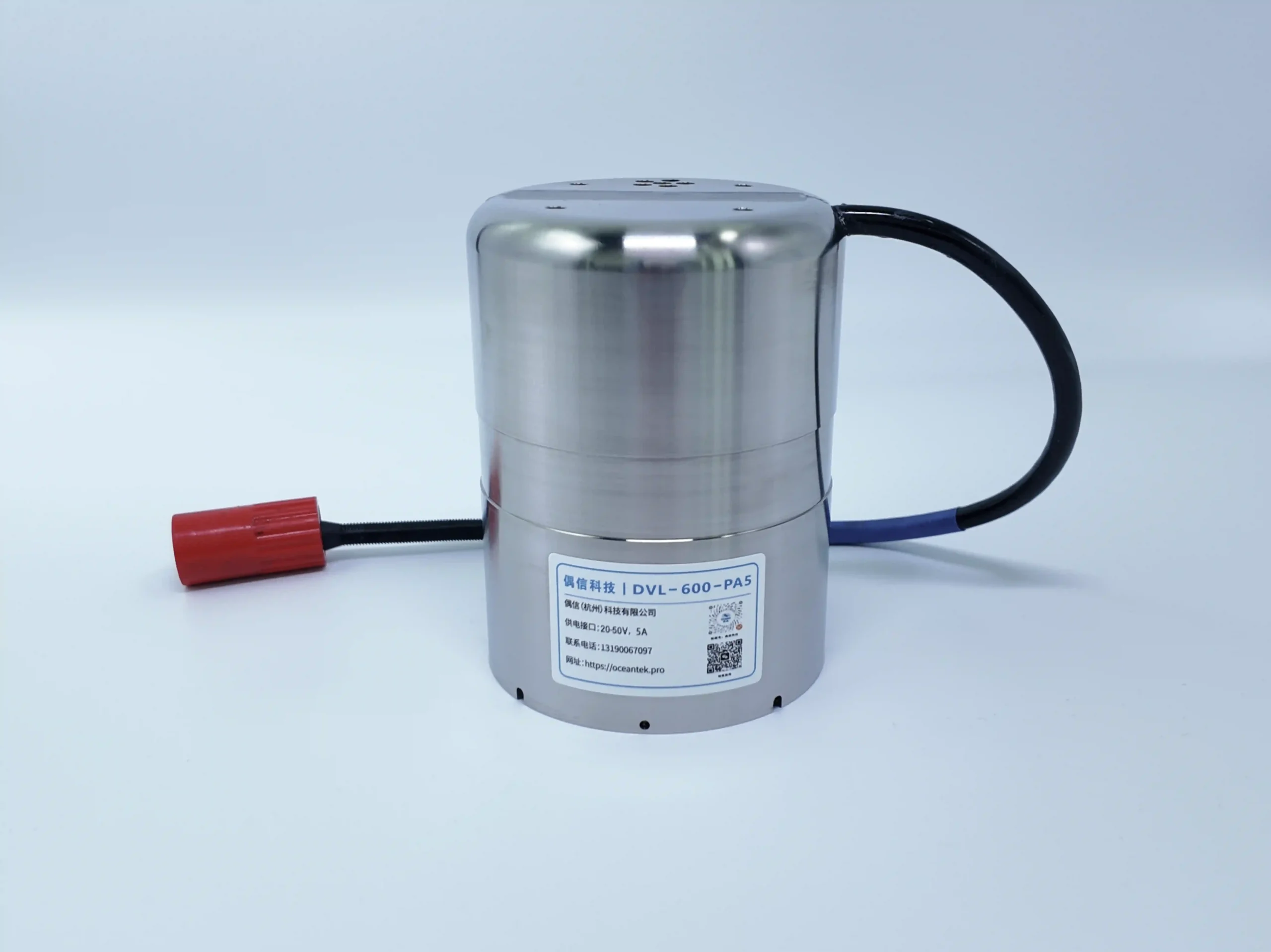
DVL-600-PA5
600kHz0.3%±3mm/s110m Bottom-Lock
5 Beams
Same 600kHz frequency in a phased-array form factor — more compact, lighter, and with a wider beam aperture. Ideal for medium-sized AUVs where volume and weight are constrained.
Comparison
How a DVL Differs from an ADCP
They share acoustic technology — but their missions are completely different.
| DVL | Ocean ADCP | |
|---|---|---|
| Primary Function | Vehicle navigation velocity | Water-column current profiling |
| Primary User | AUV/ROV navigation engineer | Oceanographer / hydrographer |
| Key Output | Bottom-track velocity (u,v,w) + altitude | Current speed/direction vs. depth |
| Mounting | Fixed in vehicle hull, typically flush | Over-side, mooring, or platform |
| Data Integration | INS / DVL-aided navigation filter | Survey software / data logger |
| Beam Angle | 20°–30° from vertical | 20°–30° from vertical |
| Bottom-Lock Range | Critical spec; varies by model | Secondary — used for moving-boat discharge |
| Accuracy Demand | Navigation-grade (±0.2–0.5%) | Survey-grade (±0.25–1% typical) |
| DR / SC | Direct-Reading only | Both available on all models |
| View DVL Products → | Explore Ocean ADCP → |
Side-by-Side DVL Comparison
Key navigation specs across the three models. Bottom-lock range and transducer type
are the deciding factors.
| DVL-600-FA4 | DVL-600-PA5 | DVL-300-FA4 | |
|---|---|---|---|
| Frequency | 600kHz | 600kHz | 300kHz |
| Transducer | FA4 Piston · Janus | PA5 Phased-Array | FA4 Piston · Janus |
| Bottom-Track Range | 110m | 110m | 220m |
| Velocity Accuracy | ±0.3% ± 3mm/s | ±0.3% ± 3mm/s | ±0.5% ± 5mm/s |
| Beam Angle | 20° | 30° | 20° |
| Dimensions | Φ148 × 150–167mm | Φ92 × 112mm | Φ224–230 × 158–161mm |
| Weight (in air) | 3.5 – 5.7 kg | ≤ 1.8 kg | 5.3 – 7.7 kg |
| Power Consumption | ≤ 10W | ≤ 5W | ≤ 10W |
| Max Depth Rating | 1,000 / 3,000 / 6,000m | 1,000 / 3,000 / 6,000m | 1,000 / 3,000 / 6,000m |
| Altitude Output | ✓ | ✓ | ✓ |
| Water-Track Fallback | ✓ | ✓ | ✓ |
| Best For | Work-class ROV, large AUV, soft seabed | Small AUV, glider, inspection ROV | Deep-water AUV/ROV beyond shelf break |
| Details → | Details → | Details → |
Where DVLs Are Deployed
DVLs are the navigation backbone for these underwater vehicle operations.
AUV Seabed Survey
Pipeline inspection, bathymetric mapping, and geophysical survey AUVs rely on DVL-aided INS for precise track-keeping over hundreds of kilometers.
Work-Class ROV Operations
Subsea construction, IRM (inspection, repair, maintenance), and intervention ROVs use DVL for station-keeping and auto-position hold in currents.
Manned Submersibles
Research and tourism submersibles use DVL for navigation, speed-over-ground display, and terrain-relative positioning in low-visibility conditions.
What Matters in a DVL
When evaluating DVLs for your vehicle platform, these are the specs that determine
navigation performance.
±0.2%
Bottom-Track
Velocity Accuracy
4 / 5 Beams
Redundant 3D Velocity
120–220m
Bottom-Lock
Altitude Range
1,000–6,000m
Maximum Operating
Depth Rating
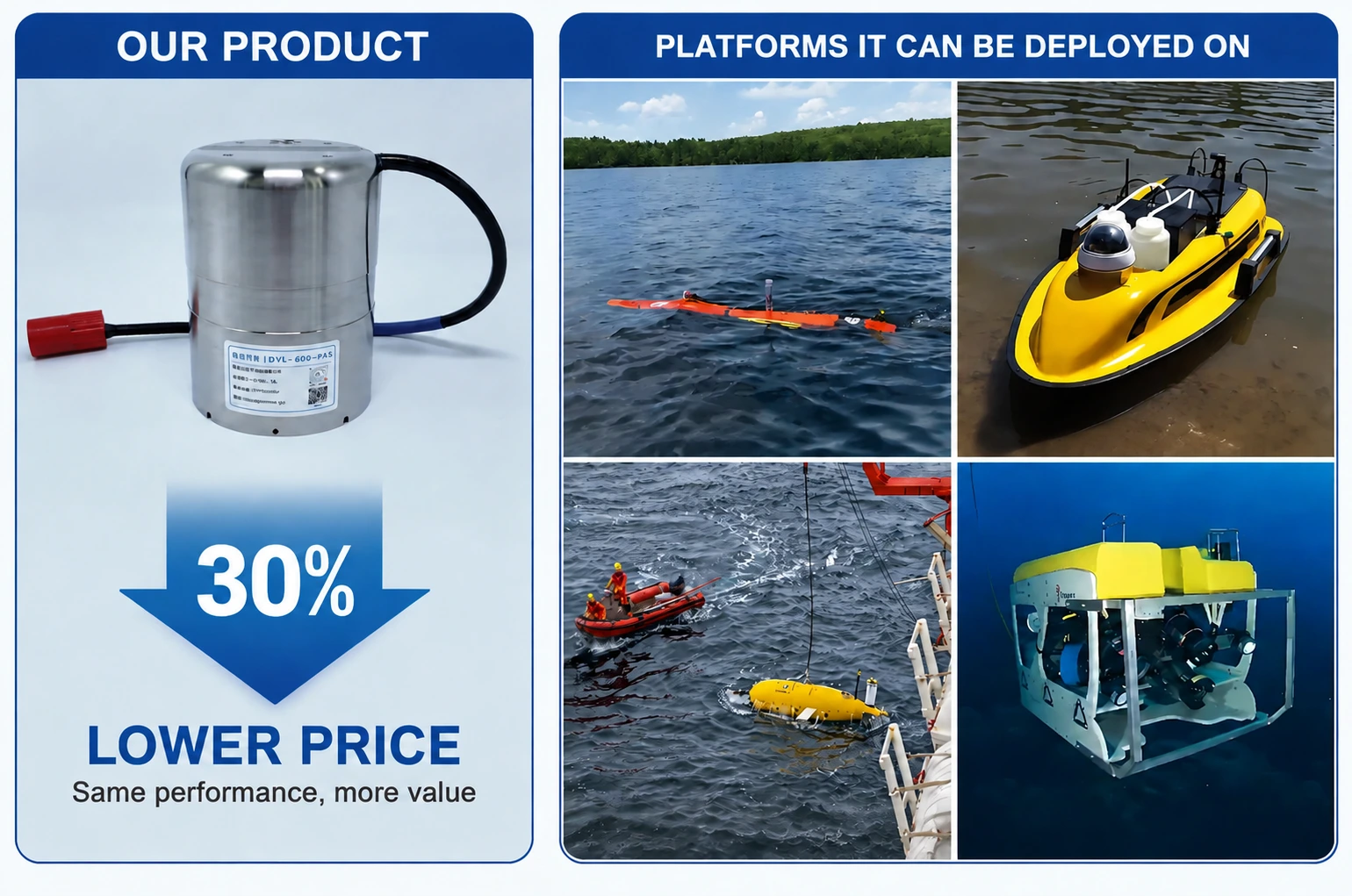
Cost-Effective Pricing For Your Projects
The DVL we produce meets the same performance as international brands, while offering you a more affordable price.
Frequently Asked Questions
How does a DVL work?
A DVL transmits acoustic beams (typically 4 beams in a Janus configuration) toward the seabed. By measuring the Doppler frequency shift in each reflected beam, it calculates the vehicle’s 3D velocity — forward/back, lateral, and vertical. When the seabed is within range,it uses bottom tracking for absolute velocity; in deeper water beyond bottom lock, it switches to water tracking and measures velocity relative to a water
layer at a fixed distance. Learn more:Bottom Tracking vs Water Tracking in DVL →
What is the smallest DVL available from Oceantek?
TheDVL-600-PA5 is our most compact Doppler Velocity Log, designed specifically for small-diameter AUVs and portable ROVs where space and weight are at a premium. For applications requiring an even smaller form factor — such as micro-AUVs or diver-held navigation systems — contact our engineering team to discuss custom miniaturization options.
How does an Oceantek DVL compare to Nortek or Waterlinked DVLs?
Oceantek DVLs compete directly with Nortek and Waterlinked on performance while offering several practical advantages:
- Titanium alloy housing as standard (not an upsell) — corrosion-free without sacrificial anodes
- Direct-manufacturer pricing — typically 20–40% below established brands for equivalent specifications
- OEM/ODM flexibility — custom beam configurations, depth ratings, and interface protocols available
How do I choose between DVL-600-FA4 and DVL-600-PA5?
What happens when the DVL loses bottom-lock in deep water?
Integrating a DVL Into Your Vehicle Platform?
Tell us about your AUV or ROV — we’ll recommend the right DVL and support your integration from CAD to sea trial.
Also explore our other product lines: