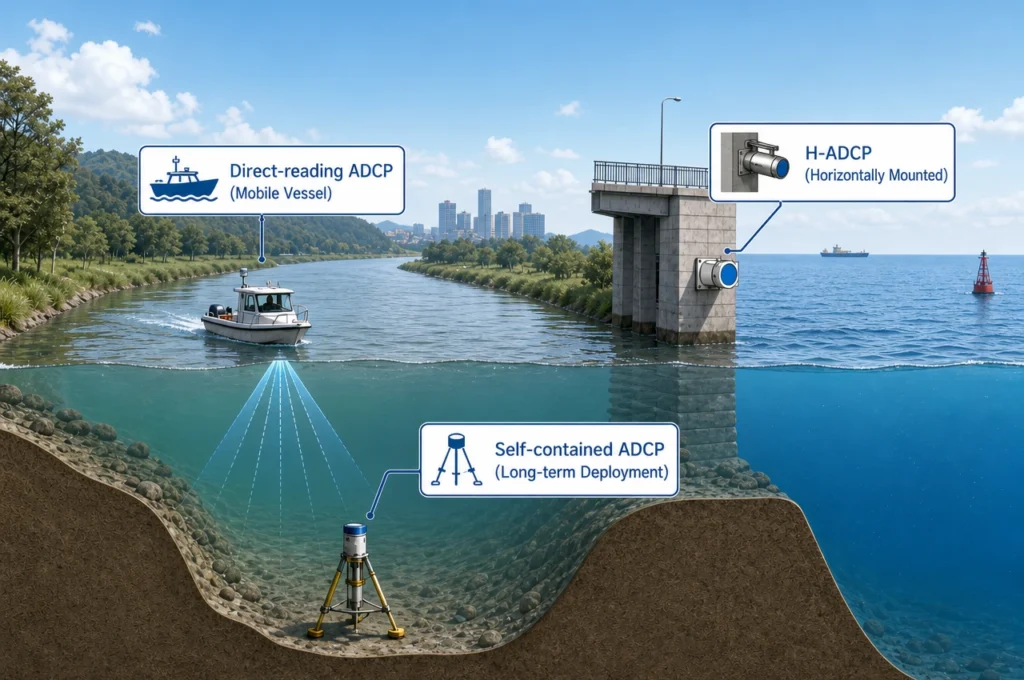
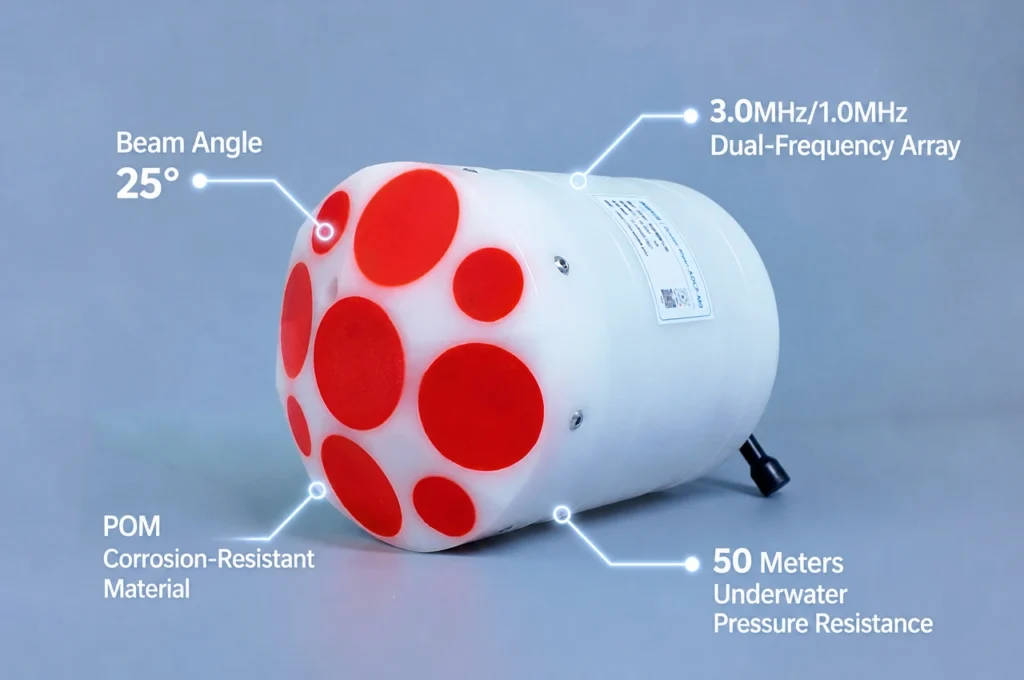
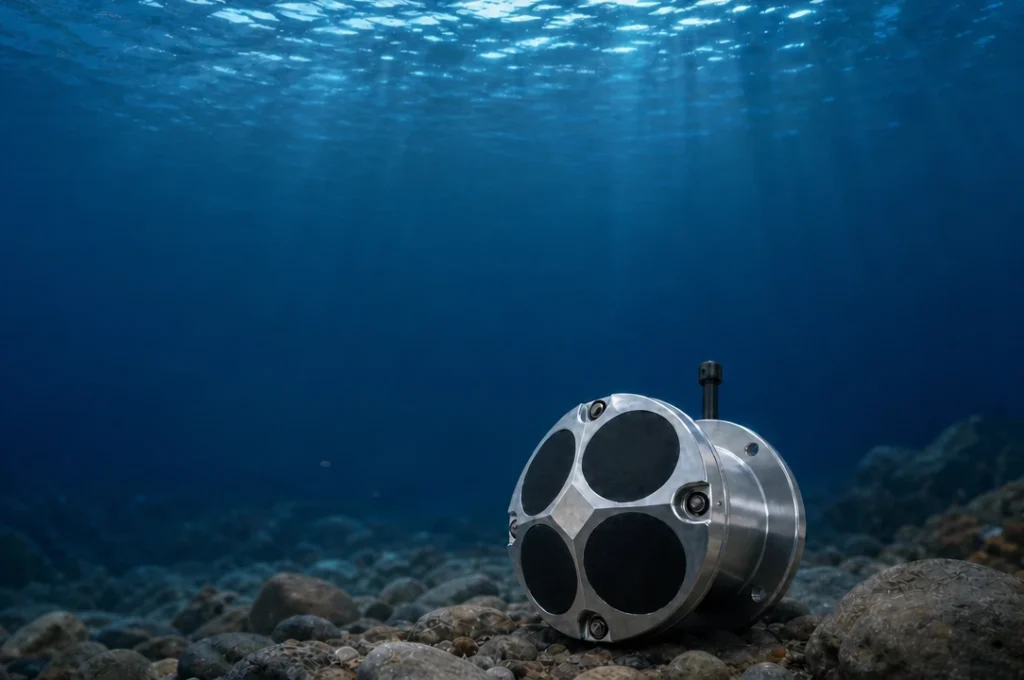
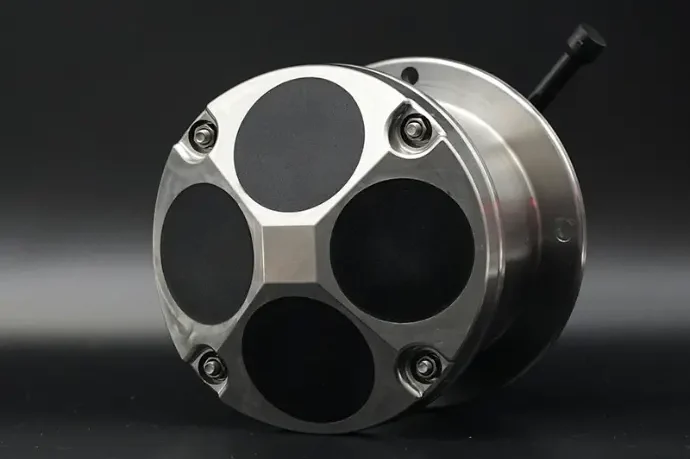
The platform you mount your ADCP on determines everything about your data quality that the instrument itself cannot control. Motion, orientation stability, flow disturbance, and accessibility for maintenance all derive from the mounting platform, not the transducer. An ADCP that performs flawlessly in a test tank can produce unusable data when mounted on a buoy that pendulums in a seaway or a pier bracket that places the transducer in the eddy shadow of a piling. Here is how to design mounts for the three most common fixed platforms.
Surface Buoys: The Motion Problem
A surface buoy is the most challenging ADCP platform from a motion perspective. The buoy heaves, pitches, rolls, and — if it is on a slack mooring in a current — executes a figure-eight watch-circle motion as vortex shedding alternates from side to side. All of this motion contaminates the velocity measurement if it is not properly measured and subtracted.
Modern ADCPs correct for platform motion using internal tilt sensors and compass, but these corrections have limits. The tilt correction assumes the instrument is tilted but stationary — it corrects for the geometric effect of beam angle on a tilted transducer. It does not correct for the velocity of the transducer as it moves through the water. For that, you need a separate motion reference unit — an inertial measurement unit or a Doppler velocity log — to measure the buoy’s velocity and subtract it from the water velocity measurement. Without a motion reference, a buoy-mounted ADCP in anything above a light chop is measuring buoy motion as much as water motion.
The mounting location on the buoy matters enormously. The ideal position is in a central moon pool or well — a vertical shaft through the buoy — that places the transducer at least 1.5 meters below the waterline, below the zone of wave-orbital velocity contamination, and protected from direct wave impact. The transducer should be rigidly fixed to the buoy structure, not suspended on a pendant line that allows independent swinging. If a moon pool is not available, a rigid deployment tube extending downward from the buoy hull is the next best option.
For Oceantek ADCP-600-DR-FA4 installations on data buoys, the instrument’s direct-reading capability allows power and data to be supplied through the buoy’s existing cable harness, eliminating the need for internal batteries.
Seabed Tripods: Stability Is Everything
A seabed tripod or quadpod provides the most stable ADCP platform available short of a concrete pier. The instrument sits on a rigid metal frame planted on the seafloor, with no surface expression and minimal motion. If the frame is properly designed, total tilt over a 12-month deployment should be less than 2° — within the correction range of the internal tilt sensor and negligible for most applications.
Key design parameters for tripod-mounted ADCPs:
Instrument height above the seabed: The ADCP should be high enough to see above the benthic boundary layer — the zone of reduced velocity and high suspended-sediment concentration within 1–2 meters of the bed. For most coastal deployments, a transducer height of 1.5–2.5 meters above the seabed is adequate. For deep-water deployments with weaker benthic currents, 1.0–1.5 meters may suffice. The trade-off is that a taller tripod is heavier, harder to deploy, and more vulnerable to toppling in strong currents.
Leg spread and stability: The tripod legs should spread at 30–40° from vertical. A wider spread angle provides more stability against toppling but increases the frame footprint, weight, and the risk of one leg settling into a sediment depression. For sand seabeds, a broader spread (35–40°) compensates for the possibility of scour around one leg. For hard rock seabeds, a narrower spread (25–30°) is sufficient because the legs cannot settle.
Anti-scour measures: In sandy environments with currents above 0.5 m/s, the tripod legs will scour — sediment erodes around each leg, creating depressions that can tilt the frame. Scour can be reduced by attaching circular base plates (mud mats) to each leg to distribute the weight, or by burying a ballast plate below the sediment surface that the legs bolt to.
Fixed Piers and Platforms: The Easy Option with Hidden Caveats
A pier-mounted ADCP is the simplest installation and the easiest to maintain. A rigid bracket bolts to a pier pile or dock structure, and the ADCP is lowered into the water on a deployment pole. AC power is available at the pier, data can be cabled directly to a shore station, and the instrument can be raised for cleaning and inspection without a vessel. For long-term monitoring stations with accessible infrastructure, pier mounting is the obvious choice.
But piers are built in specific locations for specific reasons — sheltered harbors, estuaries, navigation channels — and the flow at the pier may not be representative of the coastal waters you intend to monitor. Pier pilings generate eddy streets that can contaminate velocity measurements tens of meters downstream. The ADCP should be mounted at least 2 meters horizontally from any piling in the upstream direction and at least 1 meter from the nearest piling laterally. If the predominant current direction reverses with the tide, both directions are upstream at different times, and the instrument should be positioned to maintain clearance in both directions.
The pier structure itself can create bubble clouds — waves breaking against pilings entrain air that is carried past the transducer — and floating debris accumulates around pier structures, posing a collision risk. A protective cage or guard around the transducer is recommended, but it must be designed so the guard bars do not intersect any acoustic beam path. A bar crossing a beam at close range produces a persistent, range-gated echo that contaminates the affected depth cell in every ensemble.
Mounting Hardware: What Works and What Corrodes
All mounting hardware — brackets, clamps, bolts — in contact with seawater should be 316L stainless steel or better. Avoid mixing metals: a stainless bracket bolted to an aluminum pier ladder with a steel bolt creates a galvanic cell that corrodes the aluminum rapidly. Use nylon or Delrin insulating washers if dissimilar metals cannot be avoided.
For deployments longer than six months, all fasteners should be secured with thread-locking compound (Loctite 243 or equivalent for marine use) and backed up with mechanical locking — split washers, castle nuts with cotter pins, or lock wire. Vibration from waves and currents loosens fasteners over months, and a single loosened bolt can allow the bracket to rotate, misaligning the ADCP and corrupting the velocity data.
For specific mounting guidance for your platform, contact Oceantek with your platform details, deployment depth, and expected current regime.