Quick answer
There are three ways to replace a SonTek RiverSurveyor M9, and they are not interchangeable. The first is another 9-transducer M9-class instrument: dual 4-beam 3.0/1.0 MHz Janus arrays plus a 0.5 MHz vertical beam, a 0.06–40 m profiling range and 0.02–4 m cells. The second is a five-beam shallow-water instrument for sites around 6 m and shallower. The third is a 4-beam river ADCP for sections where the second frequency and the vertical beam are not earning their cost.
On published specifications, the M9-class instruments have converged. The SonTek M9 and the Oceantek River-ADCP-M9 both list nine transducers, the same 25° Janus geometry, the same profiling range and the same cell-size envelope. The purchase decision therefore turns on what a datasheet comparison does not settle: weight and platform fit, cells and storage, the software and data path your agency actually uses, GNSS and RTK options, calibration documentation, spares and turnaround, and what each quote includes.
This page puts the two datasheets side by side, separates the differences that change field outcomes from the ones that do not, and gives five tests to run on your own section before you sign.
Key takeaways
- Do not buy on the transducer count. Nine transducers is now a class specification, not a differentiator. The two M9-class instruments list the same nine-transducer layout, the same 0.06–40 m range and the same 0.02–4 m cells.
- The data path decides whether the instrument is usable. If you cannot get raw data into the processing chain your reviewers expect, the specification is irrelevant. Ask for a tested export, not a file extension.
- Weight changes coverage. 2.3 kg against 1.5 kg is the difference between a two-person launch and one technician carrying the kit to a bank site.
- “Price on application” means the comparison is only valid at equal scope. Build the quote as line items before you compare totals, or you are comparing two different systems.
- A demo on someone else’s site proves nothing. Five checks on your own section, including the shallowest one, are what de-risk the purchase.
Contents
- What “M9-class” means, in four hardware facts
- The published specification comparison
- Which differences change field outcomes
- Software and data path: the question that decides it
- GNSS, RTK and the boat mount
- Five tests to run before you sign
- What “delivered price” should include
- Delivery, documentation and acceptance on arrival
- If you do not need M9-class
- Which route suits which buyer
- Frequently asked questions
1. What “M9-class” means, in four hardware facts
The name matters less than the configuration behind it. An M9-class river ADCP is defined by four things, and an instrument that lacks any one of them is a different tool rather than a cheaper equivalent.
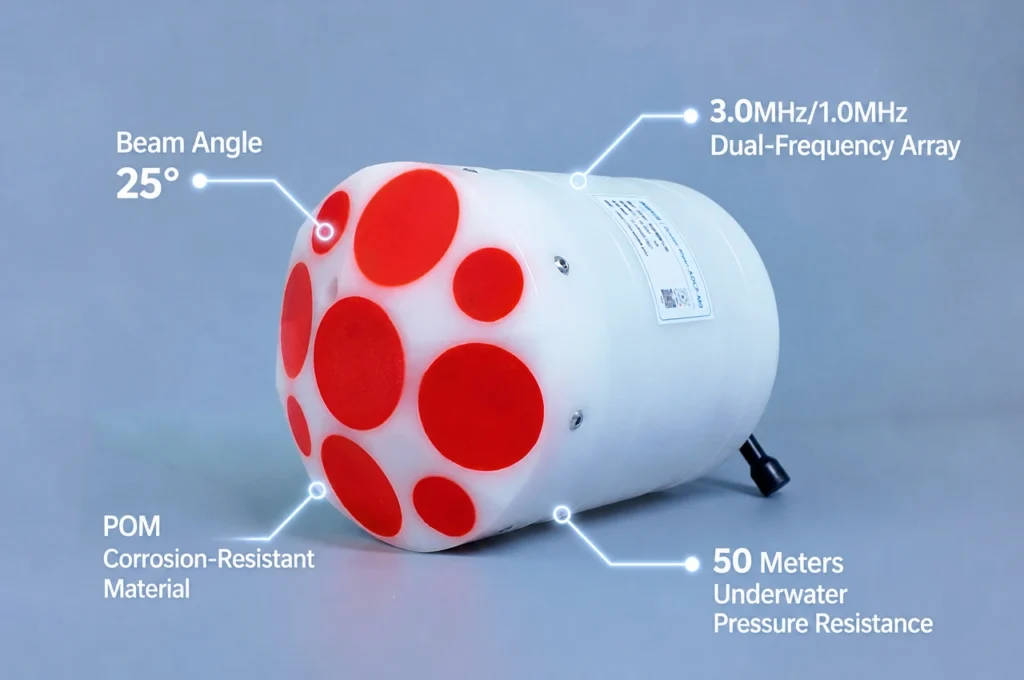
- Two Janus arrays on different frequencies. Four beams at 3.0 MHz for resolution near the surface and in shallow water, four at 1.0 MHz for range and for bottom tracking in deeper or more turbid water. Both instruments mount these at a 25° slant angle.
- A dedicated vertical beam at 0.5 MHz. This measures depth independently of the slanted beams, which matters where bed detection is the weak link and gives a bathymetry channel that does not depend on bottom-track quality.
- Automatic mode selection across the frequencies. The instrument picks frequency, pulse scheme and cell size as depth and velocity change during a transect, instead of asking the operator to reconfigure mid-crossing.
- A 0.06–40 m profile with 0.02–4 m cells. That envelope is what separates the class from the shallow-water five-beam instruments and from long-range 4-beam profilers.
Everything below the class definition is negotiation: cells per profile, storage, output rate, pressure rating, weight, software, and what comes in the box.
2. The published specification comparison
These are the manufacturers’ published figures for the two M9-class instruments, captured on 2026-10-17. Rows shaded green are identical or effectively identical on paper; that is the point — most of the table does not distinguish them.
| Parameter | SonTek RiverSurveyor M9 | Oceantek River-ADCP-M9 |
|---|---|---|
| Transducer configuration | 9: dual 4-beam 3.0 MHz / 1.0 MHz Janus at 25° slant + 0.5 MHz vertical beam | 9: dual 4-beam 3.0 MHz / 1.0 MHz Janus at 25° + 0.5 MHz vertical beam |
| Profiling range | 0.06–40 m (environment dependent) | 0.06–40 m |
| Cell size | 0.02–4 m | 0.02–4 m |
| Velocity accuracy | ±0.25% of measured velocity; ±0.2 cm/s | ±0.25%; ±2 mm/s |
| Velocity range | ±20 m/s (profiling ±10 m/s) | ±20 m/s (profiling ±10 m/s) |
| Depth range | 0.20–80 m | 0.2–80 m |
| Depth accuracy | 1%; 0.02% with full water-column sound-speed correction | 1%; 0.02% with full water-column sound-speed correction |
| Bottom-track range | 0.3–40 m | 0.3–40 m |
| Cells per profile | Up to 128 | 1–255 |
| Data output rate | 1 Hz maximum; internal sampling to 70 Hz | 2 Hz maximum; internal sampling to 70 Hz |
| Internal storage | 8 GB | 64 GB |
| Heading / tilt accuracy | Heading ±2°; pitch/roll ±1° | Heading 0.8° RMS; pitch/roll ±1°; resolution 0.01° |
| Pressure rating | 30 m | 50 m |
| Supply / interface | 12–18 VDC; RS232 direct; GNSS via RS232 input | 10–26 V; RS-232 / RS-422 |
| Weight in air | 2.3 kg (weight in water −0.6 kg) | ≤1.5 kg |
| Dimensions | Not stated on the product page; ask for the outline drawing | Φ128 × 168 mm |
| Operating / storage temperature | −5 to 45 °C / −10 to 70 °C | −5 to 45 °C / −40 to 70 °C |
Figures as published by each manufacturer on 2026-10-17. Datasheets are revised: confirm against the revision supplied with your quotation, and treat any figure that differs between revisions as a question for the supplier rather than an error on this page.
3. Which differences change field outcomes
Nine rows of that table differ. The seven below are the ones worth discussing with a supplier; the remaining two — dimensions and supply/interface — you settle with an outline drawing and a serial-port question.
| Difference | When it changes the outcome | What to do about it |
|---|---|---|
| Weight: 2.3 kg vs 1.5 kg | Bank access on foot, one-person launch from an inflatable, or a programme where one crew covers many sites per week. A third less weight is a third less handling risk at every deployment. | Ask for a weighed system — instrument, mount, battery, cable — and test carrying it to your least accessible site. |
| Cells: 128 vs 255 | Deep sections where you want to hold a fixed cell size across a long profile, or where fine near-bed resolution is part of the brief. More cells do not improve accuracy on their own. | Specify the cell size and count you need for your deepest site and check both instruments can hold it at that range. |
| Storage: 8 GB vs 64 GB | Long stationary deployments, high-rate raw logging, or programmes that archive raw data for every transect over a season. | Estimate raw bytes per measurement day at your configuration, then compare against the recorder. |
| Output: 1 Hz vs 2 Hz | Fast transects in high-velocity sections, and turbulence or short-duration work where more independent samples per second matter. | Run a fast transect on both during the demonstration and compare the ensemble count, not the headline rate. |
| Pressure rating: 30 m vs 50 m | Deep reservoirs, dam forebays, or estuary work beyond 30 m. For most river sections neither figure is the binding constraint. | Check your deepest site against the lower figure. If it is above 30 m, the choice is made for you. |
| Storage temperature: −10 °C vs −40 °C | Kit stored in an unheated vehicle or store through winter. | Check battery chemistry as well as the instrument range; the pack is usually the limiting item. |
| Heading specification | Only where heading error propagates into velocity direction on a long transect or near steel structures. | Compare like with like: one figure is quoted as accuracy, the other as RMS. Verify in the compass calibration, on site, near the structures you actually work beside. |
4. Software and data path: the question that decides it
This is where a mature ecosystem earns its premium, and where a cheaper instrument can quietly fail. The instrument produces ensembles and bottom-track data; the software turns those into a defensible discharge figure. If that chain is not accepted by the people who review your data, the hardware comparison is academic.
Ask each supplier the same six questions, in writing:
- Can the software export raw beam and bottom-track data, not only the computed discharge?
- What exactly does the export produce, and has it been tested against the processing package your agency uses?
- Does the acquisition software run offline, and are the licences perpetual or subscription?
- Does it support stationary mid-section and mean-section measurements as well as moving-boat transects?
- Does it handle moving-bed tests and loop correction inside the same workflow?
- Can it log GNSS input (position and velocity) alongside the ensembles, and does it record which reference was used?
SonTek’s advantage in this area is real and should be stated plainly: RiverSurveyor Live has been refined against two decades of agency practice, and its handling of moving beds, edge cases and reporting is the benchmark the alternatives are measured against. The question for a buyer is not whether that is valuable — it is whether your team needs all of it, and whether the cheaper instrument’s workflow is good enough for the measurements you actually deliver.
If your reviewers expect a specific export format, make that the first test in the demonstration. A file extension in a brochure is not a tested path. For the measurement procedure itself — transects, moving-bed tests, edge estimation — see how a discharge measurement is actually run; this page assumes you already know the procedure and are choosing the instrument that has to fit it.
5. GNSS, RTK and the boat mount
Three items cause most of the surprise on a first purchase, and all three are usually missing from the headline quote.
GNSS is not optional for serious work
Bottom tracking is the primary boat-velocity reference and is sufficient on a stable bed with a clean return. It stops being sufficient when the bed is moving, when the bed is too deep or too soft for a reliable echo, or when you need an independent check on compass heading. In those cases the GNSS reference is what keeps the measurement valid, so the interface for it belongs in the specification rather than in the accessories list.
RTK solves a different problem
RTK improves absolute position. In a moving-boat measurement the position is used to derive velocity and the section track, so velocity accuracy matters more than absolute centimetres, and DGPS is normally adequate. RTK earns its cost when absolute position is the point: fixing station positions for stationary or index-velocity work, measuring bank and edge geometry, repeating transects on an exact line, or tying bathymetry to a survey datum. Ask for a demonstration using the correction service available where you work, because RTK coverage varies by region and sky view.
The mount is part of the measurement
Transducer draft, mounting rigidity, heading offset and cable routing all affect the result, and none of them appear on a datasheet. Confirm whether the trimaran, hull or boat bracket is included in the quoted price, whether the draft can be measured and entered, and whether the mount fits the boat you actually use. A rigid mount with a documented draft is worth more than a kilogram of saved weight.
6. Five tests to run before you sign
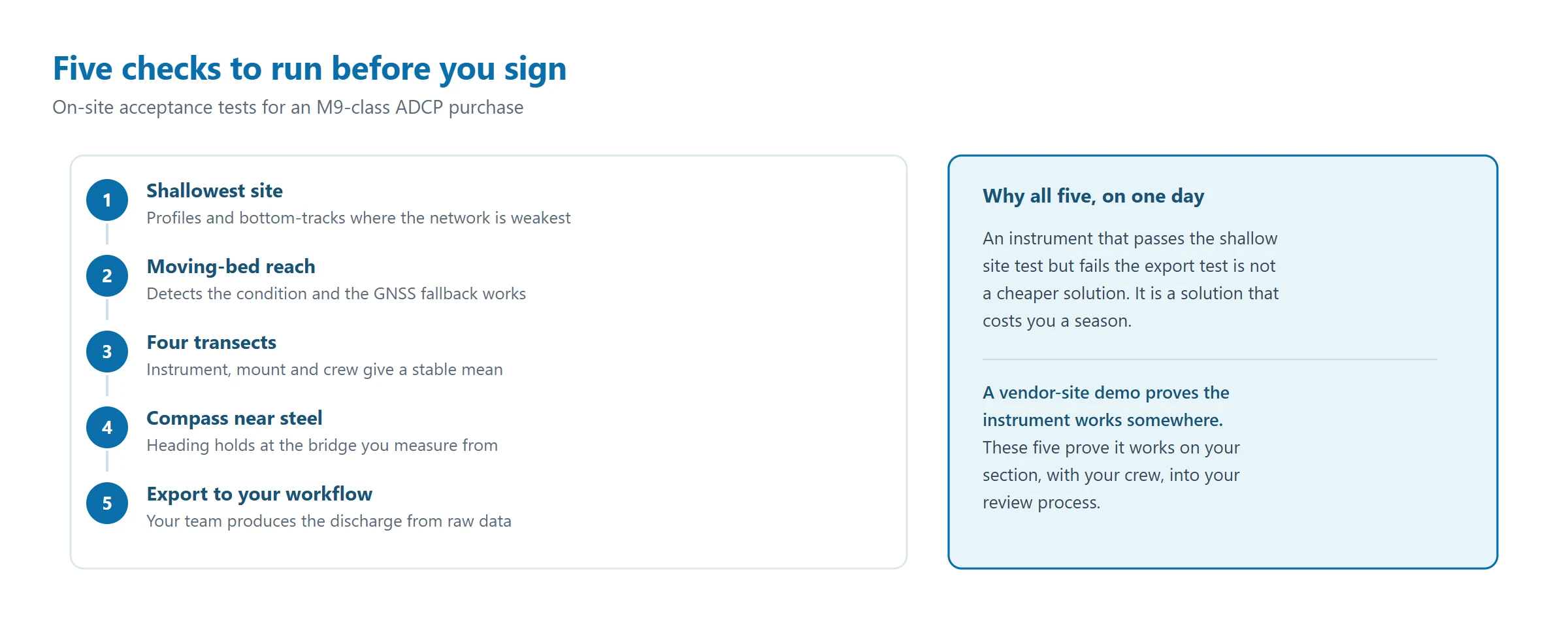
A demonstration on a vendor’s chosen site shows that the instrument works somewhere. These five checks show that it works on your section, in your workflow, with your crew.
| Test | What it proves | What a pass looks like |
|---|---|---|
| 1. Shallowest site | The instrument profiles and bottom-tracks at the depth where your network is weakest — small streams and canals are where coverage is usually lost | A complete profile with valid ensembles to the bed, and a discharge figure your operator trusts |
| 2. Moving-bed reach | The moving-bed test and the GNSS fallback work where the bed actually moves | A test that detects the condition, and a corrected or GNSS-referenced measurement you can defend |
| 3. Four-transect repeatability | The instrument, the mount and the crew together produce a stable mean on your section | Four transects whose spread is consistent with the site, not with the instrument |
| 4. Compass near steel | Heading holds up at the bridge or pier you actually measure from | Stable heading through a full rotation, and a velocity direction that matches the channel |
| 5. Export into your workflow | Raw data reaches the processing package your reviewers use | A completed discharge computation, produced by your own team, from exported raw data |
Run all five on the same day if you can, because the point is the combination. An instrument that passes the shallow-site test but fails the export test is not a cheaper solution; it is a solution that will cost you a season.
7. What “delivered price” should include
Neither manufacturer publishes a list price for the M9 class, and resellers quote on application. That makes the total meaningless unless the scope is identical, so build the comparison as line items and force both quotes into the same shape.
| Cost line | Why it belongs in the comparison |
|---|---|
| Instrument head | The unit itself, with the frequency configuration you specified |
| Mount, hull or boat bracket | Often quoted separately; without it the instrument cannot be deployed |
| GNSS receiver, antenna and cabling | Required for moving-bed conditions and for an independent heading check |
| Acquisition and processing software licences | Per-seat, per-instrument or perpetual — the terms change the five-year cost |
| Batteries, charger and transit case | Consumables that wear out; ask for replacement cost and lead time |
| Initial calibration and certificate | The document your reviewers will ask for, and the one that cannot be recreated later |
| Training and commissioning | Two days with an applications engineer is usually cheaper than a season of wrong transects |
| Freight, insurance, duties and taxes | Frequently the line that reverses a headline price advantage on cross-border purchase |
| Warranty extension and service contract | Compare what is covered, the response time, and where the instrument has to travel for repair |
| Spares holding | Cables, connectors and a spare battery determine whether a failure costs a day or a month |
Then divide the five-year total by the number of sites you intend to instrument. That number — cost per instrumented site, not unit price — is the one that decides whether a lower-cost instrument changes your coverage. For the wider cost structure behind these lines, including what tends to be underestimated, see what actually drives ADCP cost.
8. Delivery, documentation and acceptance on arrival
The instrument is a precision acoustic device with a calibration record. What arrives with it, and what you do in the first hour, determine whether the purchase is complete.
What the documentation package should contain
| Document | What to check |
|---|---|
| Datasheet revision in force | Matches the specification you ordered, including the frequency configuration |
| Calibration certificate | Dated, with the method and traceability stated; issued for the serial number you received |
| Compass calibration record | Shows the date and conditions of the last calibration |
| Firmware and hardware version record | Recorded at dispatch, so you can prove what changed later |
| Serial number record | Matches the instrument, the case and the certificate |
| Software licence and version | Licence terms, activation method and the version shipped |
| Manual revision | Matches the firmware; older manuals describe menus that no longer exist |
| Transport documentation for batteries | If a lithium pack is supplied, ask how it is classified and documented for carriage |
Inspection on arrival
- Check the case and the transducer faces before signing for delivery. Pitting, delamination or a deformed face is a transit issue, and it is much easier to resolve before the courier leaves.
- Run the diagnostic suite immediately, not at the first site. Record the serial number, firmware and hardware versions against the documentation package.
- Compensate the compass and rotate the instrument through a full turn in the environment you will work in.
- Compare depth against a surveyed section — a section with a known profile gives a fast, independent check of the depth channel.
- Complete a four-transect measurement at a site you already trust and compare it with your existing reference. Commissioning should end with data, not with a signed delivery note.
9. If you do not need M9-class
Part of the value of a comparison page is telling you when the comparison does not apply. If every site in your network is shallow, or if your sections are simple and your reviewers accept a 4-beam workflow, the M9 class is over-specified.
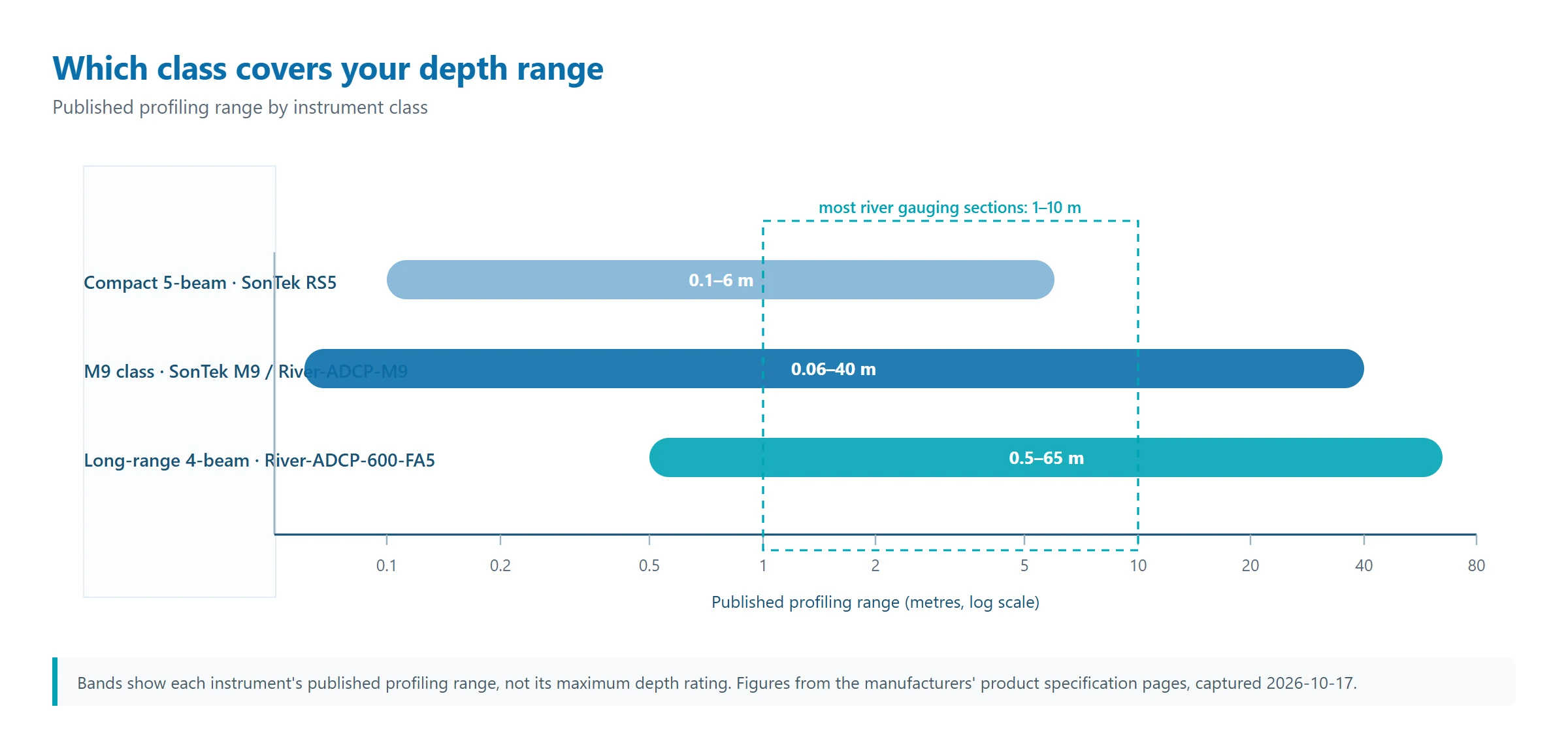
| Class | Typical configuration | Where it fits |
|---|---|---|
| M9-class (9 transducer) | Dual 4-beam 3.0/1.0 MHz Janus + 0.5 MHz vertical; 0.06–40 m; 0.02–4 m cells | Variable-depth rivers, moving-bed sites, programmes that need one instrument to cover shallow and deep sections |
| Long-range 4-beam (e.g. River-ADCP-600-FA5) | 600 kHz, 4 piston Janus + 1 vertical, 20° beam; 0.5–65 m; 0.1–6 m cells; ≤3.5 kg | Longer range and a wider beam than the M9 class, but a single frequency; suits silty beds where bottom lock needs a wider beam |
| Compact shallow water (e.g. SonTek RS5) | 5 transducers, 3.0 MHz, 3° beam; 0.1–6 m; 2.5–30 cm cells | Small streams, canals, wading measurements; lightest and lowest-cost route where 6 m is enough |
| 4-beam direct-reading (e.g. ADCP-600-DR-FA4) | Single-frequency 600 kHz piston array with vertical beam | Routine river gauging where the section is uniform and the second frequency is not required |
Two routing rules are worth carrying into a specification meeting. First, if your deepest site is under about 6 m, a shallow-water five-beam instrument will usually give you better resolution per unit cost than an M9-class unit. Second, if your sites span shallow and deep water in the same programme, the class exists precisely to avoid buying two instruments — which is the case the M9 class was designed for. For the frequency trade-off behind those rules, see 600 kHz vs 300 kHz and frequency selection.
10. Which route suits which buyer
| Buyer type | What usually decides the purchase | What to insist on |
|---|---|---|
| National or regional agency, many sites | Continuity of method, documented calibration, and a support network that reaches remote stations | Written calibration and service terms, spares holding, and a demonstration that matches your standing procedure |
| Consultancy, mixed sites, fixed schedules | Weight, setup time and turnaround when something breaks mid-project | Carry weight including mount and battery, plus repair turnaround in writing |
| University or research group | Raw data access and the ability to reprocess with your own methods | Raw export, documented processing, and licence terms that survive the project |
| Single-site operator or utility | The simplest instrument that covers the site, with local support | A demonstration at the actual site, and a service route you can reach within a day |
The instrument is rarely the constraint in the first three rows. Documentation, support and the data path are what determine whether the measurement programme survives its first audit. Our key parameters that decide an ADCP purchase covers the specification side in more depth, and the TRDI alternatives analysis applies the same comparison method to the other major brand.
11. Frequently asked questions
Does a 9-beam ADCP measure discharge better than a 4-beam one?
Not automatically. Discharge accuracy comes from how much of the section you measure, how well you establish boat velocity, and how carefully the unmeasured top, bottom and edge zones are estimated. A 4-beam instrument with a reliable bottom track and good edge practice will beat a 9-beam instrument on a site that suits it. The ninth beam and the second frequency earn their cost in three specific situations: variable-depth cross-sections where the instrument must change resolution with depth, sites where an independent vertical-beam depth is valued alongside the skewed bottom track, and conditions where redundancy across beams protects the measurement. If none of those applies, a 4-beam river ADCP is the cheaper correct answer.
Do I need RTK, or is DGPS enough?
It depends on what the position is for. In a moving-boat discharge measurement the position fix is used to derive boat velocity and the cross-section track, so velocity accuracy matters more than absolute position, and DGPS is normally sufficient. RTK becomes worth its cost when absolute position matters: fixing station positions for stationary or index-velocity work, measuring bank and edge geometry, repeating transects on a fixed line, or tying bathymetry to a survey datum. Ask for a demonstration with the correction service you will actually use on site, because RTK availability varies by region and by sky view.
Can the instrument be stored in freezing conditions?
Check the storage temperature range, not the operating range, and check it against where the instrument actually lives. Published figures differ between M9-class instruments: the SonTek M9 lists −10 to 70 °C for storage, while the Oceantek River-ADCP-M9 lists −40 to 70 °C. If your kit spends winters in an unheated vehicle or an unheated store, that difference is a real procurement criterion rather than a datasheet detail. Battery chemistry, not the instrument housing, is usually the limiting factor, so ask how the supplied battery pack should be stored and transported.
What is the difference between the RiverSurveyor M9 and the RS5?
They are different classes of instrument. The RS5 is a five-transducer, single-frequency 3.0 MHz system with a published profiling range of 0.1 to 6 m and cell sizes from 2.5 to 30 cm. The M9 uses nine transducers across 3.0 MHz, 1.0 MHz and a 0.5 MHz vertical beam, with a published range of 0.06 to 40 m and cells from 0.02 to 4 m. The RS5 is lighter, cheaper and well matched to shallow streams and small channels; it is not a substitute for an M9 on a deep or variable-depth river section.
Is a used or ex-demo M9 worth considering?
It can be, if the record comes with it. Ask for the calibration certificate and its date, the compass calibration history, the firmware version, the service history, and the reason for sale. Inspect the transducer faces for pitting or delamination, and run a full diagnostic before payment rather than after delivery. Then repeat a four-transect measurement at a site you already trust and compare it against your own reference. A used instrument without a calibration record is a project risk, not a bargain, because the missing record cannot be recreated retrospectively.
Sources. SonTek RiverSurveyor M9 specifications and RS5 specifications are taken from the manufacturer’s product specification tables at ysi.com/sontek-m9 and ysi.com/rs5, captured 2026-10-17; the M9 transducer configuration and SmartPulseHD description are also stated in SonTek’s published M9 brochure. Oceantek River-ADCP-M9 and River-ADCP-600-FA5 figures are taken from the specification tables on this site’s product pages. Calibration and measurement procedure references follow USGS Techniques and Methods 3-A22 (Mueller and Wagner, 2009) and the standards summarised in our standards guide. No prices, lead times, certifications or test results are stated on this page because none are published by the manufacturers; compare them from written quotations.