When you need to listen to what is happening underwater—whether for marine research, industrial noise monitoring, or defense applications—the core tool is a hydrophone. Unlike sonar, which actively transmits sound and listens for echoes, a hydrophone works passively: it only listens. This approach is called Passive Acoustic Monitoring (PAM), and it has become one of the most widely used techniques for underwater sound surveillance across scientific, industrial, and security domains.
This guide explains what hydrophones are, how PAM works, the main types of systems available, and what to look for when selecting a hydrophone for your application.
What Is a Hydrophone?
A hydrophone is an underwater microphone. It converts sound pressure waves traveling through water into electrical signals that can be recorded, analyzed, or transmitted in real time. The sensitive element inside most modern hydrophones is a piezoelectric ceramic—a material that generates a voltage when deformed by sound wave pressure. Piezoelectric ceramics are the backbone of underwater acoustics because they are sensitive, durable, and operate across a wide frequency range without needing an external power source for the sensing element itself.
→ Related: What Is Piezoelectric Ceramic? The Material Behind Underwater Acoustic Sensors
Passive vs Active Acoustic Monitoring
| Passive (PAM) | Active (Sonar) | |
|---|---|---|
| How it works | Listens only—records existing sound | Transmits sound pulses, analyzes echoes |
| Impact on marine life | None—completely non-invasive | Can disturb or injure animals at high power |
| Typical hardware | Hydrophone + recorder or cable | Transducer / transducer array |
| Best for | Long-term monitoring, biological studies, noise surveys | Range finding, imaging, target tracking |
| Example | Recording whale vocalizations over months | ADCP measuring current velocity profiles |
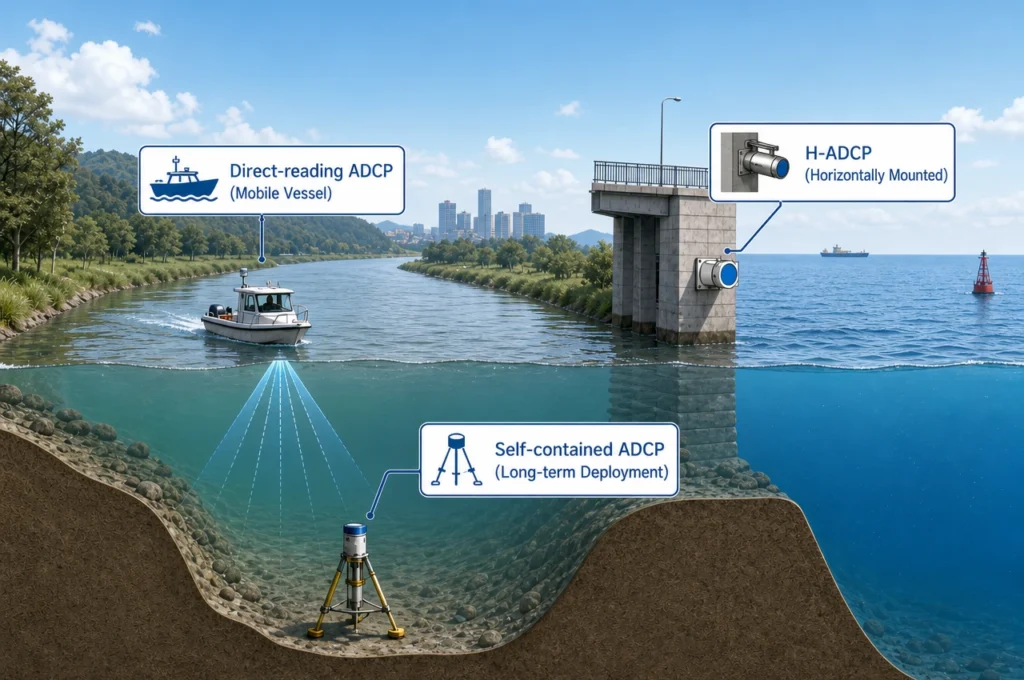
The distinction matters at the hardware level. An ADCP (Acoustic Doppler Current Profiler) is an active sonar—it transmits and receives. A hydrophone-based PAM system only receives. Some projects deploy both: ADCP for current measurement, hydrophone for ambient noise monitoring.
Types of Hydrophone Systems
Self-Contained (Autonomous) Hydrophones
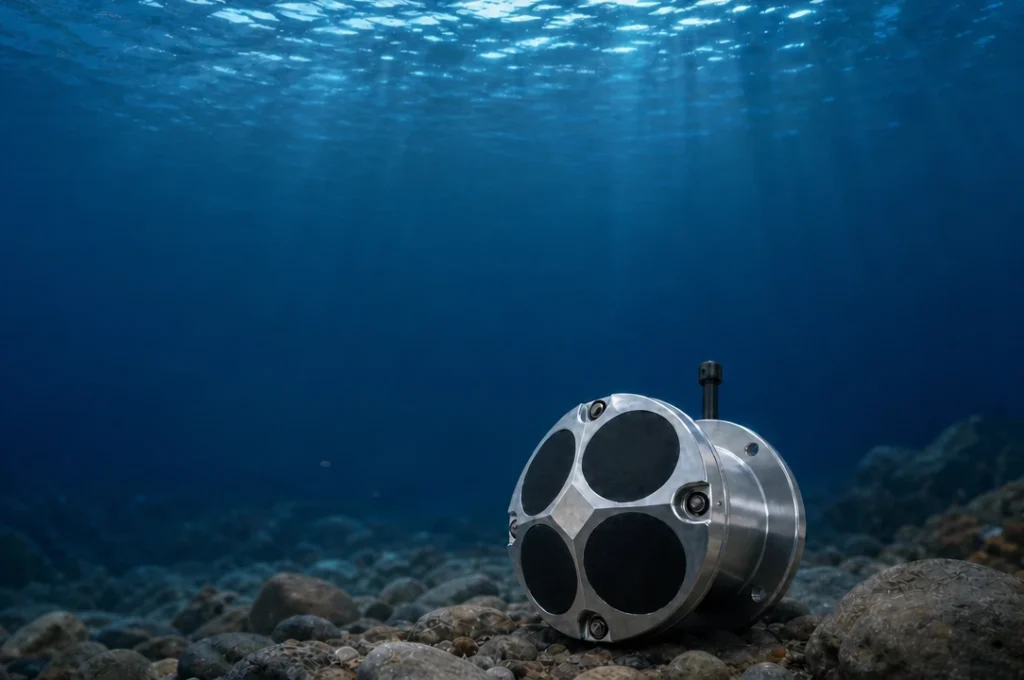
A self-contained hydrophone packages the sensor, battery, storage, and processing electronics into a single submersible unit. It is deployed on the seafloor or a mooring line, records continuously or on a duty cycle for weeks to months, and is recovered for data download. This is the most common configuration for long-term environmental monitoring because it requires no surface vessel or cable connection during the recording period.
Typical specifications for a self-contained system like the H3-OCEAN-6000:
- Depth rating: up to 6,000 meters
- Bandwidth: covers frequencies relevant to marine mammal monitoring, ambient noise surveys, and industrial sound field verification
- Endurance: 60–180 days continuous recording (longer with duty cycling)
- Form factor: compact and self-contained—no external cables or surface buoys required
Cabled / Real-Time Hydrophones
Cabled systems connect the hydrophone directly to a shore station, surface buoy, or vessel via an underwater cable. They provide real-time data streaming but require infrastructure—power, data link, and a fixed mounting point. Cabled observatories can operate indefinitely but involve significantly higher installation and maintenance costs.
Towed Arrays
A towed hydrophone array is a line of hydrophone elements pulled behind a survey vessel. This configuration is common in seismic surveys and naval applications. Towed arrays provide spatial coverage but are limited to the duration of a vessel survey.
Key Specifications When Selecting a Hydrophone
| Specification | What It Means | Why It Matters |
|---|---|---|
| Sensitivity | How much voltage the hydrophone produces for a given sound pressure level (dB re 1V/μPa) | Determines the quietest sound you can detect above the system’s self-noise floor |
| Frequency bandwidth | The range of frequencies the hydrophone responds to (Hz to kHz) | Low frequencies for baleen whales and distant sources; high frequencies for dolphin clicks and industrial noise characterization |
| Self-noise | The electrical noise generated by the hydrophone and preamplifier itself | Sets the lower limit of detection—if your signal is quieter than the self-noise, you will not measure it |
| Depth rating | Maximum operating depth before risk of housing failure | Coastal deployments may need 200 m; deep-ocean work may require 6,000 m or more |
| Sampling rate | How many times per second the acoustic signal is digitized | Must be at least 2× the highest frequency of interest (Nyquist criterion). 48–96 kHz for general work; 192–384 kHz for high-frequency odontocete clicks |
| Dynamic range | The ratio between the loudest and quietest signal the system can capture (in dB) | A wide dynamic range is critical in environments with both loud impulsive sounds (seismic airguns, pile driving) and quiet ambient periods |
| Storage & endurance | Battery life and data storage capacity | Determines deployment duration. Duty cycling extends endurance by recording only a fraction of each hour |
Do You Need to Calibrate a Hydrophone?
Yes—if absolute sound pressure levels matter for your application. A traceable laboratory calibration before and after each major deployment is the gold standard. For regulatory compliance monitoring, noise mapping, or any quantitative comparison across deployments, nominal manufacturer specifications are not sufficient: you need instrument-specific calibration data.
Field checks using a pistonphone calibrator (typically at 250 Hz) should be performed before and after every deployment. For long-term monitoring programs, budget for calibration as a recurring operational cost—not a one-time purchase feature.
Common Applications
Marine Environmental Monitoring
Long-term recording of ambient noise baselines, marine mammal presence and distribution, and anthropogenic noise from shipping lanes, construction, and seismic surveys.
Industrial Noise Compliance
Offshore wind farm construction, oil and gas platform decommissioning, and port expansion projects often require PAM as part of environmental impact assessments and regulatory permitting.
Defense and Security
Port and harbor surveillance, underwater intruder detection, and submarine acoustic signature analysis. Defense-grade hydrophones emphasize wide dynamic range and low self-noise.
Scientific Research
Ocean acoustic propagation studies, bioacoustics research (fish choruses, cetacean communication), and soundscape ecology. Research hydrophones often prioritize calibrated sensitivity and broad bandwidth.
Frequently Asked Questions
A hydrophone is a receive-only device—it converts sound into an electrical signal. A transducer can both transmit and receive. In practical terms: a hydrophone is a listening device; a transducer is a transmit-and-receive device. ADCPs and echosounders use transducers; PAM systems use hydrophones.
This depends on battery capacity, storage, and sampling settings. A typical system using the H3-OCEAN platform can record continuously for 60–180 days. With duty cycling—recording, for example, 5 minutes out of every 30—deployments can extend to a year or more.
Apply the Nyquist criterion: sample at least twice as fast as the highest frequency you need to capture. For fish sounds and general ambient noise monitoring, 48–96 kHz is adequate. For harbor porpoise clicks (up to 150 kHz), use 192–384 kHz. For baleen whale monitoring focused on low frequencies, lower rates extend deployment time.
Costs span a wide range. Entry-level hydrophone sensors start at a few hundred dollars. Professional self-contained systems suitable for regulatory-grade monitoring—including calibrated sensors, deep-water housing, large storage, and long-life batteries—range from $5,000 to $25,000+. Factor in operating costs: vessel time for deployment and recovery, calibration services, and analyst time for data processing often exceed hardware costs over the life of a monitoring program.
Detection range depends on frequency, source level, and environmental conditions. Low-frequency sounds (12–40 Hz) in quiet, deep-water conditions can propagate for hundreds of kilometers. High-frequency sounds (~130 kHz) may only travel a few hundred meters before being absorbed. Ambient noise—from wind, waves, shipping, and biological sources—reduces detection range in practice.
Yes—and this is increasingly common. A single mooring can carry both an ADCP (measuring current profiles) and a hydrophone (recording ambient sound). The data streams complement each other: current data helps interpret acoustic propagation conditions, and ambient noise data provides environmental context for flow measurements. Oceantek manufactures both ADCP instruments and hydrophone systems, enabling integrated deployment solutions from a single supplier.
Choosing the Right Hydrophone for Your Project
Three questions to answer before selecting hardware:
- What frequencies do you need to capture? This determines your sensor sensitivity curve and sampling rate requirements.
- How deep and how long? This determines your housing depth rating, battery sizing, and storage capacity.
- Do you need absolute sound levels? If yes, budget for calibration. If you only need presence/absence detection, nominal specifications may suffice.
→ For detailed specifications, see the H3-OCEAN-6000 Self-Contained Hydrophone, designed for deep-water autonomous deployment up to 6,000 meters with wide-bandwidth recording capability.
Further Reading
- What Is Piezoelectric Ceramic? The Core Material in Underwater Acoustics
- How ADCP Works — Acoustic Doppler Current Profiler Explained
- How Titanium Alloy Casings Benefit Deep-Sea Equipment
- Marine Survey Equipment Guide: How to Select and Where to Buy
Disclaimer: Oceantek manufactures acoustic instruments including ADCPs, DVLs, and hydrophones. This guide explains hydrophone technology for educational purposes. Product specifications referenced are for the H3-OCEAN-6000 self-contained hydrophone series.
Published: July 2026