Quick answer
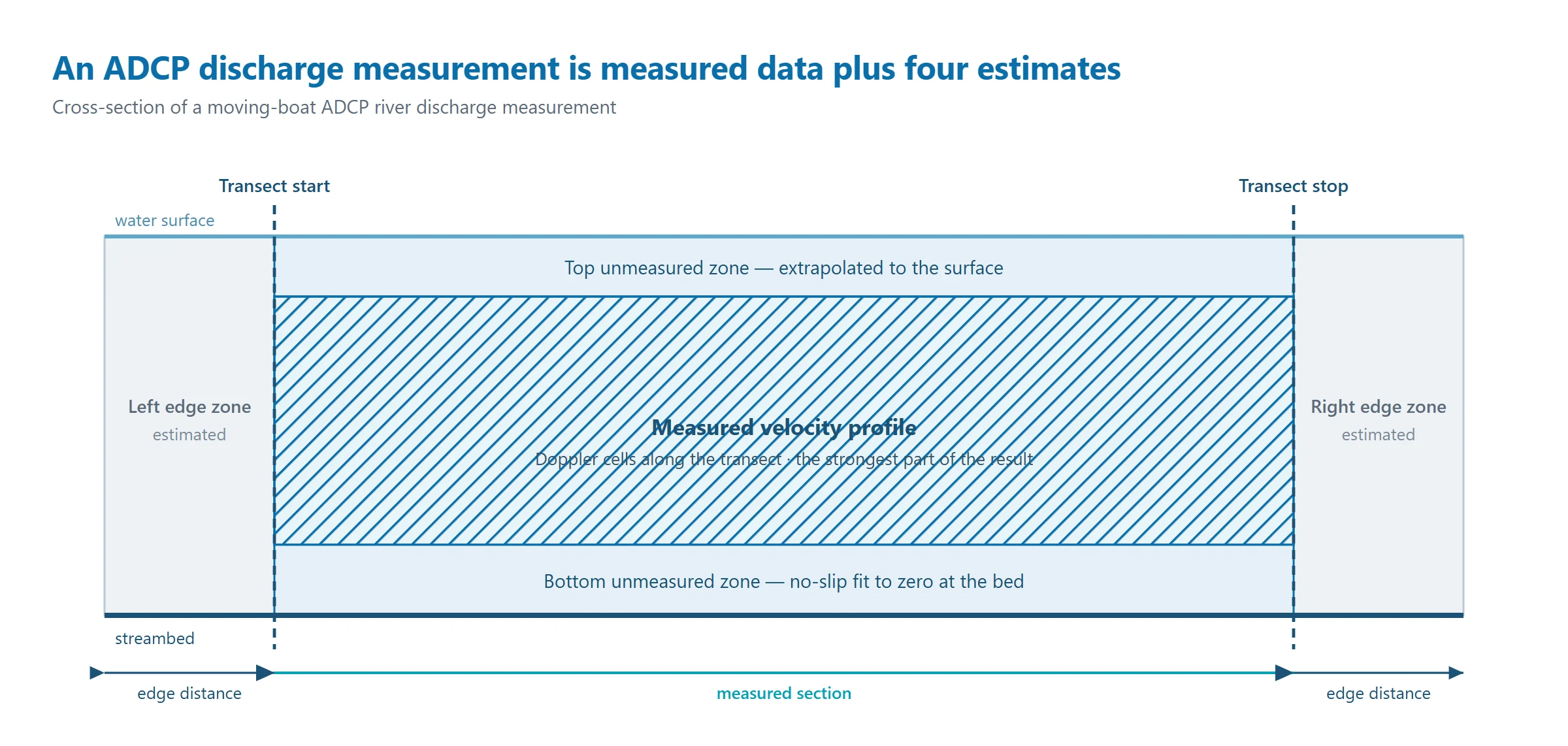
An ADCP river discharge measurement works by profiling velocity through the water column while the instrument tracks the streambed — or fixes position by GNSS — to establish how far the boat travelled. The profiling software integrates velocity and depth across the section, then adds estimates for the parts it could not measure directly: the top of the column, the layer near the bed, and the edges. The result is a discharge in cubic metres per second.
The number itself is routine. What decides whether it survives review is procedure: choosing the right measurement section, proving the bed is not moving, measuring the edge distances, running enough transects to average turbulence, and knowing which data-quality flags mean repeat the transect and which mean reject it. This guide walks through that sequence in the order you actually do it — site, checks, transects, computation, acceptance — and gives the field criteria normally quoted, with sources. It ends with what to put in a specification if you are buying the instrument, and what to verify on delivery.
Key takeaways
- Site selection solves more problems than any configuration change. Eddies, tributary inflow between the section and the control, and a steel truss bridge overhead are not data-quality issues you can average away. Move the site.
- Never skip the moving-bed test. A moving bed biases measured velocity and discharge low, and higher-frequency instruments are the most exposed. There is no reliable way to predict it from the site alone, so test every measurement.
- Four transects is the floor, not the target. If one transect sits more than 5 percent off the mean and you cannot point to a documented reason, the answer is four more transects — not a smaller average.
- The edge and unmeasured zones are estimates, and they decide the uncertainty. Two crews can measure the same section and differ mainly in how carefully they measured edge distances and selected the edge shape.
- Deliver the record, not just the number. Configuration, moving-bed test, edge shapes, terminated transects and the reason for each — that is what lets a reviewer re-derive your result a year later.
Contents
- What an ADCP discharge measurement actually consists of
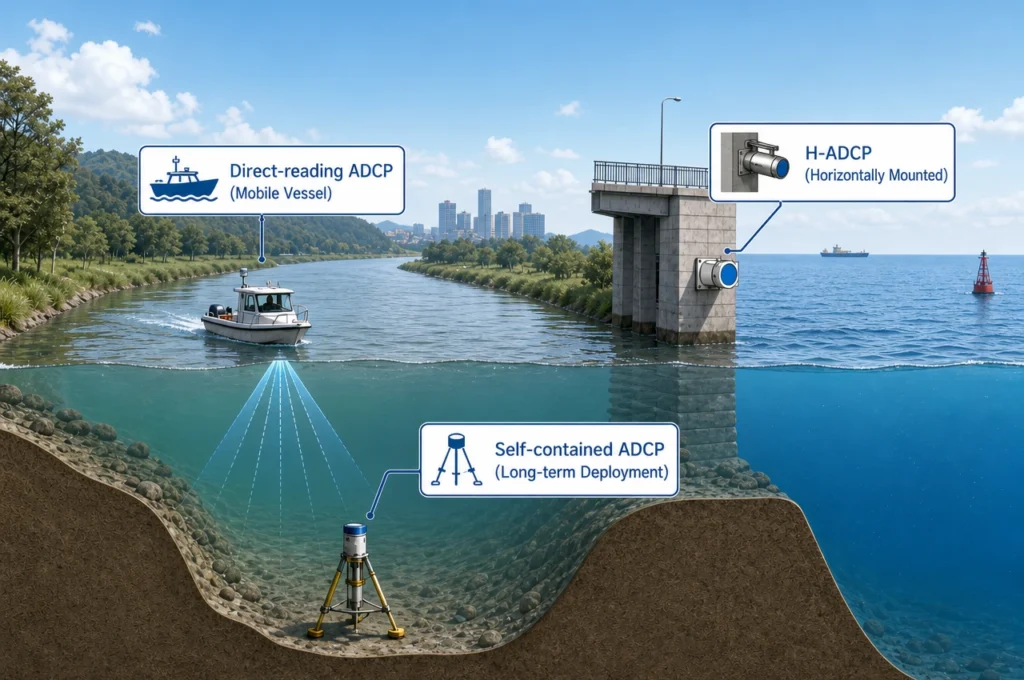
- Choosing the approach: moving boat, fixed station or index velocity
- Site selection, before anything else is decided
- Pre-measurement checks that invalidate the result if skipped
- Running the transect
- Turning transects into a discharge figure
- Data-quality indicators: accept, repeat or reject
- How many transects are enough
- Recording what you did, while you can still remember it
- Which standard governs your measurement
- Specifying and accepting a river ADCP
- Troubleshooting the measurements that go wrong
- Frequently asked questions
1. What an ADCP discharge measurement actually consists of
Every discharge measurement, whatever the instrument, rests on the same identity: discharge equals the integral of velocity over the cross-sectional area. The velocity-area method that ISO 748:2021 defines is the standard expression of that idea for point measurements. An ADCP changes the mechanics, not the principle — instead of dropping a current meter at a set of verticals, it profiles velocity continuously and derives the cross-section from depth soundings along the path.
Q = ∫ v · dA ≈ (measured profile discharge) + (top estimate) + (bottom estimate) + (edge estimates)
That expansion is the part worth internalising, because it splits the result into what was measured and what was inferred. The measured part is the strongest. Everything else is a model of the flow you could not sample, and reviewers know it. If you can say how large those estimated zones were and how they were filled in, you can defend the number. If you cannot, the measurement is an assertion.
| Component | How it is obtained | What a reviewer will ask |
|---|---|---|
| Profiled velocity field | Doppler cells through the water column along each transect | Were enough cells configured to reach the bed, and were they valid? |
| Boat velocity | Bottom tracking, or GNSS, or both | Was the bed moving? Which reference was used and why? |
| Depth and cross-section area | Vertical beam or slanted beams plus the boat track | Was sound speed set correctly for depth conversion? |
| Top unmeasured zone | Extrapolation from the upper cells to the surface | Which extrapolation, and does the profile suit it? |
| Bottom unmeasured zone | Extrapolation to zero velocity at the bed | Was a no-slip power fit used, and over which cells? |
| Edge zones | Estimate from edge distance, depth and an edge-shape coefficient | How were edge distances measured, and was the shape recorded? |
The physics behind the profiled part — beams, gating, correlation and the conversion from beam coordinates to earth coordinates — sits behind the numbers rather than in front of them, and it is covered in the companion article on how the profiler turns echoes into velocity. What matters at the section is that the instrument is measuring, and the operator knows where the measuring stops and the estimating begins.
2. Choosing the approach: moving boat, fixed station or index velocity
Three configurations cover almost all river discharge work, and they answer different questions. Choosing between them is the first decision, because it determines the transect procedure, the edge handling and what the instrument has to be able to do.
| Approach | What it produces | Best suited to | Main constraint |
|---|---|---|---|
| Moving boat (tethered raft, manned boat or USV crossing the section) | A discrete discharge measurement at a moment in time | Periodic gauging, rating-curve development, flood measurements, site-to-site comparison | Needs a crossable section and a boat-velocity reference; the whole measurement depends on consistent transects |
| Fixed station (bottom-mounted frame, or side-looking horizontal ADCP on a bank or pier) | A continuous velocity record, converted to discharge through a rating | Real-time monitoring, flood warning, stations where access is infrequent | The site has to be stable and the index has to hold its relationship with mean velocity |
| Index velocity | Continuous discharge from a measured index velocity plus stage and cross-section data | Tidal or backwater-affected reaches where stage alone does not determine discharge | Requires periodic moving-boat measurements to develop and check the relationship |
Most programmes end up with both a moving-boat procedure and at least one fixed station, and the moving-boat measurements are what keep the fixed station honest: they are the reference against which the index or rating is checked. For the fixed-station side of that pairing, including installation geometry and index-velocity calibration, we cover the fixed-station case separately. The rest of this guide deals with the moving-boat measurement, because that is the procedure most teams perform and the one with the most ways to go quietly wrong.
3. Site selection, before anything else is decided
The single most productive ten minutes of a discharge measurement happen before the instrument is unpacked. A section with a clean velocity field will return good data on a modestly configured instrument; a section with eddies, backwater or a magnetic anomaly will defeat a good one. The USGS guidance puts it plainly — many ADCP measurement problems are solved by moving to a better measurement site — and the criteria below are the ones to walk the bank with.
| What to look for | Why it matters | What to do |
|---|---|---|
| Straight reach with parallel streamlines and uniform flow | Turbulence, eddies, slack water and standing waves break the assumption that the profiled velocity represents the section | Walk upstream and downstream before committing; reject bends and obvious flow separation |
| Proximity to the gauging control | A tributary entering between the section and the control, or storage between them, breaks the stage-discharge relationship you are trying to support | Keep the section as close to the control as the site allows |
| Section shape, especially vertical walls | Acoustic energy from the main beam or side lobes hitting a wall corrupts the outer cells | Start and stop no closer to a vertical wall than the water depth at that wall |
| Flow velocity and boat control | A section that cannot be crossed smoothly at a controlled speed produces unusable transects | Prefer a section where the boat can move slowly; see §5 on speed |
| Local magnetic environment | Steel truss bridges and similar structures generate fields comparable to the Earth's, producing compass error and a rotated velocity record | Avoid them; if unavoidable, compensate with GNSS and document it |
| GNSS reception quality | Multipath from trees, bridges and buildings degrades the position track that the discharge depends on | Prefer open sky; check satellite count and HDOP before starting |
| Acoustic scatterers in the water | Very clear water can return too little energy for a valid velocity; heavy sediment near the bed can blur the bed detection | Check beam intensity in the first transect and move if the profile is weak or the bed is indistinct |
4. Pre-measurement checks that invalidate the result if skipped
These take a few minutes and are the difference between a measurement that can be reviewed and one that gets quietly dropped from the record a month later.
4.1 Clock, diagnostics and sound speed
Set the instrument clock to a known reference and make it consistent with the recorder or data logger at the station. This matters most when the measurement is used to calibrate or check a fixed installation, or when flow is unsteady — a timestamp that disagrees by minutes makes the measurement unusable for that purpose.
Run the diagnostic tests before every measurement, from a stationary boat in still water where the test requires it, and archive the results with the measurement. The set worth capturing includes the instrument serial number, firmware and hardware versions, the beam transformation matrix, the electronics diagnostics, the internal system tests and the sensor verification. If the software or the test suite is not available for a given instrument, that is a question for the manufacturer, not something to skip.
Sound speed deserves a specific mention because it is widely misunderstood. Variation in sound speed with depth does not bias the measurement of horizontal velocity — Snell's law conserves the horizontal wave number across horizontal interfaces — but it scales the measured range and the vertical velocity component. Set temperature and salinity correctly so that depth, and therefore area, comes out right.
4.2 Compass and heading
Compensate the compass in situ, away from vehicles and steel, and verify that the heading behaves sensibly as the boat rotates. Heading error propagates directly into the velocity direction and into the boat track. On sites near large steel structures, treat a stable-looking heading with suspicion: the error is systematic, so it will not show up as scatter in the data, only as a discharge that is wrong in a consistent direction.
4.3 Moving-bed test
Bottom tracking assumes the bed is stationary. When sediment is moving along the bed, the bottom-tracking echo carries its own Doppler shift, the instrument concludes it is drifting upstream, and the boat velocity derived from bottom tracking is biased. The consequences are not random: measured velocities and discharge come out low, and higher-frequency instruments are more susceptible than lower-frequency ones. There is no quantitative rule that tells you in advance whether a given site will produce a moving bed, which is why this is a test and not an assumption.
Three field methods are in standard use, and the criteria are specific:
| Test | How it is run | Moving bed is indicated when |
|---|---|---|
| Stationary test, boat anchored or tethered | Hold the instrument still over the bed and record bottom-track motion | Measured moving-bed velocity exceeds 1% of the mean water velocity at the test location |
| Stationary test, boat not anchored | Same, but the boat may drift either way | Threshold relaxes to 2%, because boat movement adds uncertainty to the test |
| Loop method | Cross the stream and return to the same point; examine the distortion of the bottom-track ship track | Implied moving-bed velocity exceeds 0.04 ft/s (about 0.012 m/s) and 1% of the mean water velocity |
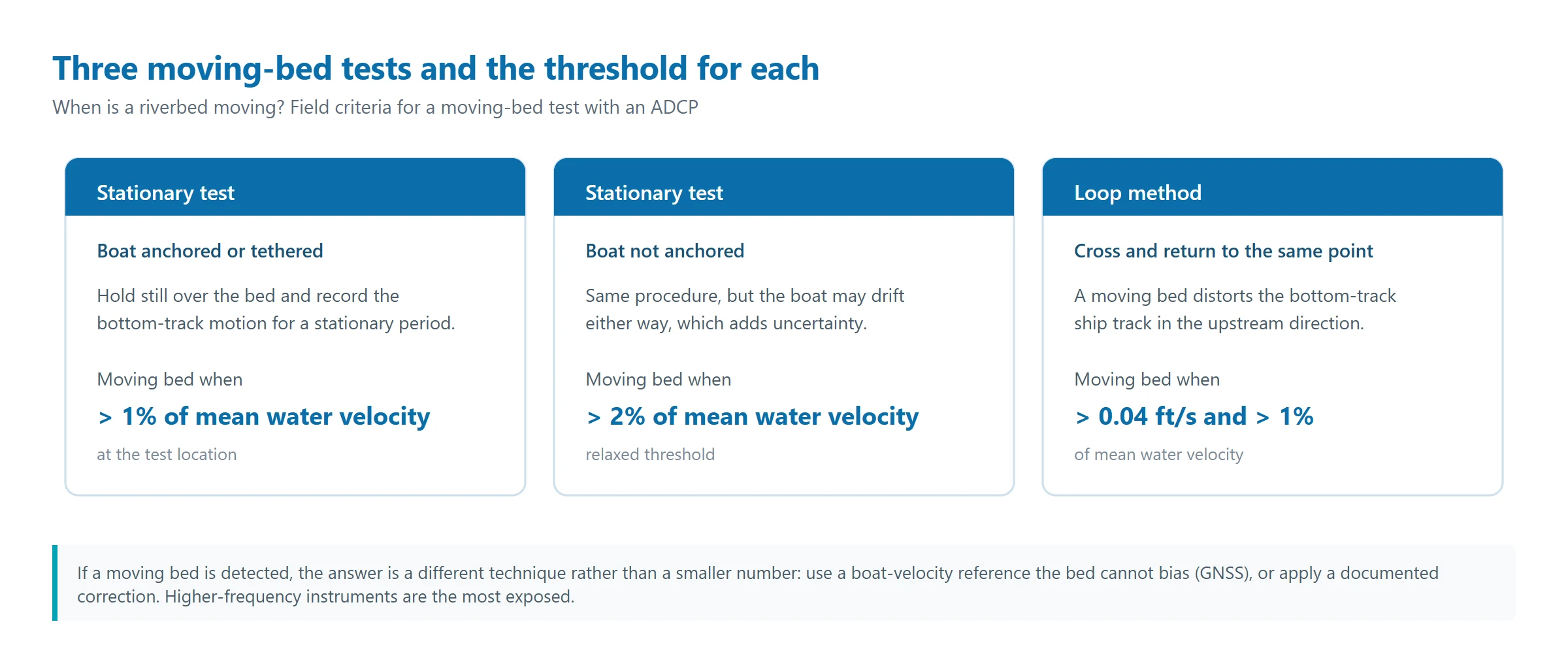
A stationary test characterises one location in the section, so on a wide or heterogeneous channel it is worth repeating at more than one point and at more than one stage. Where GNSS is available and interfaced with the collection software, hold the boat stationary for at least five minutes of good-quality GNSS data and correct the bottom-track displacement by the GNSS displacement; that gives a more direct estimate of the error than the unaided stationary test. The loop method is powerful but unforgiving — it produces wrong answers if it is not executed exactly, and it should be attempted only after reading the procedure properly.
If a moving bed is detected, the correct response is a different technique rather than a smaller answer: use a boat-velocity reference that is not affected by the bed (GNSS), or apply a documented correction. The broader field procedure, including how the tests fit into the wider USGS protocol, is summarised in our article on USGS TM 3-A22 field procedures.
5. Running the transect
Good boat handling is worth more than a better instrument. The measurement is an average of a moving system, and the way the platform moves is part of the measurement, not just the delivery method.
5.1 Speed and smoothness
Keep boat speed at or below the average water speed wherever it is safe to do so. Where that is not possible — fast flow, or a bridge or cableway where control is limited — use the slowest speed that still allows smooth operation, and record on the field note why the boat was faster than the water. Rapid course changes and high boat speed are particularly damaging when GNSS supplies the velocity reference, because compass errors are additive and grow with speed. Smooth motion matters more than a perfectly straight line.
Ongoing work summarised in the USGS guidance found that the number of transects and the boat speed matter less than the cumulative time over which data are collected and averaged. A cumulative collection time of at least 720 seconds is the practical target for a good mean discharge in steady-flow conditions. That reframes the field plan: rather than counting crossings, budget time on the water.
5.2 Edges: measure them or lose the measurement
As the boat approaches a bank, the water becomes too shallow for valid data, so the near-shore discharge is estimated. That estimate is only as good as the edge distances, so measure the distance from the edge of water to the start point and from the end point to the far edge of water with a rangefinder, tagline or other accurate device. Marker buoys set at the start and end points are a cheap way to keep every pass in the same section and to keep the edge estimate consistent between transects.
At the start and end of each pass, hold the boat nearly stationary for five to ten seconds so that a reliable mean velocity is available for the edge estimate. On sections with vertical walls, start and stop no closer to the wall than the water depth there — at 10 feet of depth, keep 10 feet clear. And record the edge shape, sloping or vertical, because it selects the coefficient used in the estimate.
6. Turning transects into a discharge figure
The profiling software does the arithmetic, but it makes several modelling choices on your behalf. Each one is a place where the measurement can be improved in the office or quietly degraded.
| Component | Typical treatment | What to check before accepting the total |
|---|---|---|
| Measured profile discharge | Sum of cell velocities × cell areas across each ensemble | Cells reach the bed; invalid cells are not clustered in one part of the section |
| Top unmeasured zone | Extrapolation from the upper cells — a constant or a power law, or a slope fitted to the top cells | Does the fitted profile follow the measured cells? Wind and density stratification commonly break the one-sixth power-law assumption |
| Bottom unmeasured zone | Power fit forced to zero velocity at the bed (no-slip), typically using cells in the lower 20% of the depth; linear interpolation is an alternative depending on the software's bottom-extrapolation setting | Is there enough of a profile above the bed for the fit to be meaningful? |
| Edge zones | Estimated from edge distance, depth and an edge-shape coefficient | Were the distances measured or paced? Was the shape recorded correctly? |
Two habits pay off here. First, review the extrapolation rather than accepting the default: if the top or bottom fit visibly departs from the measured cells, changing the method — or limiting the portion of the profile used for the fit — is legitimate, provided the change and the reason are documented. Second, compute the measurement with the bed returning to zero velocity, and satisfy yourself that the fit does that. A bottom estimate that implies non-zero velocity at the bed is describing a different flow from the one you measured.
Where unsteady flow is the issue rather than extrapolation — flood waves, rapidly changing stage, lock operations — the sequencing of transects matters more than the arithmetic, and the measurement is normally paired with a stage reading at a defined moment. Document that moment explicitly; a discharge figure without the time it refers to cannot be reconciled with a continuous record.
7. Data-quality indicators: accept, repeat or reject
These indicators are worth watching on screen during the transect, not only in the office. Most measurements that fail review were visibly failing in the field at the time.
| Indicator | What it usually means | Action |
|---|---|---|
| Numerous missing ensembles | Communication or power problem — the computer could not keep up, the link dropped, or power was interrupted | Missing data cannot be recovered. Abort, fix the hardware or connection, restart the transect |
| Numerous invalid ensembles | Invalid bottom tracking; decorrelation from turbulence, shear, debris or fish; low backscatter; air entrainment; or data-quality criteria set too tightly | Identify which cause applies. Invalid bottom tracking is a measurement problem; a too-tight criterion is a configuration problem |
| Beam intensity anomalies through the column | Side walls, fish, trees or submerged debris obstructing beams | Move the transect line or the section; do not average the anomaly into the result |
| Velocity spikes compared with neighbouring cells | Ambiguity errors — typically a broadband-mode issue | Can often be filtered in post-processing; verify that the filtered profile is still consistent |
| Missing or invalid ensembles concentrated in one part of the section, with more than about 5% of the flow estimated | A local obstruction or a section problem, not random noise | Downgrade the measurement or reject the transect. Uniformly scattered invalid cells are far less serious than a cluster |
| Poor fit of the extrapolated top or bottom profile | The assumed velocity distribution does not match the site — commonly wind or stratified density currents | Change the extrapolation method or restrict the fitted portion, and document it |
8. How many transects are enough
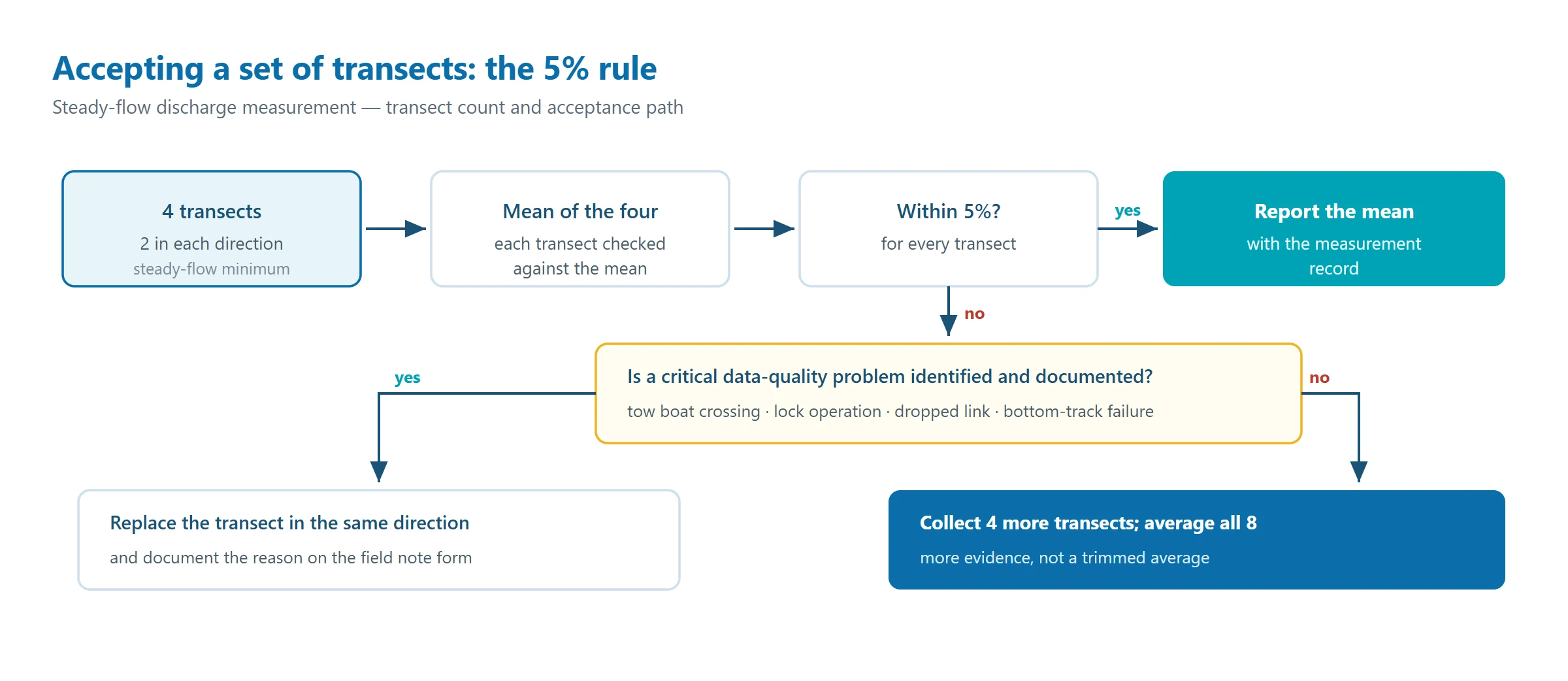
In steady-flow conditions the standard USGS procedure produces the measured discharge from a minimum of four transects, two in each direction, averaged. Reciprocal pairs — one pass left to right, one right to left — are collected deliberately, because directional bias is real: discharges measured consistently in one direction can sit above or below those measured in the other.
The rule that governs when to keep going is the useful part. If any one of the four transects differs from the mean measured discharge by more than 5% and no critical data-quality problem can be identified and documented, collect a minimum of four further transects and average all eight. In other words, a transect that deviates is treated as a signal to gather more evidence, not as a value to trim out. If a critical problem can be identified — a tow boat crossing, a lock operation, a dropped communication link — the deviating transect may be replaced by an additional one collected in the same direction, and the reason is documented.
Slow flow deserves its own expectation. At mean channel velocities below about 0.8 ft/s (roughly 0.24 m/s), the variability between individual transects can be several times higher than in faster flow — USGS tests with a StreamPro ADCP measured a coefficient of variation around 12% at low velocity against roughly 2.5% at higher velocity. The mean is still unbiased, provided enough transects go into it, which in the slowest conditions can mean more than eight. If your site is slow and your budget is two transects, the honest output is a wider uncertainty statement, not a confident single figure.
9. Recording what you did, while you can still remember it
A discharge measurement is only as good as the record that accompanies it. Give every measurement its own directory and put everything in it: the raw data files, the instrument configuration, the moving-bed test, the instrument checks, the calibration information and the field notes. Naming conventions should let a colleague identify the site, the date, the measurement number and the file type without opening anything.
The field notes carry the parts that never appear in the data files. Record the edge distances and edge shapes, whether boat speed was held below water speed and if not why, any transect that was terminated and the reason, and any site criterion that could not be met. Where a transect was excluded from the computation, note both the exclusion and the justification. This is not administrative overhead: it is the mechanism by which your measurement can be reviewed by someone who was not there, which is precisely the standard that environmental data often has to meet.
10. Which standard governs your measurement
Naming the governing document in the scope of work is the cheapest way to avoid an argument at handover. The documents most often cited for river discharge work with a profiler are these.
| Document | Covers | Use it when |
|---|---|---|
| ISO 748:2021 Hydrometry — Measurement of liquid flow in open channels — Velocity area methods using point velocity measurements | Velocity-area discharge measurement using point velocity observations | The method is a conventional velocity-area measurement, or the client specifies ISO methods |
| ISO 24578:2021 Hydrometry — Acoustic Doppler profiler — Method and application for measurement of flow in open channels from a moving boat | The moving-boat profiler method and its application | The measurement is made with a profiler from a moving platform — the most common case for this page |
| USGS Techniques and Methods 3-A22 | Field procedures, quality assurance, moving-bed handling and data-quality indicators for moving-boat ADCP measurement | You need operational thresholds: transect counts, the 5% band, moving-bed criteria, edge estimation |
| WMO Manual on Stream Gauging (No. 519) | National-scale practice for stream gauging programmes | The programme is organised around WMO practice |
| ISO 25377:2020 Hydrometric uncertainty guidance (HUG) | Expressing uncertainty in discharge measurement | A formal uncertainty statement is required alongside the result |
The designations and titles above are the published ones; our article on the standards that govern the measurement sets out how they relate to each other, and the ISO 25377 uncertainty framework (HUG) is covered separately for teams that have to publish a budget. If you are procuring a survey rather than performing one, put the standard and the required reporting package into the specification — it costs nothing and prevents a delivery that meets the letter of the brief but cannot be audited.
For context on where profiling sits in the broader picture, including weirs, flumes, ultrasonic and dilution methods, see the wider set of flow-measurement methods.
11. Specifying and accepting a river ADCP
If you are the one buying the instrument, the field procedure above translates directly into requirements. Each row below is a question whose answer should be in writing before you compare prices — the ones that go unanswered usually reappear as rework in the field.
| Requirement | Why it matters in the field | What to ask the supplier for |
|---|---|---|
| Minimum profile depth and cell size | Decides whether the instrument can measure the shallow and slow sites in your network at all — small streams and irrigation channels are where most programmes lose coverage | Published minimum depth and smallest cell size, and a field demonstration at the shallow end of your range |
| Operating frequency or frequencies | Sets the range-versus-resolution trade-off; a single frequency commits you to one end of it | A clear statement of which depth band each frequency is intended for; see frequency selection for the trade-off |
| Beam configuration, including a vertical beam | An independent vertical beam gives bathymetry that does not depend on the slant beams, which matters where bed detection is the weak link | Beam count, geometry, beam angle, and how depth is derived |
| Boat-velocity reference: bottom track range and GNSS interface | Bottom tracking is the failure mode in mobile-bed conditions; a GNSS interface is the standard mitigation | Bottom-track range, GNSS input format, and confirmation that the software accepts an external position |
| Compass and attitude sensors | Heading error biases velocity direction; attitude data are needed for motion compensation on a small boat | Heading accuracy figure, and how the compass is calibrated in the field |
| Raw data output and software path | You will need the raw data, not only the computed discharge, and you need to be able to process it in your own workflow or your agency's software | Native output format, availability of raw beam and bottom-track data, and documented export into the discharge software you use |
| Published processing modes | Mode determines what the instrument can resolve; a river discharge measurement needs a mode suited to full-depth profiling at metre-per-second flows | Which processing modes are supported and at what range and velocity limits; background in broadband and pulse-coherent processing |
| Handling, power and platform fit | Weight and diameter decide whether one person can deploy from an inflatable or a cableway, and power decides your battery plan | Mass in air, dimensions, depth rating, supply voltage range and current draw |
| Calibration and verification documentation | You will be asked for it during review, and a missing record is not retrospectively creatable | What calibration documentation ships with the unit, and the recommended field verification interval |
| Service, spares and firmware policy | The instrument is the cheap part of a gauging network; downtime is the expensive part | Consumables and spares list, repair turnaround, and how firmware updates are issued and validated |
On delivery, verify before you deploy
- Match the record: serial number, firmware and hardware versions against the documentation package, and run the diagnostic suite on arrival rather than at the first site.
- Check the compass in the environment you will use it: compensate it on site, and confirm the heading is stable and correct with the boat rotated through a full turn.
- Compare depth against a known section: a section with a surveyed profile gives you a fast, independent check of the depth channel before it matters.
- Run a moving-bed test and a full four-transect measurement at a familiar site, and compare against a measurement you already trust. Commissioning should end with data, not with a delivery note.
As one worked example of how these requirements are expressed in a product document, the River-ADCP-M9 published specifications list a 0.06–40 m profile range with 0.02–4 m cells and a 9-beam 3.0/1.0 MHz Janus array plus a 0.5 MHz vertical beam in a 1.5 kg, Φ128 × 168 mm housing — figures that matter in this context mainly because they set which sites the instrument can reach and how many of them one person can cover in a day. Manufacturer-published figures should be treated as a starting point for the specification table above, not as a substitute for the field demonstration on the shallow end of your own network.
12. Troubleshooting the measurements that go wrong
| Symptom | Likely cause | First thing to check |
|---|---|---|
| Discharge systematically lower than a reliable alternative estimate | Moving bed, or an under-estimated edge zone | Run a moving-bed test and verify the edge distances; suspect this pairing before suspecting the instrument |
| Transects scatter widely around the mean at a slow site | Expected behaviour at low velocity rather than an error | Extend cumulative collection time and add transects; report a wider uncertainty |
| Velocity direction rotated relative to expectation | Compass error from a local magnetic field | Check for steel structures near the section; compensate on site or fall back to GNSS referencing |
| Intermittent gaps in the record | Communications or power | Cable seating, battery condition and computer load; missing ensembles cannot be recovered, so fix before the next transect |
| Bed detection unstable in high sediment | Near-bed sediment concentration competing with the bed echo | Beam intensity and depth trace consistency; consider a lower frequency or a different section |
| Weak or absent echoes in clear water | Too few acoustic scatterers in the water column | Beam intensity profile; if the column is genuinely empty of scatterers, the instrument cannot measure it |
| Poor top extrapolation fit | Wind or density stratification violating the assumed power law | Compare fitted and measured cells; change method or restrict the fitted portion, and document it |
Where the issue is the backscatter data itself rather than the discharge — suspended-sediment concentration estimated from echo intensity — that is a separate analysis with its own calibration requirements, treated in our article on suspended-sediment backscatter work.
13. Frequently asked questions
Can an ADCP measure discharge in very shallow water or a canal?
It can, down to the instrument's minimum profile depth, but the economics of the measurement change quickly. As depth falls, a fixed layer near the bed and near the surface becomes unmeasurable, so a growing share of the section is extrapolated rather than measured and the result leans on the bottom fit. Very shallow channels and canals are usually better served by a horizontal ADCP fixed to the bank, which measures a fixed horizon and is calibrated against periodic moving-boat measurements, or by point measurements where the section is small enough. Check the minimum profile depth and smallest cell size before assuming a profiling instrument fits the site.
Can I measure river discharge with an ADCP from a bridge or cableway?
Yes, using a tethered or remote-controlled boat, but the edge work changes. Distances from the edge of water to the start and stop points still have to be measured, typically with handrail or guardrail distance marks, a tagline, or a laser rangefinder in missing-line mode. Marker buoys help keep every pass in the same section. Where a vertical wall forms the edge, start and stop no closer to the wall than the water depth at the wall.
Do I need GNSS if the instrument already has bottom tracking?
Not always, but the cases where you do are the cases that matter. Bottom tracking is the primary boat-velocity reference and is sufficient on a stable bed with a clean acoustic return. GNSS becomes necessary when a moving bed is detected, because bottom tracking then biases the boat velocity; when the bed is too deep or too soft for a reliable bottom echo; and where the compass environment is poor, since position fixes provide an independent check on heading error. Avoid sites with multipath from trees, bridges and buildings, and check satellite count and dilution of precision before starting a transect.
What is the difference between discharge and streamflow?
Discharge is the volume of water passing through a cross-section per unit time, normally reported in cubic metres per second or cubic feet per second. Streamflow refers to the flow of water in a stream or river, and in practice the two terms describe the same quantity: a discharge measurement is a single determination at a moment in time, while a streamflow record is the continuous series a gauging station produces from stage and a rating or index relationship. When a specification asks for streamflow, confirm which of the two it means at the point of delivery.
What accuracy can I claim for an ADCP discharge measurement?
No single figure applies across sites. The result depends on how much of the section was measured rather than estimated, the size of the top, bottom and edge zones, the quality of the boat-velocity reference, and how stable the flow was. Report the components and the quality flags with the number, and use ISO 25377 when a formal uncertainty statement is needed.
Sources for the field criteria on this page. Operational thresholds — transect counts, the 5% agreement band, the 1% and 2% moving-bed criteria, the 0.04 ft/s loop-method threshold, the 720-second cumulative collection target, the edge-and-wall rules, the 5% invalid-ensemble limit, the no-slip bottom extrapolation using the lower 20% of the depth, and the data-quality indicator set — follow Mueller, D.S., and Wagner, C.R., 2009, Measuring discharge with acoustic Doppler current profilers from a moving boat: U.S. Geological Survey Techniques and Methods 3A–22, 72 p. Standard titles are given as published by ISO. Site selection criteria are those set out in the same USGS publication, drawing on the traditional gauging guidance it cites. Product specifications quoted in §11 are as published by the manufacturer.