In this post
- Introduction
- What is Piezoelectric Ceramic?
- How Does Piezoelectric Ceramic Work?
- What Is the Piezoelectric Effect?
- Role of Piezoelectric Ceramic in ADCP Systems
- Why Piezoelectric Ceramic Is Critical for ADCP Performance?
- Key Performance Parameters of Piezoelectric Ceramics in ADCP
- Types of Piezoelectric Ceramics Used in ADCP
- Practical Applications of ADCP Enabled by Piezoelectric Ceramics
- Future Trends in Piezoelectric Ceramics for ADCP
- Summary
- Key Takeaways
Introduction
If you’ve ever wondered how an Acoustic Doppler Current Profiler (ADCP) manages to measure water velocity hundreds of meters below the surface with remarkable precision, the answer lies in a small but powerful component: the piezoelectric ceramic. This material sits at the heart of every ADCP transducer, converting electrical signals into acoustic pulses and back again — making underwater current measurement possible. In this article, we’ll walk through what piezoelectric ceramic is, how it works, the science behind the piezoelectric effect, and why it plays such a critical role in ADCP performance. Whether you’re an oceanographer, a hydrographic surveyor, or simply curious about the technology behind current profiling, this guide will give you a clear, practical understanding.
What Is Piezoelectric Ceramic?
Piezoelectric ceramic is a man-made crystalline material that generates an electric charge when subjected to mechanical stress — and, conversely, changes shape when an electric field is applied to it. The most widely used piezoelectric ceramic is Lead Zirconate Titanate, commonly known as PZT. Discovered in the 1950s, PZT quickly replaced naturally occurring piezoelectric materials like quartz and Rochelle salt in most engineering applications because it can be manufactured with tailored properties — higher sensitivity, broader frequency response, and greater durability.
Piezoelectric ceramics belong to a class of materials called ferroelectrics. In their raw state, the crystal domains inside the ceramic are randomly oriented, producing no net piezoelectric effect. During manufacturing, the ceramic is heated past its Curie temperature and then cooled in the presence of a strong electric field — a process called poling. This aligns the internal dipoles and “locks in” the piezoelectric behavior, giving the ceramic its unique ability to couple mechanical and electrical energy.
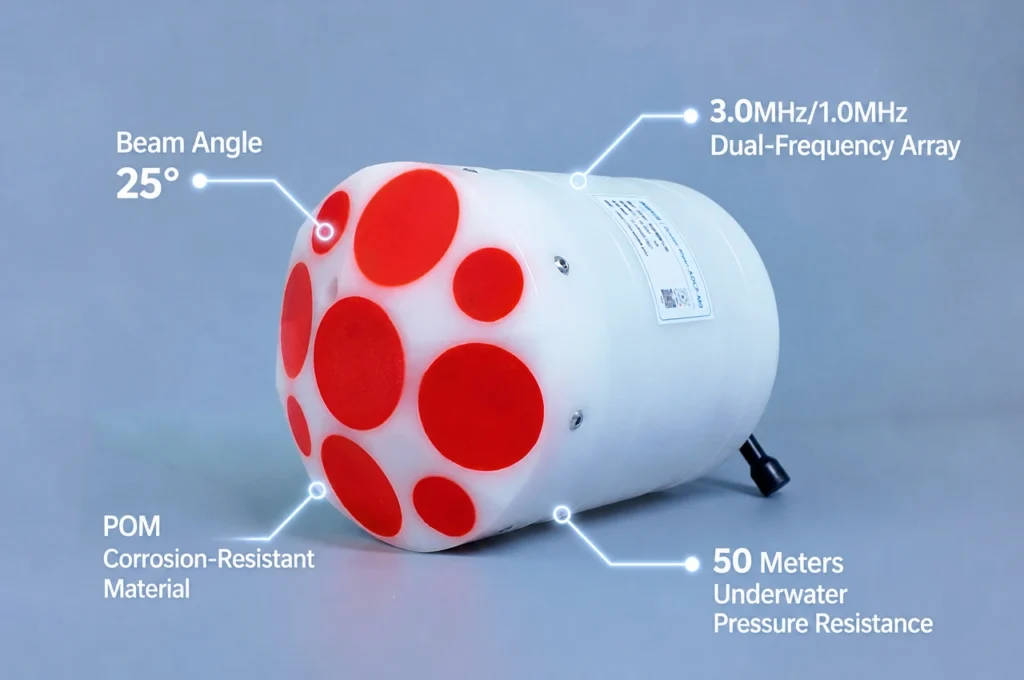
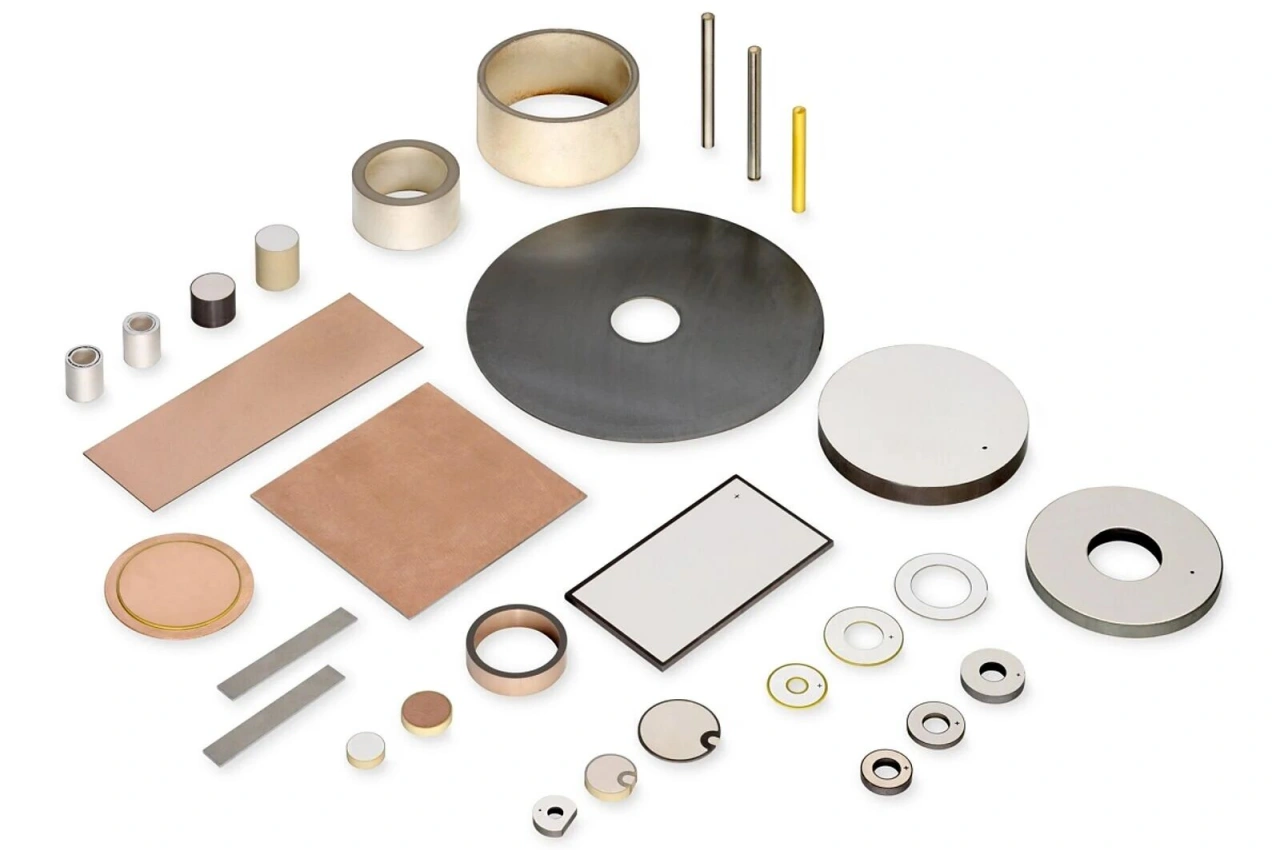
In the context of marine instrumentation, piezoelectric ceramics are most commonly formed into discs, rings, cylinders, or plates and integrated into ultrasonic transducers — the devices responsible for transmitting and receiving sound waves underwater. This is precisely where ADCP systems depend on them.
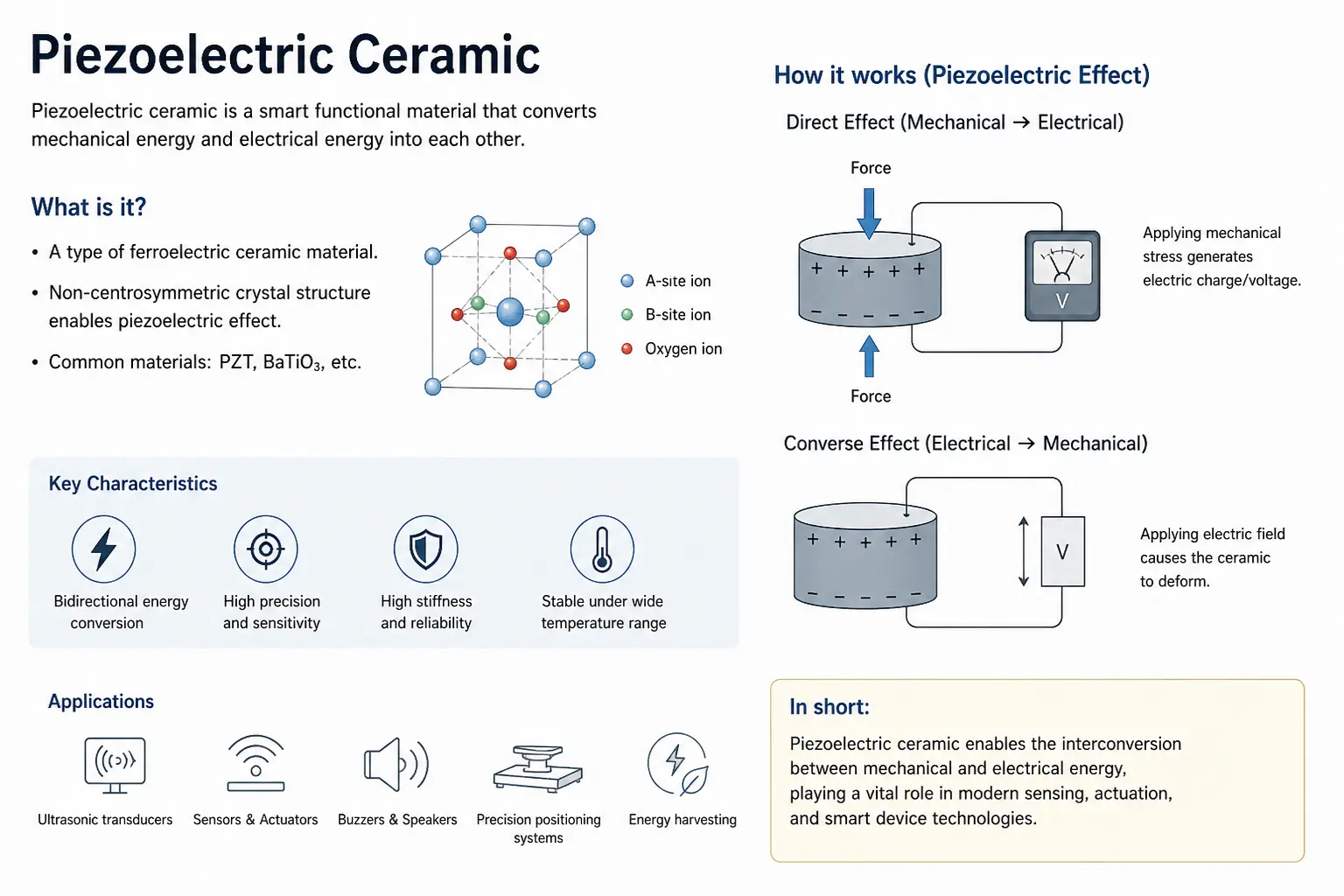
Figure 1 What is Piezoelectric Effect and how it works
How Does Piezoelectric Ceramic Work?
At its core, a piezoelectric ceramic works as an electromechanical transducer — a bridge between the electrical world and the mechanical world. When an alternating voltage is applied across a piezoelectric ceramic element, the material expands and contracts at the same frequency as the applied signal. This vibration generates ultrasonic pressure waves that travel through the surrounding medium, whether it’s water, air, or biological tissue.
The reverse is also true: when an incoming sound wave strikes the ceramic element, the mechanical pressure deforms the material, shifting its internal dipole alignment and producing a measurable voltage across its electrodes. This symmetry — transmit and receive — is what makes piezoelectric ceramics so valuable. A single ceramic element can both launch an acoustic pulse into the water and then listen for the returning echo, a fundamental requirement for ADCP operation.
The operating frequency of the ceramic is primarily determined by its physical dimensions and material composition. Thinner elements resonate at higher frequencies, while thicker ones produce lower frequencies. In an ADCP, the ceramic thickness is carefully engineered to match the system’s target frequency — typically ranging from 38 kHz for deep-water profiling up to 1 MHz or higher for shallow-water or laboratory applications.
What Is the Piezoelectric Effect?
The piezoelectric effect (from the Greek piezein, meaning “to press” or “to squeeze”) is the physical phenomenon whereby certain crystalline materials produce an electric charge in response to applied mechanical stress. It was first demonstrated by the brothers Jacques and Pierre Curie in 1880, who observed that compressing quartz crystals generated an electrical potential across their faces.
The piezoelectric effect actually describes two reciprocal phenomena:
- The Direct Piezoelectric Effect: Mechanical deformation → Electric charge. When the ceramic is squeezed, bent, or vibrated by an external force, the displacement of ions within its crystal lattice creates a net electric dipole moment, producing voltage. This is the sensing/receiving mode — how an ADCP transducer “hears” returning echoes from particles in the water column.
- The Inverse (Converse) Piezoelectric Effect: Applied electric field → Mechanical deformation. When a voltage is placed across the ceramic, the electric field causes the crystal lattice to distort, changing the physical dimensions of the material. This is the actuation/transmitting mode — how an ADCP transducer “speaks” by launching acoustic pulses into the water.
In piezoelectric ceramics like PZT, the effect is orders of magnitude stronger than in natural crystals because the perovskite crystal structure — a specific arrangement of atoms in a cubic lattice — is highly asymmetric below the Curie temperature. The central titanium or zirconium ion sits slightly off-center in its oxygen cage, creating a permanent electric dipole. Under mechanical or electrical stimulus, this dipole shifts, producing the strong electromechanical coupling that makes modern ultrasonic transducers possible.
Role of Piezoelectric Ceramic in ADCP Systems
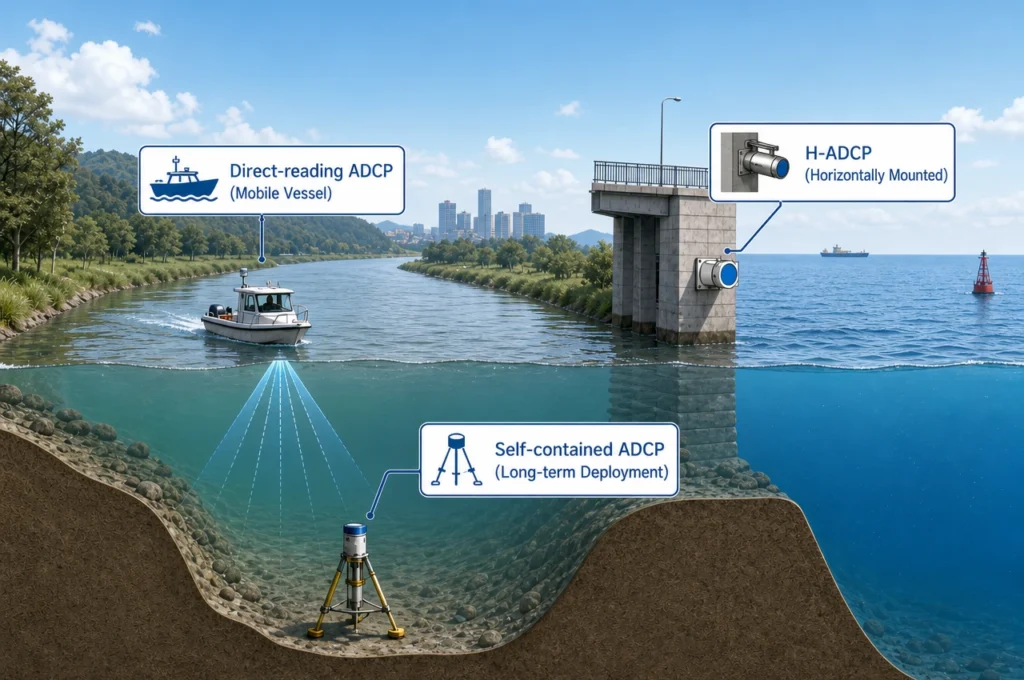
An ADCP measures water velocity by transmitting short pulses of sound into the water and then analyzing the Doppler shift of echoes reflected back from suspended particles — sediment, plankton, bubbles — moving with the water current. The piezoelectric ceramic is the physical element that makes this entire process possible. Here’s exactly how it fits into the ADCP architecture:
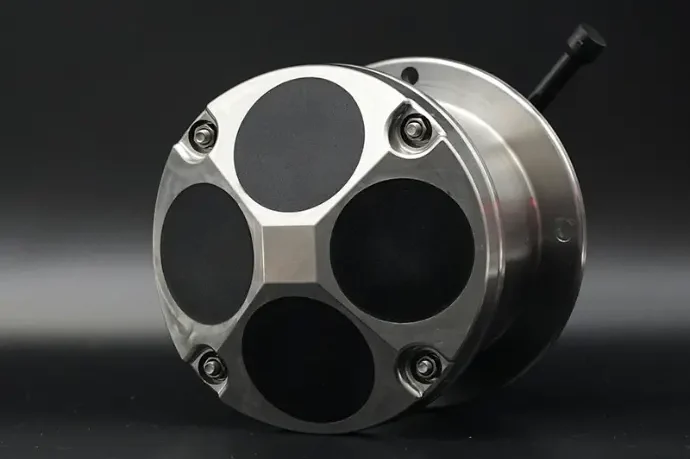
- Transmission (Tx): The ADCP’s electronics generate a high-voltage electrical pulse at a specific frequency. This pulse is applied to the piezoelectric ceramic element inside each transducer head. Through the inverse piezoelectric effect, the ceramic vibrates and launches a focused acoustic beam into the water column. Most ADCPs use three to five beams, each requiring its own transducer with a precisely matched piezoelectric element.
- Reception (Rx): After the transmit pulse ends, the same ceramic element switches to receive mode. Echoes reflected from scatterers throughout the water column strike the ceramic face, inducing minute mechanical deformations. Through the direct piezoelectric effect, these deformations generate corresponding voltage signals, which are amplified and processed by the ADCP’s receiver electronics.
- Beam Forming: The shape and dimensions of the piezoelectric ceramic, combined with the transducer housing and any matching layers, determine the beam pattern — how wide or narrow the acoustic beam spreads as it travels through the water. A well-designed beam pattern ensures that the ADCP measures currents at the intended depth range with minimal interference between beams.
- Frequency Selectivity: Piezoelectric ceramics are inherently resonant devices — they vibrate most efficiently at their natural resonant frequency. ADCP designers exploit this by selecting ceramics with a resonant frequency that matches the system’s operating frequency, maximizing signal-to-noise ratio (SNR) and minimizing power consumption.
Without piezoelectric ceramic, an ADCP would have no way to generate or detect underwater sound — the entire measurement principle would be impossible.
Why Piezoelectric Ceramic Is Critical for ADCP Performance?
The choice of piezoelectric ceramic directly determines how well an ADCP performs in the field. This isn’t just a component you can swap out casually — it influences nearly every key performance metric of the system:
- Maximum Profiling Range: The ceramic’s electromechanical coupling coefficient determines how efficiently electrical power is converted into acoustic energy. A higher coupling coefficient means more of the transmitter’s power reaches the water as usable sound, extending the maximum range at which the ADCP can detect returning echoes. For deep-ocean ADCPs operating at 38 kHz or 75 kHz, every decibel of source level matters — and that starts with the ceramic.
- Velocity Resolution and Accuracy: The ceramic’s mechanical quality factor (Q) influences the bandwidth of the transmitted pulse. A well-chosen Q balances pulse length against frequency spread, directly affecting the ADCP’s ability to resolve small velocity differences between adjacent depth cells.
- Power Efficiency: Battery-powered ADCPs deployed on moorings, buoys, or autonomous vehicles have strict energy budgets. Piezoelectric ceramics with high coupling and low dielectric loss convert more of the battery’s energy into useful acoustic output and less into waste heat — extending deployment duration from weeks to months.
- Beam Pattern Stability: The uniformity of the ceramic’s vibration across its radiating surface determines how clean and predictable the acoustic beam pattern is. Irregularities in the ceramic — voids, grain size variations, incomplete poling — create side lobes that can reflect off the seafloor or water surface, contaminating velocity measurements with unwanted signals.
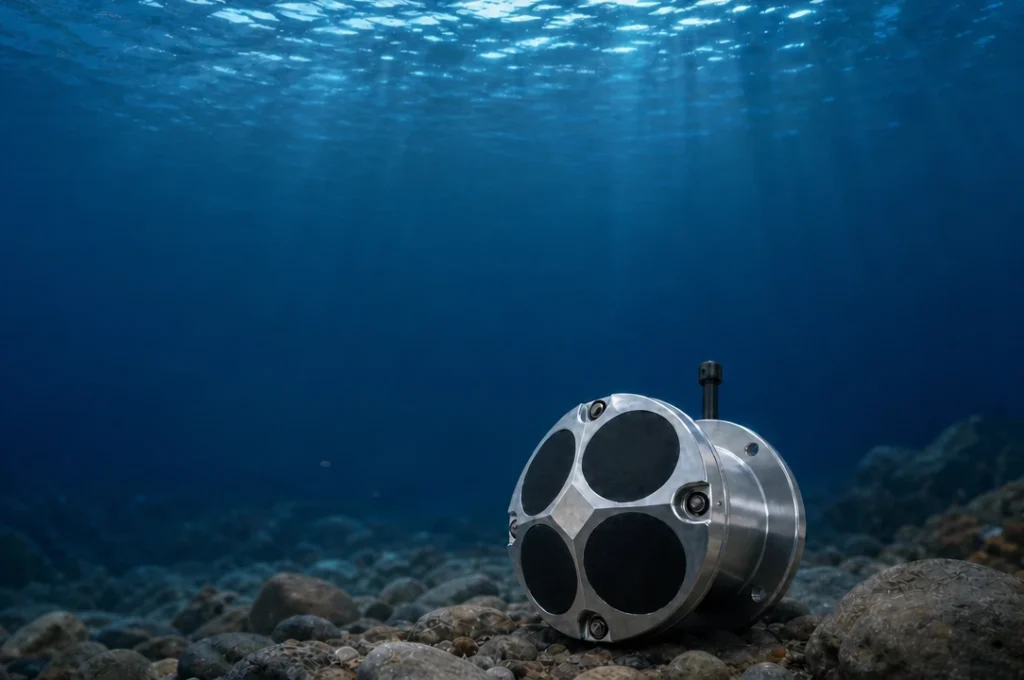
- Long-Term Reliability: ADCPs are often deployed for multi-year missions in harsh marine environments. Piezoelectric ceramics must resist depolarization from temperature cycling, hydrostatic pressure at depth, and chemical attack from seawater. The best-performing systems use ceramics that maintain stable properties over thousands of transmit-receive cycles and years of continuous immersion.
Key Performance Parameters of Piezoelectric Ceramics in ADCP
When engineers select a piezoelectric ceramic for an ADCP transducer, they evaluate several material parameters. Understanding these helps explain why different ADCP models perform differently — and why premium ceramics command a premium price:
| Parameter | Symbol | What It Means for ADCP |
|---|---|---|
| Piezoelectric Charge Constant | d33 | Measures how much mechanical displacement you get per applied volt (transmit) and how much voltage you get per unit of mechanical stress (receive). Higher d33 values mean stronger transmission and more sensitive reception — directly translating to longer profiling range. |
| Electromechanical Coupling Coefficient | kp / kt | Represents the fraction of electrical energy converted to mechanical energy (and vice versa). A high kp (planar coupling) or kt (thickness coupling) means less energy wasted as heat and more converted to useful acoustic output. Critical for battery-operated ADCPs. |
| Mechanical Quality Factor | Qm | Describes how sharply the ceramic resonates. A higher Qm gives a narrower bandwidth but greater efficiency at the resonant frequency. Lower Qm provides broader bandwidth — useful for ADCPs that use coded pulses or broadband signaling. The ideal value depends on the specific ADCP design. |
| Dielectric Constant | εr | Affects the electrical impedance of the transducer element. A higher dielectric constant allows a smaller ceramic element to achieve a given capacitance, which influences the design of matching networks and transmitter electronics. |
| Frequency Constant | Nt | Relates the ceramic’s thickness to its resonant frequency. Given Nt, the designer calculates the exact thickness needed for the target operating frequency — e.g., a 300 kHz ADCP requires a thinner ceramic than a 75 kHz unit. |
| Dielectric Loss Tangent | tan δ | Measures energy lost as heat within the ceramic when an AC voltage is applied. Lower tan δ values mean less self-heating during high-power transmission — important for ADCPs that ping frequently or use long transmit pulses. |
| Curie Temperature | Tc | The temperature above which the ceramic permanently loses its piezoelectric properties. For ADCPs deployed in warm surface waters or near hydrothermal vents, a high Tc provides a safety margin against depolarization. |
Types of Piezoelectric Ceramics Used in ADCP
Not all piezoelectric ceramics are the same, and ADCP manufacturers choose specific formulations based on the instrument’s target application. The two broad categories relevant to ADCP are:
Hard PZT (Navy Type I / PZT-4)
Hard PZT ceramics are doped with acceptor ions (such as iron or manganese) that create oxygen vacancies in the crystal lattice, “pinning” the domain walls and making the material more difficult to depolarize. The result is a ceramic with:
- Lower dielectric losses (tan δ), enabling high-power operation without overheating
- Higher mechanical quality factor (Qm), giving excellent efficiency at resonance
- Greater resistance to depolarization under high electrical or mechanical stress
- Excellent stability over time and temperature cycling
ADCP application: Hard PZT is the preferred choice for high-power, long-range ADCPs — particularly deep-water systems operating at 38 kHz, 55 kHz, or 75 kHz, where transmit power levels can reach hundreds of watts. The ceramic’s ability to handle high drive voltages without degrading makes it ideal for instruments that must profile through thousands of meters of water. Most workhorse ADCPs used in oceanographic research rely on hard PZT formulations.
Soft PZT (Navy Type II / PZT-5A, PZT-5H)
Soft PZT ceramics are doped with donor ions (such as niobium or lanthanum) that create cation vacancies, making the domain walls more mobile. This produces a ceramic with:
- Higher piezoelectric charge constants (d33), delivering stronger signal output per unit of mechanical input — better receive sensitivity
- Higher electromechanical coupling (kp), providing more efficient energy conversion at moderate power levels
- Higher dielectric constant, allowing smaller element sizes for a given frequency
- Lower Qm, enabling wider bandwidth operation
ADCP application: Soft PZT is often used in higher-frequency ADCPs (300 kHz, 600 kHz, 1.2 MHz) designed for shallower water, where receive sensitivity is more important than raw transmit power. These ADCPs typically operate at lower drive voltages, and the soft PZT’s superior sensitivity helps detect the weaker echoes that return from shorter ranges. Broadband and coded-pulse ADCPs also benefit from the wider bandwidth that soft PZT provides.
Piezoelectric Composites (1-3 Connectivity)
A more recent development is the 1-3 piezocomposite, in which thin rods of piezoelectric ceramic are embedded in a passive polymer matrix. This hybrid structure offers:
- Much higher coupling coefficients than monolithic ceramics (kt can exceed 0.7)
- Lower acoustic impedance, providing better acoustic matching to water — less energy lost at the ceramic-water interface
- Broader bandwidth, supporting multi-frequency and chirp-based ADCP systems
- Greater design flexibility — the ceramic volume fraction and pillar geometry can be tuned for specific beam patterns
ADCP application: 1-3 composites are increasingly found in next-generation ADCPs that demand the highest possible bandwidth and sensitivity. They are particularly advantageous in phased-array ADCPs, where multiple ceramic elements work together to form and steer beams electronically. The superior acoustic impedance match to water eliminates the need for complex matching layers, simplifying transducer construction while improving performance.
Practical Applications of ADCP Enabled by Piezoelectric Ceramics
It’s worth stepping back to appreciate that without piezoelectric ceramics — and the ADCP transducers they enable — many critical marine operations would be far more difficult or impossible. Here are some real-world applications where piezoelectric-ceramic-based ADCP systems are indispensable:
- Ocean Current Mapping: Research vessels use hull-mounted ADCPs to continuously profile currents along their cruise tracks, building up basin-scale maps of ocean circulation. These data feed into climate models, weather forecasting, and our understanding of heat transport in the ocean.
- Offshore Energy: Oil and gas platforms, as well as offshore wind farms, use ADCPs to monitor current conditions during construction and operation. Real-time current data ensures safe diving operations, informs the positioning of drilling rigs, and helps optimize the placement of subsea infrastructure.
- Tidal and Hydrokinetic Energy: Before installing tidal turbines, developers deploy ADCPs to characterize the tidal current resource — measuring velocity profiles over full tidal cycles to predict energy yield and select turbine locations.
- Port and Harbor Management: Permanent ADCP installations at port entrances provide real-time current data to harbor pilots navigating large vessels through narrow channels, reducing the risk of collisions and groundings.
- Environmental Monitoring: ADCPs mounted on buoys or autonomous underwater vehicles (AUVs) monitor discharge plumes from wastewater outfalls, cooling water from power plants, and sediment transport in estuaries — all of which depend on reliable, long-duration acoustic transmission and reception.
- Aquaculture: Fish farms use ADCPs to monitor water exchange and currents through net pens, helping to manage waste dispersion, oxygen replenishment, and the health of farmed stocks.
Future Trends in Piezoelectric Ceramics for ADCP
The field of piezoelectric materials is far from static, and several emerging trends promise to shape the next generation of ADCP systems:
- Lead-Free Piezoelectric Ceramics: Environmental regulations like the EU’s RoHS directive are driving research into lead-free alternatives to PZT. Materials such as sodium potassium niobate (KNN) and bismuth sodium titanate (BNT) have shown promising piezoelectric properties. While they currently fall short of PZT’s performance in several key metrics, steady progress suggests that lead-free ADCP transducers will become commercially viable within the next decade. This matters for organizations seeking to reduce their environmental footprint and comply with tightening hazardous-substance regulations.
- Single-Crystal Piezoelectrics: Relaxor-based single crystals like PMN-PT (lead magnesium niobate-lead titanate) exhibit piezoelectric coefficients several times higher than the best PZT ceramics. Their extraordinary d33 and coupling values could enable ADCPs with dramatically longer range or lower power consumption. The current barrier is cost — single-crystal growth is slow and expensive — but manufacturing advances are gradually closing the gap.
- Micro-Machined Ultrasonic Transducers (pMUTs): Borrowing from semiconductor manufacturing, piezoelectric micromachined ultrasonic transducers use thin-film piezoelectric layers deposited on silicon substrates. While currently limited to higher frequencies, pMUT arrays could eventually enable compact, low-cost ADCPs with thousands of individually addressable elements — opening the door to advanced beam-forming and 3D current mapping in a handheld form factor.
- Multi-Frequency and Tunable Transducers: Advanced composite designs are enabling transducers that operate efficiently across multiple frequencies. A future ADCP could automatically switch between a low frequency for deep profiling and a high frequency for high-resolution near-boundary measurements — all from the same transducer head — by exploiting the broadband characteristics of novel piezocomposite structures.
- Additive Manufacturing of Piezoelectric Elements: 3D printing of piezoelectric ceramics is an active area of research. The ability to print complex transducer geometries — curved radiating surfaces, functionally graded compositions, embedded cooling channels — could unlock beam patterns and performance characteristics impossible to achieve with conventional machining and pressing techniques.
Summary
Piezoelectric ceramic is the enabling technology at the core of every ADCP system. It converts electrical signals into the acoustic pulses that probe the water column and then converts the returning echoes back into electrical signals for processing. Without it, the acoustic Doppler current profiling that oceanographers, engineers, and environmental scientists rely on would simply not exist.
The selection of the right piezoelectric material — hard PZT for high-power deep-water systems, soft PZT for sensitive shallow-water instruments, or advanced composites for cutting-edge broadband applications — is one of the most consequential design decisions an ADCP manufacturer makes. It determines the instrument’s range, resolution, power consumption, and long-term reliability. As new materials and manufacturing techniques mature, the next generation of ADCPs will be even more capable: longer range, higher resolution, lower power, and more environmentally sustainable.
Key Takeaways
- Piezoelectric ceramic — primarily PZT — is the electromechanical heart of every ADCP transducer, enabling both the transmission and reception of underwater acoustic signals through the direct and inverse piezoelectric effects.
- The material’s key parameters — coupling coefficient, charge constant, quality factor, and dielectric properties — directly determine an ADCP’s profiling range, velocity accuracy, power efficiency, and deployment longevity.
- Hard PZT (Type I / PZT-4) dominates deep-water, high-power ADCP applications; soft PZT (Type II / PZT-5) excels in high-frequency, shallow-water instruments; and 1-3 piezocomposites represent the cutting edge for broadband and phased-array systems.
- When evaluating ADCPs for your application, understanding the underlying transducer technology — starting with the piezoelectric ceramic — helps you make an informed choice between competing instruments. The best electronics in the world cannot compensate for a transducer built around the wrong ceramic.
- Emerging materials including lead-free ceramics, single-crystal piezoelectrics, and 3D-printed transducer elements are poised to reshape what ADCPs can achieve in the coming decade, bringing greater performance with reduced environmental impact.
Interested in learning more about ADCP technology and selecting the right instrument for your application? Explore our ADCP Products or contact our team for expert guidance.