Introduction
For decades, the mechanical current meter — the Price AA meter, propeller-type meter — was the undisputed workhorse of hydrological measurement. Hydrologists waded into rivers, lowered spinning impellers to precise depths, and built discharge measurements vertical by vertical. The method was reliable, standardized, and universally understood.
Then came the Acoustic Doppler Current Profiler (ADCP) , and the rules changed fundamentally.
Today, field hydrologists face a critical question: Should I invest in an ADCP, or does a traditional current meter still serve my project better?
The answer depends on understanding what each instrument does differently. USGS research confirms that “in most cases, an ADCP discharge-measurement system is dramatically faster than conventional discharge-measurement systems and has comparable or better accuracy.” Yet traditional meters remain robust — NIWA notes they “have been used to gauge rivers for decades … and are reasonably robust and reliable.”
This article provides an evidence-based comparison across five dimensions to help you choose the right tool.
Key Takeaways:
- ADCP: Profiles entire water column in minutes; ideal for deep, dynamic, or high-flow waters.
- Traditional meter: Point measurement; low capital cost; best for shallow, stable streams.
- Hidden cost: Traditional meters require annual calibration and more field time.
- Safety & Speed: ADCPs excel during floods and tidal events where traditional methods are slow or dangerous.
1. Basic Difference in Working Principle
1.1 Mechanical and Electromagnetic Meters: The Point-Measurement Legacy
Traditional current meters fall into two categories — both measure flow at a single point.
Mechanical Meters (e.g., Price AA cup-type)
- Principle: Water spins an impeller or rotor; rotation rate = flow velocity.
- Process: The stream is divided into vertical sections. At each vertical, the meter is lowered to specific depths (0.2 and 0.8 of total depth) to measure point velocities. Discharge is integrated across the channel.
- Limitations:
- Time-intensive: “Takes a long period of time to complete the velocity measurements of the whole cross-section.”
- Velocity cap: *“Upper limit of the flow velocity is usually about 3 m/s.”*
Electromagnetic Meters
- Principle: Faraday’s law — water (a conductor) passes through a magnetic field, producing a voltage proportional to velocity.
- Advantage: No moving parts; works well in debris-laden flows.
- Limitation: Still a single-point device.
Research comparing electromagnetic and acoustic methods found “differences in measured flow discharge from 12 to 35%, depending on the method.” This gap highlights the uncertainty of point-based extrapolation.
1.2 ADCP: The Profiling Revolution
The ADCP represents a paradigm shift — from point sampling to full-profile measurement.
- Principle: Transmits high-frequency acoustic pulses. Sound reflects off suspended particles (sediment, plankton) moving with the water. The Doppler frequency shift gives velocity.
- Distinction: “The major difference … is that ADCP is capable of measuring a profile of the water current through the water column.”
- Process: Divides the water column into dozens to hundreds of range bins and measures velocity in each simultaneously. A full channel cross-section is captured in a single transect.
*“Dynamic discharge conditions impose an unreasonably short time constraint on conventional current-meter methods … Tidally affected discharge can change more than 100 percent during a 10-minute period.”* — USGS
An ADCP solves this because it completes a full measurement in minutes, not hours.
1.3 Core Difference at a Glance
| Aspect | Traditional Current Meter | ADCP |
|---|---|---|
| Measurement principle | Mechanical rotation or electromagnetic induction | Acoustic Doppler frequency shift |
| Spatial coverage | Single point per measurement | Full-column profile, multiple bins simultaneously |
| Time for full cross-section | 1 hour or more | Minutes |
| Moving parts | Yes (mechanical) / No (electromagnetic) | No |
| Calibration | Annual mechanical calibration required | Factory-calibrated; no routine recalibration |
2. Accuracy & Measuring Range Comparison
2.1 Velocity Accuracy: Reading the Specifications
Accuracy specs are formatted as “±X% of measured velocity ± Y mm/s”.
- Traditional meters: ~±1% to ±2% under ideal conditions. Accuracy degrades at very low velocities (bearing friction) and high velocities (turbulence).
- ADCPs: Significantly tighter specs.
- Teledyne RDI RiverPro: ±0.25% ± 0.2 cm/s
- Workhorse Sentinel: ±0.3% ± 0.3 cm/s
- SonTek M9: ±0.25% ± 2 mm/s
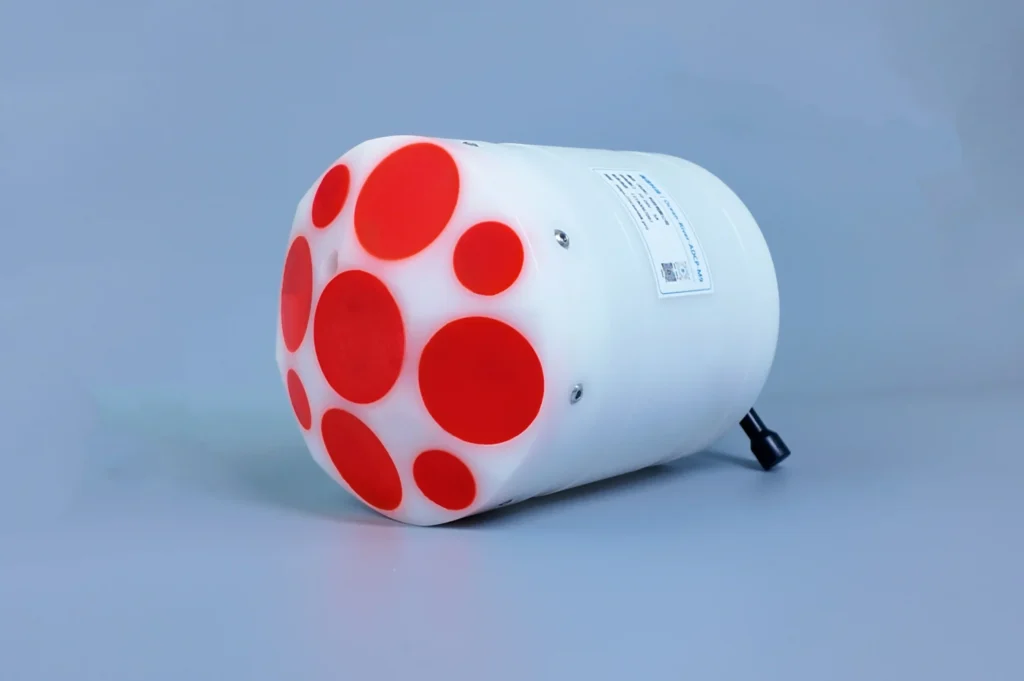
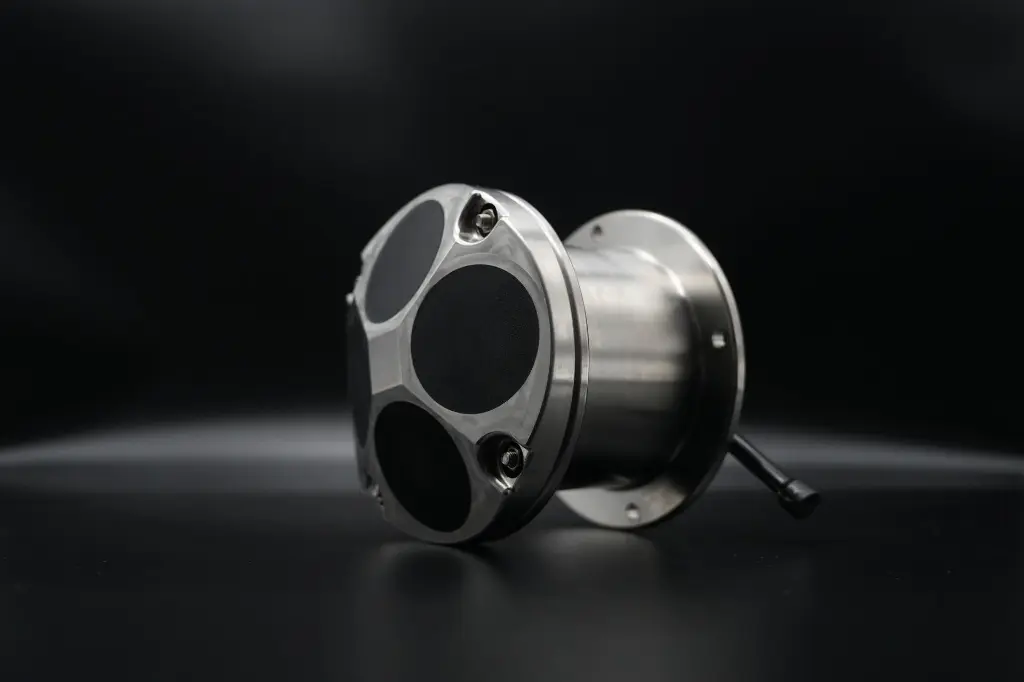
- Oceantek 600 kHz ADCP: ±0.3% ± 3 mm/s velocity accuracy with 1 mm/s resolution. Features titanium alloy housing as standard — a significant long-term durability advantage.
*For a flow of 1 m/s, ±0.25% ± 2 mm/s translates to ~±4.5 mm/s total error — under 0.5%.*
2.2 Velocity Range: The High-Flow Advantage
- Traditional: Practical upper limit around 3 m/s. Above this, bearing stress and cavitation cause failure.
- ADCP: No mechanical limit. Typical ranges are ±5 m/s default, ±20 m/s maximum.
A 2013 typhoon study in Taiwan’s Zengwun River found that traditional Price meter measurements during extreme events are “difficult and dangerous to perform,” while the ADCP-based system proved both safe and consistent with Price meter data.
Winner for flood monitoring: ADCP, by a wide margin.
2.3 Discharge Accuracy: Field Validation
- USGS comparisons show *“mean discharges measured by each acoustic instrument were within 5 percent of the Price AA-based measurement.”*
- A Japanese study revealed a crucial nuance: ADCP accuracy was relatively lower at low discharge (where point methods excel) but higher at high discharge, where profiling speed reduces temporal errors.
- Spatial resolution: An ADCP measures up to 255 range cells simultaneously, revealing velocity pulsations, shear layers, and secondary circulations that point meters inherently miss.
3. Installation and Maintenance Cost
3.1 Capital Investment: The Upfront Reality
The purchase price difference is stark:
- Traditional meter setup: Several thousand dollars.
- ADCP system: 15,000to15,000to55,000+ depending on frequency and features.
This is the single largest barrier to ADCP adoption for limited-budget programs.
3.2 Operational Costs: Where ADCPs Earn Their Premium
The total cost of ownership tells a different story.
| Cost Factor | Traditional Current Meter | ADCP |
|---|---|---|
| Annual recalibration | Required (recurring cost, shipping) | Not required (factory-calibrated) |
| Wear parts | Bearings, rotors, contacts — regular replacement | None (solid-state) |
| Field time per site | 1–2 hours (two-person crew) | 15–30 minutes |
| Data processing | Manual computation | Integrated software |
| Long-term deployment | Not feasible | Self-contained, ≥180 days (e.g., Oceantek) |
“ADCPs not only require shorter times to collect data than traditional current meters, but also allow streamflow measurements at sites where the use of conventional meters is either very expensive, unsafe, or simply not possible.” — USGS
Cost verdict: Traditional meters have lower capital cost; ADCPs offer dramatically lower operational and personnel costs over time.
4. Suitable Application Scenarios
4.1 Where Traditional Current Meters Still Excel
Despite ADCP’s advantages, traditional meters remain the right choice for:
- Low-budget monitoring: Where capital funding is limited and measurement needs are modest.
- Very shallow streams: ADCPs need a minimum depth (0.3–0.5 m); wading rods work in ankle-deep water.
- Point-specific velocity: Verifying flow at a single intake point without needing a full profile.
- Teaching environments: The physics of flow measurement are tangible with a mechanical meter.
- Regulatory inertia: NIWA notes propeller meters are “still the standard in New Zealand.”
4.2 Where ADCPs Are the Clear Winner
ADCPs dominate when speed, safety, or resolution are paramount:
- Dynamic flows: Tidal estuaries, dam tailraces — flow changes faster than point measurement can capture.
- Flood and typhoon monitoring: Keeps personnel safely on shore; remote boat deployment possible.
- Deep water and large rivers: Profiles depths far beyond wading reach.
- Long-term autonomous monitoring: Bottom-mounted ADCPs (e.g., Oceantek self-contained models) operate unattended for 180+ days — impossible with mechanical meters.
- Turbulence research: Captures secondary flow structures, shear zones, and pulsations.
5. How to Choose for Your Project
5.1 The Six-Question Selection Framework
Ask yourself these questions before deciding:
- What is your typical measurement environment?
- Shallow, stable, wadeable streams: Traditional meter may suffice.
- Deep, dynamic, or tidally influenced waters: ADCP strongly recommended.
- What is the required spatial resolution?
- Single point at known location: Traditional meter.
- Full velocity profile: ADCP essential.
- What is your time budget per measurement?
- 1–2 hours acceptable: Traditional meter.
- Measurements in minutes: ADCP required.
- Capital budget vs operational budget?
- Low capital, can invest field time/calibration costs: Traditional.
- Higher capital, seeking low operational costs: ADCP.
- Are you measuring during extreme events?
- Fair-weather only: Both viable.
- Flood, typhoon: ADCP is safer and more capable.
- Do you need autonomous long-term deployment?
- Spot measurements only: Traditional.
- Months of unattended monitoring: Self-contained ADCP.
5.2 Decision Matrix
| Project Scenario | Recommended Instrument | Why |
|---|---|---|
| Small stream, limited budget | Mechanical/electromagnetic | Lowest capital cost; proven reliability |
| Medium river, routine discharge | Portable 600 kHz ADCP | Speed advantage; within 5% of traditional methods |
| Large river, tidal/dynamic flow | Boat-mounted 600 kHz ADCP | Only method fast enough for changing conditions |
| Flood measurement, typhoon | ADCP (remote/boat) | Safety-critical; personnel remain on shore |
| Long-term autonomous | Self-contained ADCP | ≥180 days unattended; no traditional equivalent |
| Turbulence/complex flow studies | High-resolution ADCP | Captures spatial structures point meters miss |
5.3 The Oceantek Fit for Modern Hydrology
For projects leaning toward ADCP adoption, Oceantek addresses key selection concerns:
- Cost-effectiveness: Competitive pricing makes acoustic profiling accessible for budget-conscious programs without sacrificing measurement quality.
- Standard titanium housing: Eliminates upgrade costs for corrosion resistance across freshwater and marine environments.
- Field-validated: Instruments tested in real conditions (e.g., Zhoushan sea trials) to verify specs translate to performance.
- Deployment endurance: Self-contained models support ≥180 days of continuous operation.
For technical consultation, frequency selection, or a quotation, contact the Oceantek team: sales@oceanadcp.com
Conclusion
The ADCP vs traditional current meter question is about matching technology to your needs. Traditional meters remain practical for shallow, stable streams with budget constraints. But for deep, dynamic, dangerous, or long-duration measurements, the ADCP is often not just better — it’s the only viable solution.
Use the selection framework above to audit your priorities: capital budget, operational costs, safety, and required data products. When the analysis points toward acoustic profiling, consider Oceantek’s ADCP solutions — instruments built for competitive accuracy, robust durability, and accessible field deployment.