Executive summary
Compliance in ADCP discharge measurement is a method and documentation exercise, not a product label. This FAQ answers the twelve questions field teams, buyers and reviewers ask most often: which standards apply, what “ISO compliant” really means, how to handle moving beds and edge discharges, what uncertainty to report, and what records make a measurement defensible. It draws on ISO 24578:2021, ISO 748:2021, ISO 25377 (HUG), USGS TM 3-A22 and WMO No. 519.
Contents
- Standards and scope — what compliance means, which documents apply
- Field compliance — method, moving bed, edge discharge, national practice
- Uncertainty and reporting — what to report, instrument checks
- Records and review — evidence pack, and why surveys fail review
Standards and scope
1. What does “ISO compliant” actually mean for an ADCP survey?
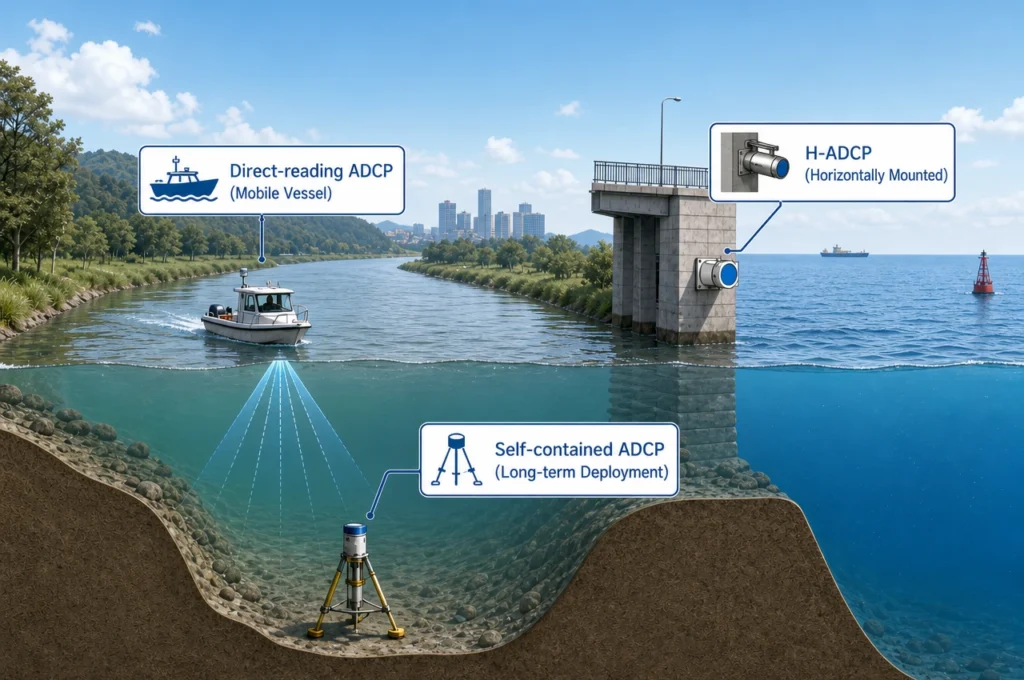
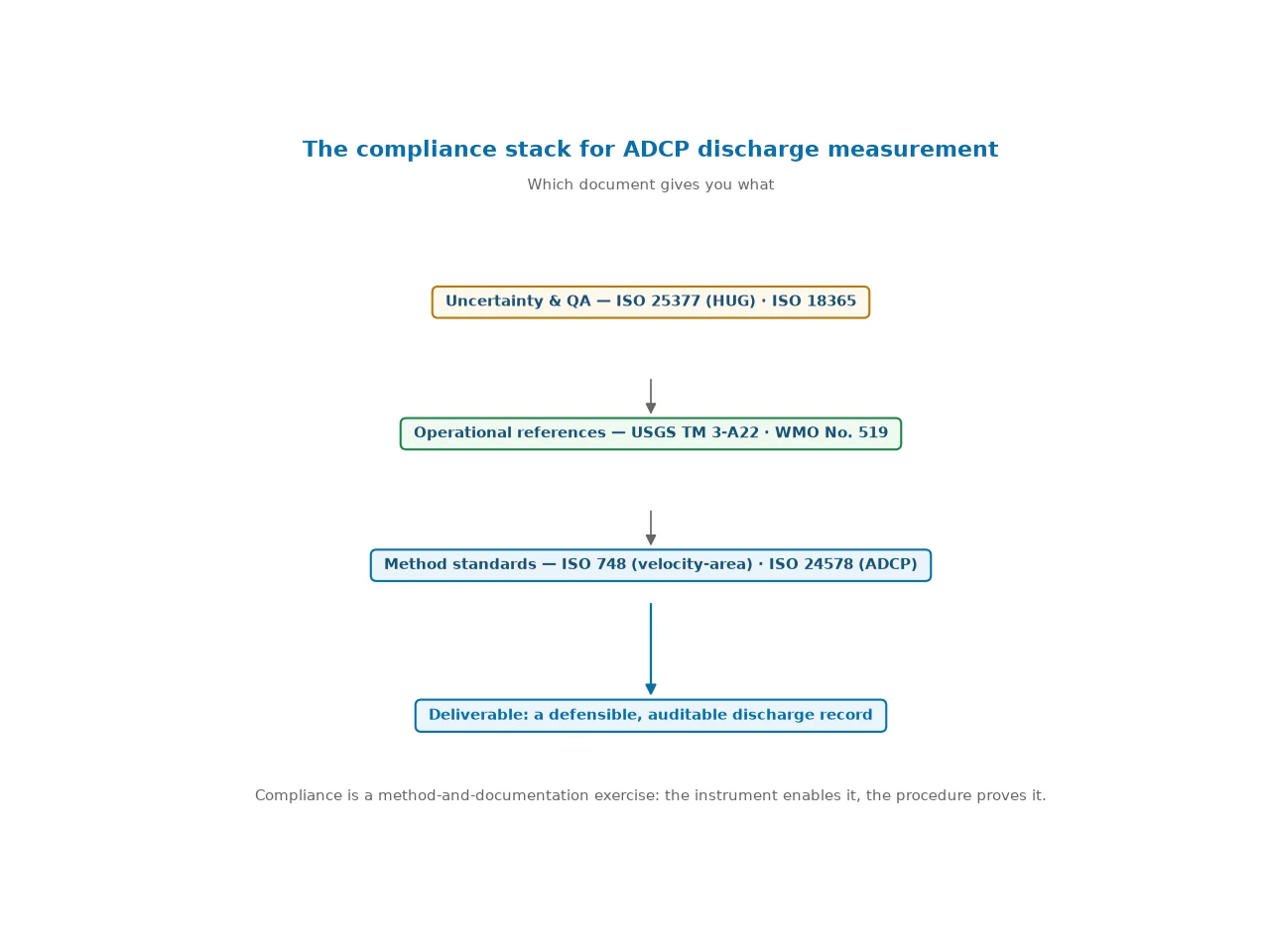
It means the survey was planned, executed and documented following the procedures of the relevant method standard — for moving-boat ADCP work, ISO 24578:2021. Compliance lives in the procedure and the records: site selection, instrument checks, moving-bed testing, edge-discharge estimation, uncertainty reporting and traceable data files.
2. Which standards apply to moving-boat ADCP discharge measurement?
| Document | Role in a compliant survey |
|---|---|
| ISO 24578:2021 | The international method standard for moving-boat ADCP discharge measurement |
| ISO 748:2021 | The velocity-area method that frames point-velocity and surface-velocity gauging, including the discharge computation |
| ISO 25377:2020 (HUG) | The uncertainty framework used to quantify and report the result |
| USGS TM 3-A22 | US field practice: preparation, field procedure, office review and QA indicators |
| WMO No. 519 | International field manual for national hydrological services and programmes |
See the standards overview for how these documents fit together.
3. Is my ADCP “ISO certified”?
No. ISO 24578 and ISO 748 are method standards, not product certifications. An ADCP cannot be “ISO certified” for discharge measurement — the instrument enables compliance, the survey procedure achieves it.
4. Can I mix ISO, USGS and WMO references on one project?
Yes — and most projects do. A common combination is ISO 24578 for the measurement method, ISO 25377 for uncertainty, and a national field manual (USGS TM 3-A22 in the US, WMO No. 519 for international programmes) for day-to-day procedure. State which document governed each part of the work so reviewers can follow the logic.
Field compliance
5. How do I run a survey that meets ISO 24578?
- select a suitable site (stable banks, uniform section);
- verify the instrument: diagnostics, beam-alignment test, speed-of-sound settings (temperature, salinity), compass calibration, configuration;
- test for a moving bed before measuring;
- collect transects with the correct boat path and speed;
- estimate edge discharge and record the method;
- process the data, check QA indicators and report uncertainty;
- keep field sheets, configuration and raw files.
6. What does USGS TM 3-A22 require that ISO 24578 does not?
TM 3-A22 is a field manual rather than a standard, so it goes deeper into operational practice: predeployment data management and naming conventions, deployment and mount guidance for manned, tethered and remote-controlled boats, a step-by-step field procedure, office review procedures, data-quality indicators and a catalogue of commonly observed measurement problems. US agencies and many US contracts expect these procedures. Our TM 3-A22 guide walks through them.
7. When should I follow WMO No. 519 instead?
When your client, national hydrological service or funding body follows WMO practice. The Manual on Stream Gauging (WMO No. 519) is the international field manual used by national services, river basin organisations and development programmes — particularly for long-term station networks and stage-discharge operations.
8. How do I handle a moving bed?
Test for it before the measurement. On sandy, alluvial rivers the bed can migrate while the boat crosses, which biases bottom-track navigation and therefore discharge. If the bed is moving, switch to a GNSS-referenced measurement, apply the appropriate moving-bed correction method, or move to a more stable section — and record the test result either way. Both ISO 24578 and USGS TM 3-A22 treat this as a mandatory quality gate.
9. How do I estimate edge discharge, and why does it matter?
An ADCP cannot profile all the way to the banks, so flow in each edge zone is estimated from the nearest measured velocities and the channel geometry (the “triangle” of unsampled flow at each bank). On wide rivers with shallow margins, edge zones can represent a meaningful share of total discharge, so the estimation method must be stated and documented rather than left implicit.
Uncertainty and reporting
10. What uncertainty statement should I report?
Report the value, the expanded uncertainty and the coverage factor: for example Q = 185 m³/s ± 6 % (k = 2), where k = 2 corresponds to roughly 95 % confidence. ISO 25377 (HUG) provides the framework for identifying, quantifying and combining the contributing uncertainties; ISO 24578 and ISO 748 provide the method-specific inputs.
11. How often do instruments need checking and calibration?
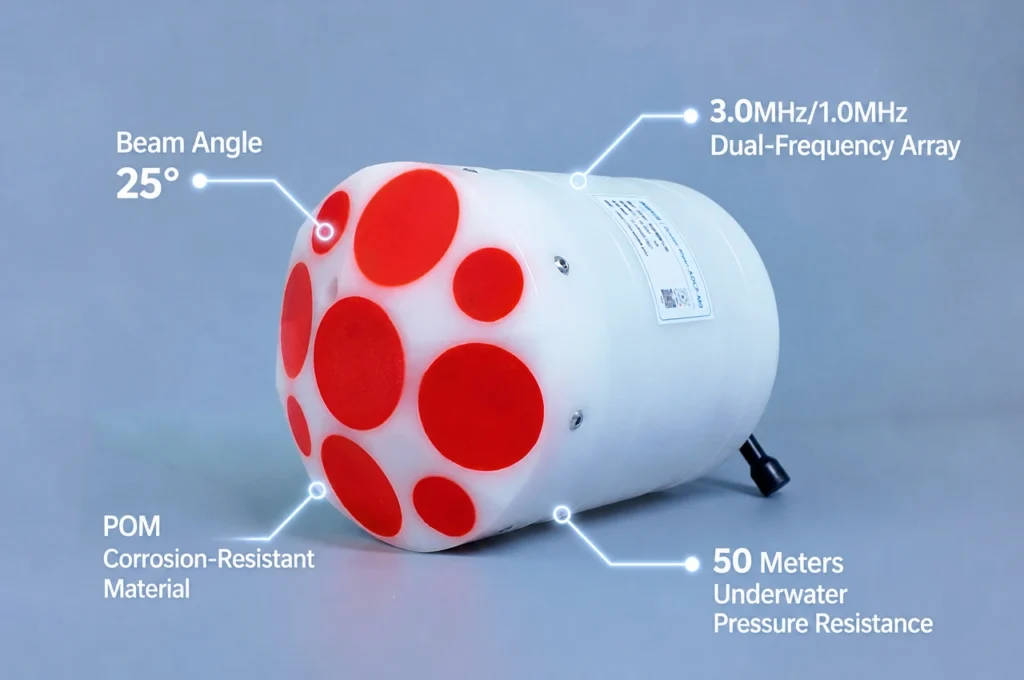
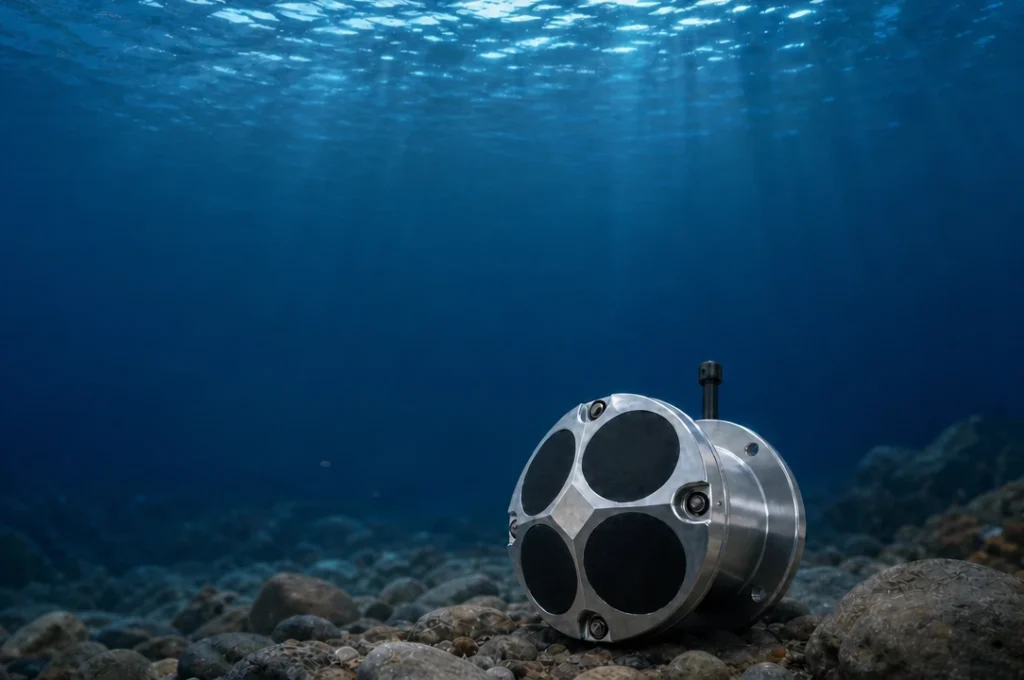
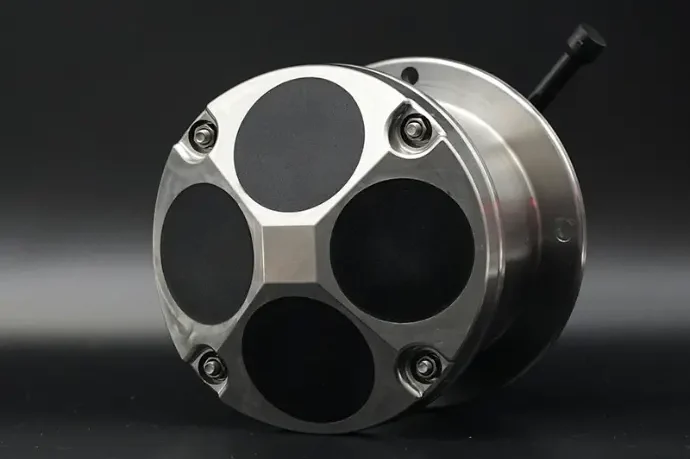
Run built-in diagnostics before and during measurements, perform the beam-alignment test as required by the standard and your programme, send the instrument for periodic major service by the manufacturer, and keep a record of every check. A discharge measurement without instrument-check records is difficult to defend in any review.
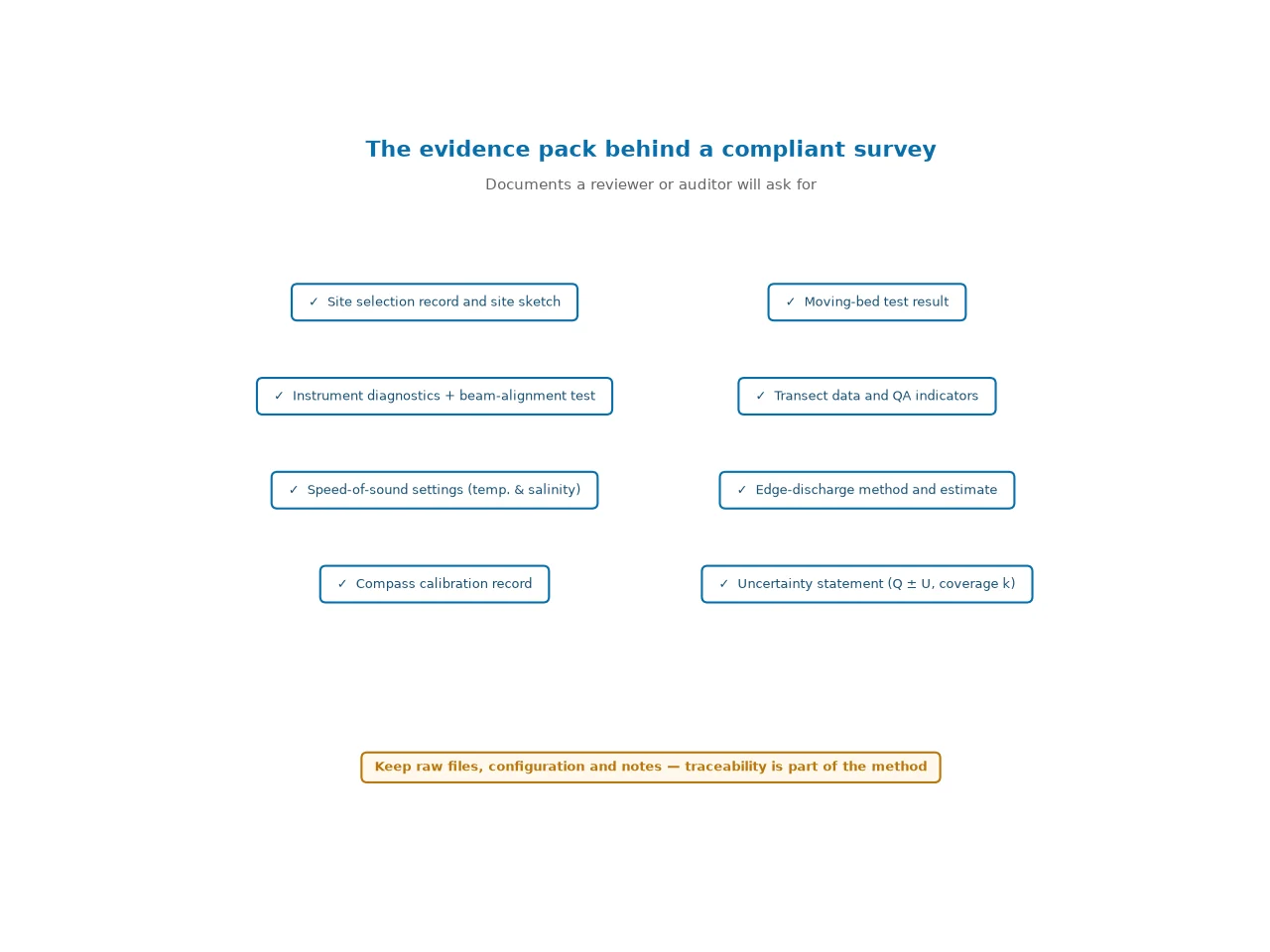
12. What documentation should I keep for an auditable measurement?
- site selection record and a site sketch;
- instrument diagnostics and beam-alignment test results;
- speed-of-sound settings (temperature and salinity) and compass calibration;
- moving-bed test result;
- raw and processed transect files with QA indicators;
- the edge-discharge method and estimate;
- the uncertainty statement with its coverage factor.
Our instrument consistency test reports show the kind of documented performance evidence that supports this pack.
Why surveys fail review
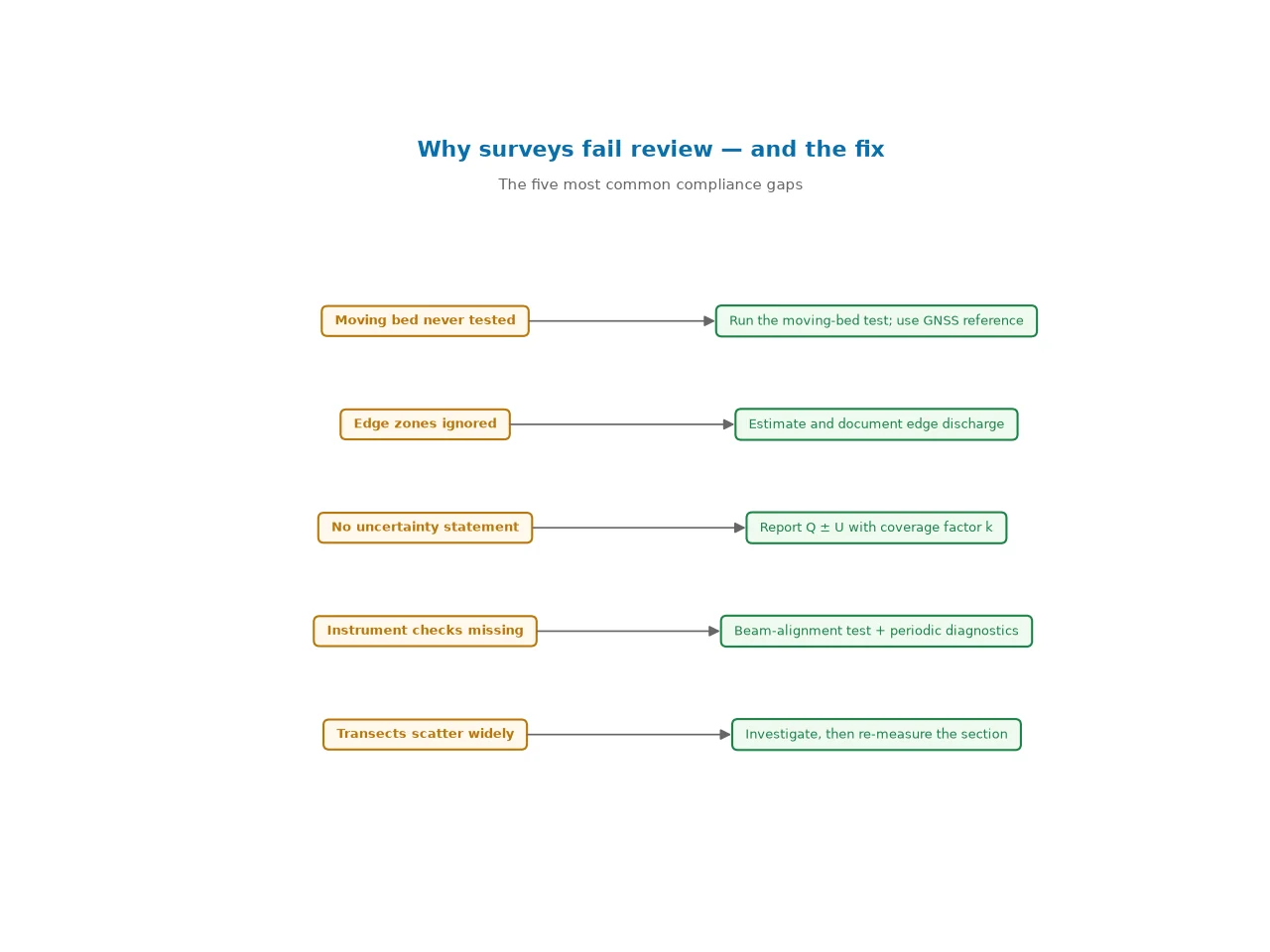
In review, surveys rarely fail because of the instrument. They fail because a step was skipped or undocumented: a moving bed that was never tested, edge zones that were ignored, an uncertainty statement that was never produced, instrument checks that were not recorded, or transects that scattered so widely the measurement should have been repeated.
This FAQ is provided for general information and does not replace the official standards and manuals, which you should obtain and follow for regulated or contractual measurement work.