Executive summary
If you measure river flow with an ADCP, four documents define the professional landscape: ISO 748:2021 (velocity-area methods), ISO 24578:2021 (moving-boat ADCP), USGS TM 3-A22 (US field practice) and the WMO Manual on Stream Gauging (No. 519). This guide explains what each one covers, how they relate to each other, and how to choose the right reference for your project — plus the supporting standards (ISO 25377, ISO 18365) you will meet along the way.
Contents
- Why discharge measurement standards exist
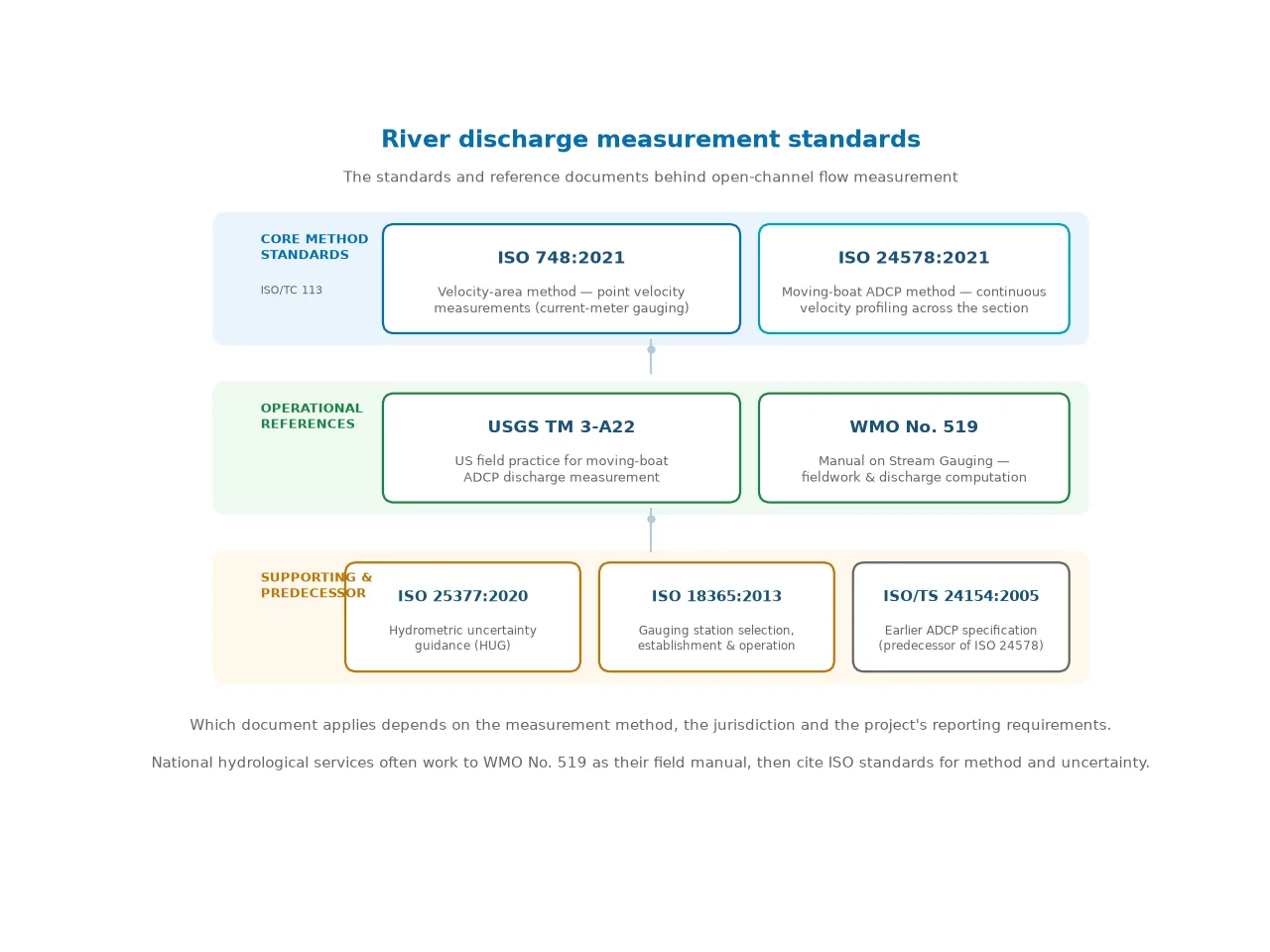
- The standards landscape at a glance
- ISO 748:2021 — the velocity-area method
- ISO 24578:2021 — the moving-boat ADCP standard
- USGS TM 3-A22 — American field practice
- WMO Manual on Stream Gauging (No. 519)
- Supporting standards you will meet
- Which standard should you use?
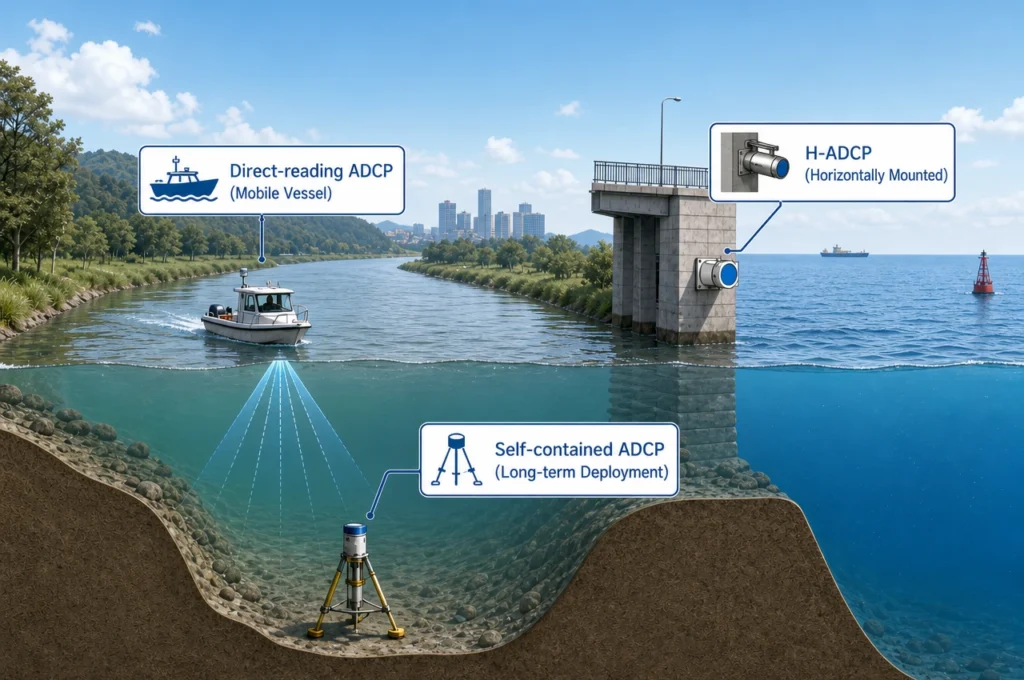
- What this means for your equipment
- FAQ
Why discharge measurement standards exist
If you measure river flow for a living, someone will eventually ask you a simple question with a complicated answer: “Which standard are you following?”
The question matters. Discharge data feeds flood warnings, water allocation, dam operations and environmental compliance. When agencies, consultants and contractors compare numbers across years, basins and borders, they need a shared, defensible method. That is what hydrometric standards provide. Standards do three jobs:
- Make measurements comparable. A discharge number is only useful if the next team can reproduce it with the same assumptions and procedures.
- Control uncertainty. Standards tell you where errors come from — instruments, cross-section geometry, operator technique — and how to quantify them.
- Protect public safety and decisions. Flood forecasts, dam releases and water rights are only as reliable as the flow data behind them.
For hydrologists, compliance is often a contractual requirement: tenders for hydrological surveys routinely cite ISO 748 or equivalent national standards. Knowing the standard you are working to is part of doing the job, not an extra.
The standards landscape at a glance
| Standard | Year | What it covers | Typical use |
|---|---|---|---|
| ISO 748 | 2021 (5th ed.) | Velocity-area methods using point velocity measurements in open channels | Conventional current-meter gauging |
| ISO 24578 | 2021 (1st ed.) | Acoustic Doppler profiler method for measuring flow in open channels from a moving boat | Moving-boat ADCP discharge surveys |
| ISO/TS 24154 | 2005 | Early technical specification for measuring river velocity and discharge with ADCPs | Historical reference |
| ISO 25377 | 2020 | Hydrometric uncertainty guidance (HUG) | Uncertainty estimation for any hydrometric method |
| ISO 18365 | 2013 | Selection, establishment and operation of a gauging station | Permanent station design and maintenance |
| USGS TM 3-A22 | 2009 (ver. 2.0, 2013) | US field guidance for measuring discharge with ADCPs from a moving boat | USGS and US water-resource agencies |
| WMO No. 519 | 1980 (updated) | Manual on Stream Gauging — fieldwork and discharge computation | International hydrological programmes |
ISO 748:2021 — the velocity-area method
ISO 748 is the workhorse standard for open-channel flow measurement. Its full title tells you what it does: “Hydrometry — Measurement of liquid flow in open channels — Velocity area methods using point velocity measurements.” The 2021 edition is the fifth; it is maintained by ISO/TC 113, the ISO technical committee for hydrometry.
The method works like this:
- Select a suitable gauging section with stable, well-defined banks and as uniform a bed as possible.
- Measure the cross-section geometry (width, depth, area).
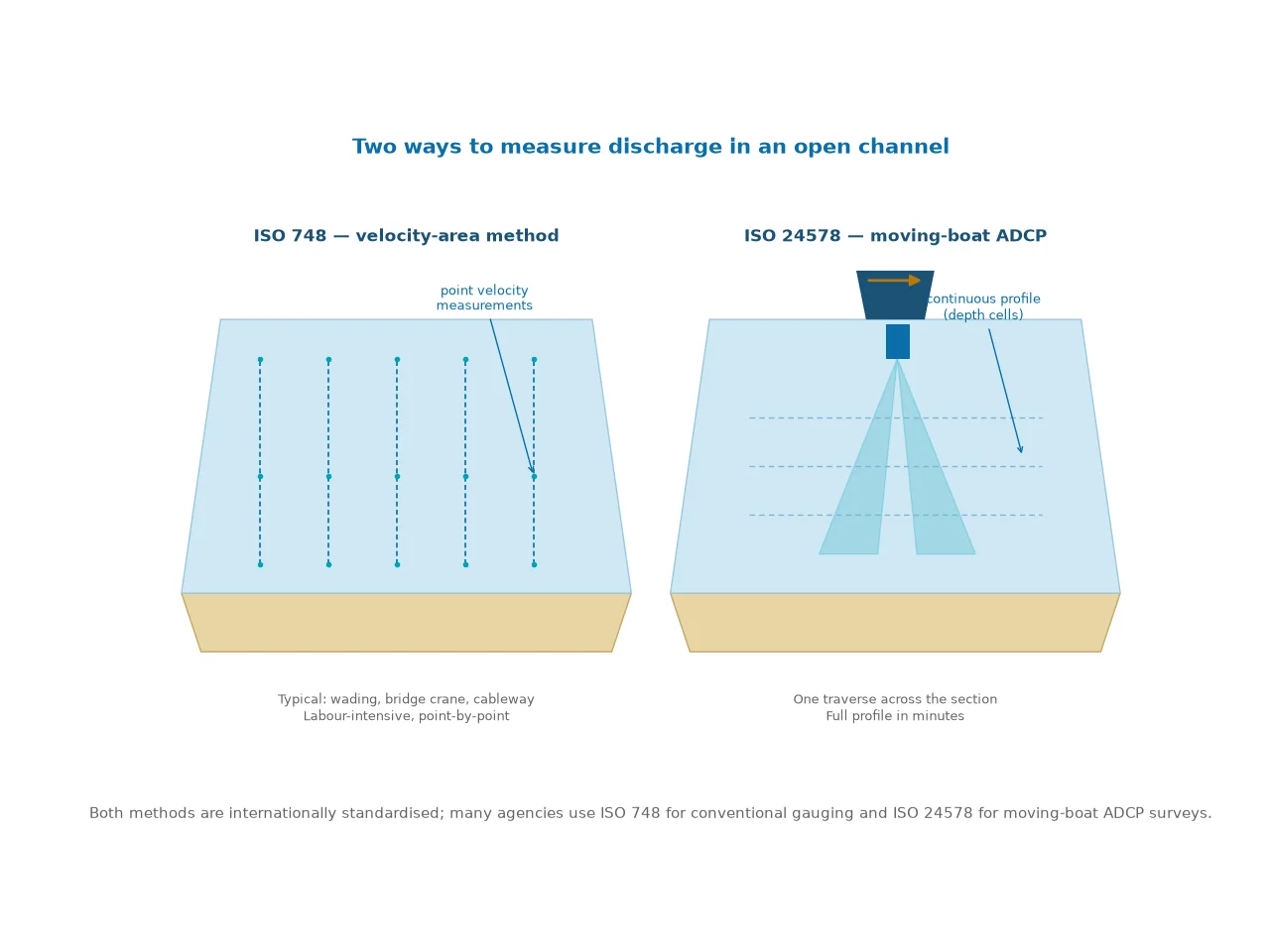
- Measure point velocities at defined positions across the section, using a current meter or an equivalent instrument.
- Integrate the velocity field across the section to compute discharge.
ISO 748 also covers site selection, the number and spacing of verticals, measurement duration, and how to handle moving-bed or unsteady-flow conditions. If you are doing conventional current-meter gauging — wading, bridge crane, or cableway — ISO 748 is the reference.
ISO 24578:2021 — the moving-boat ADCP standard
For ADCP users, ISO 24578 is the most important document in this list. Its title: “Hydrometry — Acoustic Doppler profiler — Method and application for measurement of flow in open channels from a moving boat.”
Published in March 2021 as the first edition, ISO 24578 formalises the moving-boat ADCP technique that has been used in operational hydrometry since the 1990s. It specifies:
- principles of the boat-mounted ADCP method, including the Doppler measurement principle;
- site selection criteria for moving-boat ADCP surveys;
- field procedures for measuring velocity and discharge while the boat traverses the section;
- quality-control checks, including moving-bed detection and bottom-track versus GPS-referenced navigation;
- treatment of unmeasured top and bottom zones (the blank and side-lobe regions);
- reporting of results and associated uncertainties.
ISO 24578 does not replace ISO 748; it complements it for the ADCP case. Teams that measure large rivers from boats — where wading or cranes are impractical — typically work to ISO 24578 and reference ISO 748 for the velocity-area framework.
USGS TM 3-A22 — American field practice
In the United States, the reference for moving-boat ADCP discharge measurement is USGS Techniques and Methods 3-A22, “Measuring Discharge with Acoustic Doppler Current Profilers from a Moving Boat” (2009; version 2.0 in 2013). Authored by USGS scientists, it is used by USGS field offices and many US water-resource agencies, consultants and universities.
TM 3-A22 covers:
- instrument setup and configuration;
- moving-boat measurement procedures;
- moving-bed and edge (unmeasured-zone) estimation;
- quality-assurance and uncertainty guidance;
- software processing and data review.
US projects, FEMA studies and many state and municipal contracts expect TM 3-A22 procedures. If you work with US agencies, use TM 3-A22 as your field manual and ISO 24578 for international comparability — the two are highly consistent in approach.
WMO Manual on Stream Gauging (No. 519)
The World Meteorological Organization’s Manual on Stream Gauging (WMO No. 519) is the international field manual for hydrological services. First released in 1980 and updated since, it comes in two volumes:
- Volume I: Fieldwork — gauge height, stream velocity and stream discharge measurement, including current-meter and ADCP techniques;
- Volume II: Computation of discharge — the stage-discharge (rating) relationship and its maintenance.
National hydrological services, river basin organisations and international projects (UN agencies, development banks) frequently work to WMO No. 519. It sits alongside the Guide to Hydrological Practices (WMO No. 168), which describes the broader institutional and network context.
Supporting standards you will meet
Two more standards are worth knowing because they appear in the same project documents:
- ISO 25377:2020 — Hydrometric uncertainty guidance (HUG). HUG explains how to evaluate and report uncertainty in hydrometric measurements. Discharge numbers without uncertainty statements are increasingly unacceptable in regulated work. HUG gives you the framework to produce them.
- ISO 18365:2013 — Selection, establishment and operation of a gauging station. If your project involves a permanent station (stage, stage-discharge, or direct discharge measurement), ISO 18365 sets the requirements for site selection, equipment and maintenance.
Which standard should you use?
| Situation | Primary reference |
|---|---|
| Wading or bridge current-meter gauging | ISO 748:2021 |
| Moving-boat ADCP survey, international context | ISO 24578:2021 |
| Moving-boat ADCP survey, US agencies or contracts | USGS TM 3-A22 |
| National hydrological service, international programme | WMO No. 519 |
| Quantifying and reporting measurement uncertainty | ISO 25377:2020 |
| Designing a permanent gauging station | ISO 18365:2013 |
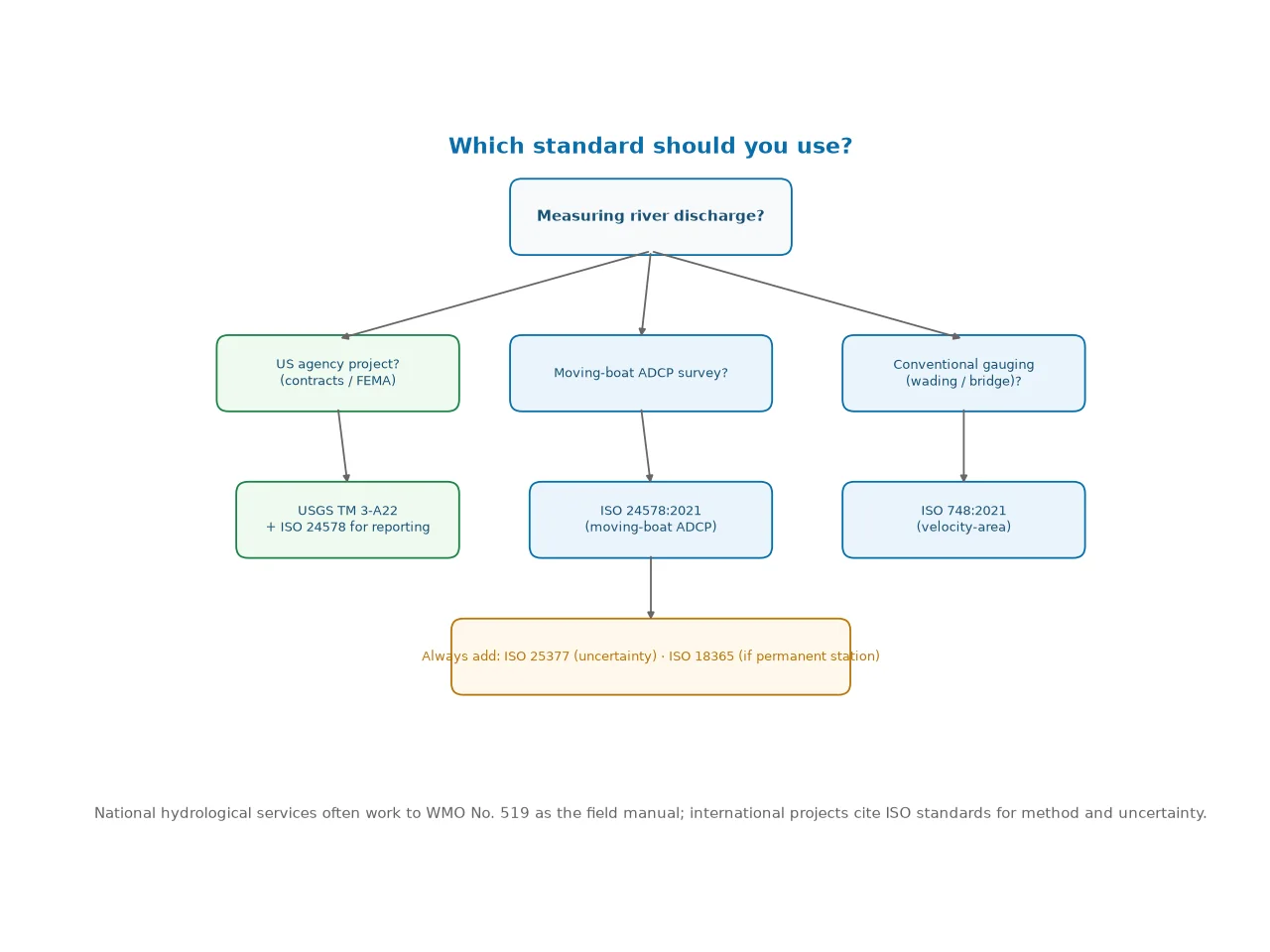
In practice, a well-run project uses several: ISO 24578 for the ADCP method, ISO 25377 for uncertainty, and a national field manual for day-to-day procedure.
What this means for your equipment
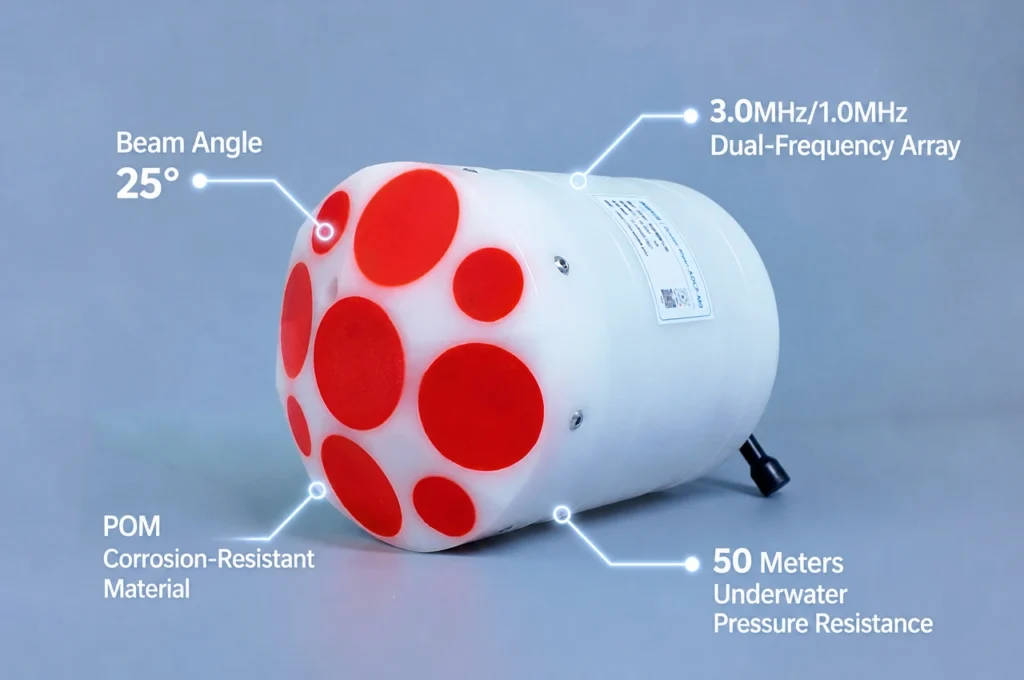
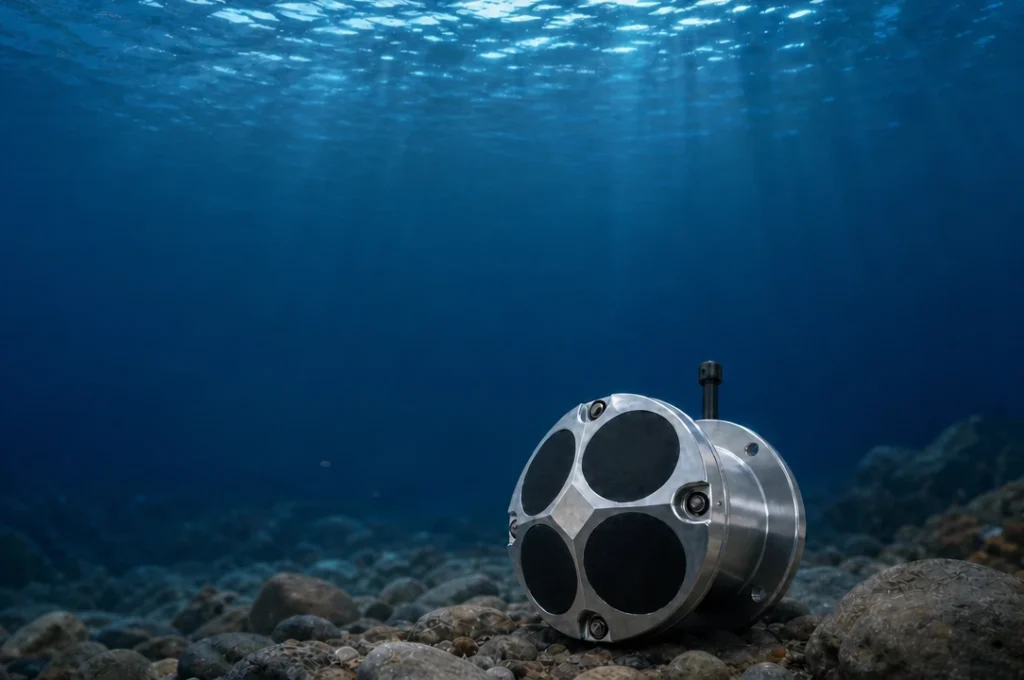
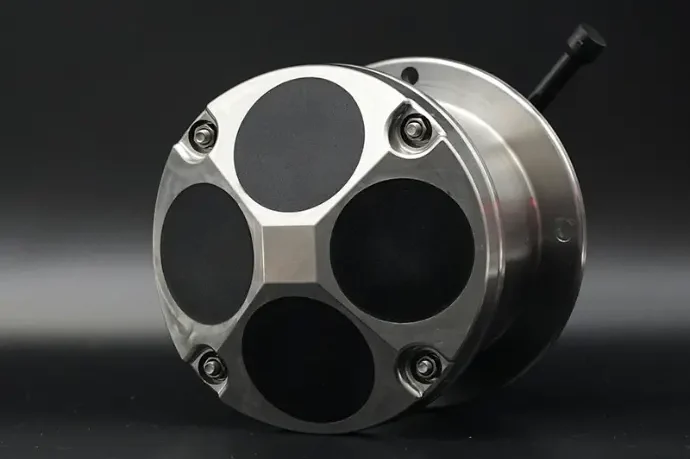
Standards describe methods, not instruments. An ADCP is neither “ISO 24578 certified” nor “ISO 748 compliant” in the certification sense — compliance is achieved by how the instrument is deployed, configured and processed. What manufacturers can do is design instruments that make compliant surveys practical:
- beam configurations suited to velocity-area and moving-boat methods (for example, 4-, 5- and 9-beam systems);
- GPS/bottom-track integration for navigation and moving-bed detection;
- software that follows standard processing conventions and reports uncertainty;
- rugged, field-proven hardware for long deployments.
At Oceantek we build ADCPs and DVLs with exactly this in mind. Our River ADCP M9 9-beam system and HADCP-600 horizontal profiler are designed for standard-based river discharge work, and our team publishes field test reports that document performance under real conditions.
FAQ
Is ISO 24578 the same as ISO 748?
No. ISO 748 covers velocity-area methods using point velocity measurements (typically current meters); ISO 24578 covers the moving-boat ADCP method.
Is my ADCP survey “ISO compliant”?
Compliance depends on your survey procedure — site selection, configuration, processing and uncertainty reporting — not on the instrument alone. Follow the relevant standard’s field procedures and document them.
Which standard do US federal projects require?
USGS and many US agencies follow TM 3-A22 for moving-boat ADCP discharge measurements; check the specific contract or agency manual for your project.
What is the difference between ISO/TS 24154 and ISO 24578?
ISO/TS 24154:2005 was the earlier ADCP technical specification; ISO 24578:2021 is the current international standard for the moving-boat ADCP method.
Do I need to buy the standards to use them?
The official texts are copyrighted and must be purchased from ISO, USGS or WMO. This guide summarises the landscape for orientation; always consult the official documents for regulated or contractual measurement work.
This guide is provided for general information and does not replace the official standards, which you should obtain and follow for any regulated or contractual measurement work.
© 2026 Ocean (Hangzhou) Technology Co., Ltd.,All rights reserved. All rights reserved. Last updated: August 28, 2026.