Executive summary
ISO 25377:2020 — the Hydrometric uncertainty guidance, or HUG — is the international framework for evaluating and reporting uncertainty in hydrometric measurements. Built on the GUM (ISO/IEC Guide 98-3), it shows how to quantify and combine the random and systematic effects that affect water level, velocity and discharge measurements. Whether you gauge with current meters, ADCPs, weirs or dilution, HUG is the common language that makes your numbers comparable and defensible.
Contents
- What is ISO 25377 (HUG)?
- Why uncertainty matters in hydrometry
- The standard at a glance
- The GUM foundation
- HUG for velocity-area discharge
- HUG for structures and dilution methods
- Instrumentation and manufacturer specifications
- Drafting uncertainty clauses
- Worked examples
- Advanced tools: MCS, IVE and stage-discharge
- How to report uncertainty
- HUG and the ISO 748 / ISO 24578 family
- Working to HUG: a practical checklist
- What this means for equipment
- FAQ
What is ISO 25377 (HUG)?
ISO 25377:2020 — Hydrometric uncertainty guidance (HUG) — explains how to evaluate and express the uncertainty of hydrometric measurements: water level, current velocity, discharge, sediment and more. It began life as the technical specification ISO/TS 25377:2007 and was elevated to a full international standard in 2020, prepared by ISO/TC 113, Hydrometry.
HUG does not replace the method standards. ISO 748 tells you how to measure discharge by the velocity-area method; ISO 24578 does the same for moving-boat ADCPs. HUG sits above them: it provides the consistent framework each method uses to quantify uncertainty, so results from different instruments, teams and countries can be compared honestly.
You can view or purchase the official text from the ISO catalogue page for ISO 25377:2020.
Why uncertainty matters in hydrometry
Every discharge number is an estimate. The question is not whether it is exact — it is not — but how far it might be from the truth, and whether that is good enough for the decision it supports:
- a flood warning threshold may be 0.5 m from the forecast water level;
- a water-allocation or dam-releases agreement may hinge on flows within a few percent;
- a rating curve used for years inherits uncertainty from every gauging that built it.
Without an uncertainty statement, a number like “185 m³/s” implies a precision it does not have. With one — “185 m³/s ± 6 % (k = 2)” — every user knows what the measurement is actually worth. Regulators, banks and international programmes increasingly require exactly this.
The standard at a glance
| Chapter | What it covers |
|---|---|
| 1–4 | Scope, normative references, terms & definitions, symbols |
| 5 | The GUM foundation — sets of measurements, random and systematic effects, distributions, law of propagation of uncertainties, expressing results |
| 6 | Velocity-area methods — mean velocity, discharge calculation, measurement uncertainty, integration, horizontal scanning and perimeter flow uncertainties |
| 7 | Critical-depth (structure) methods — weirs and flumes: head and geometry, iterative calculation, evaluating uncertainty |
| 8 | Dilution methods — continuous feed and transient mass (gulp) techniques |
| 9 | Hydrometric instrumentation — performance specifications and the validity of uncertainty statements |
| 10 | Guide for drafting uncertainty clauses in hydrometric standards |
| 11 | Worked examples — water level sensors, flow structures and current-meter gauging |
| Annex A | Introduction to hydrometric uncertainty |
| Annex B | Introduction to Monte Carlo simulation (MCS) |
| Annex C | Interpolated variance estimation (IVE) method |
| Annex D | Performance guide for hydrometric equipment |
| Annex E | Uncertainty analysis of the stage-discharge relation |
| Annex F | Measurement of velocity |
The GUM foundation
Chapter 5 translates the general framework of the GUM — the Guide to the expression of uncertainty in measurement (ISO/IEC Guide 98-3) — into hydrometry:
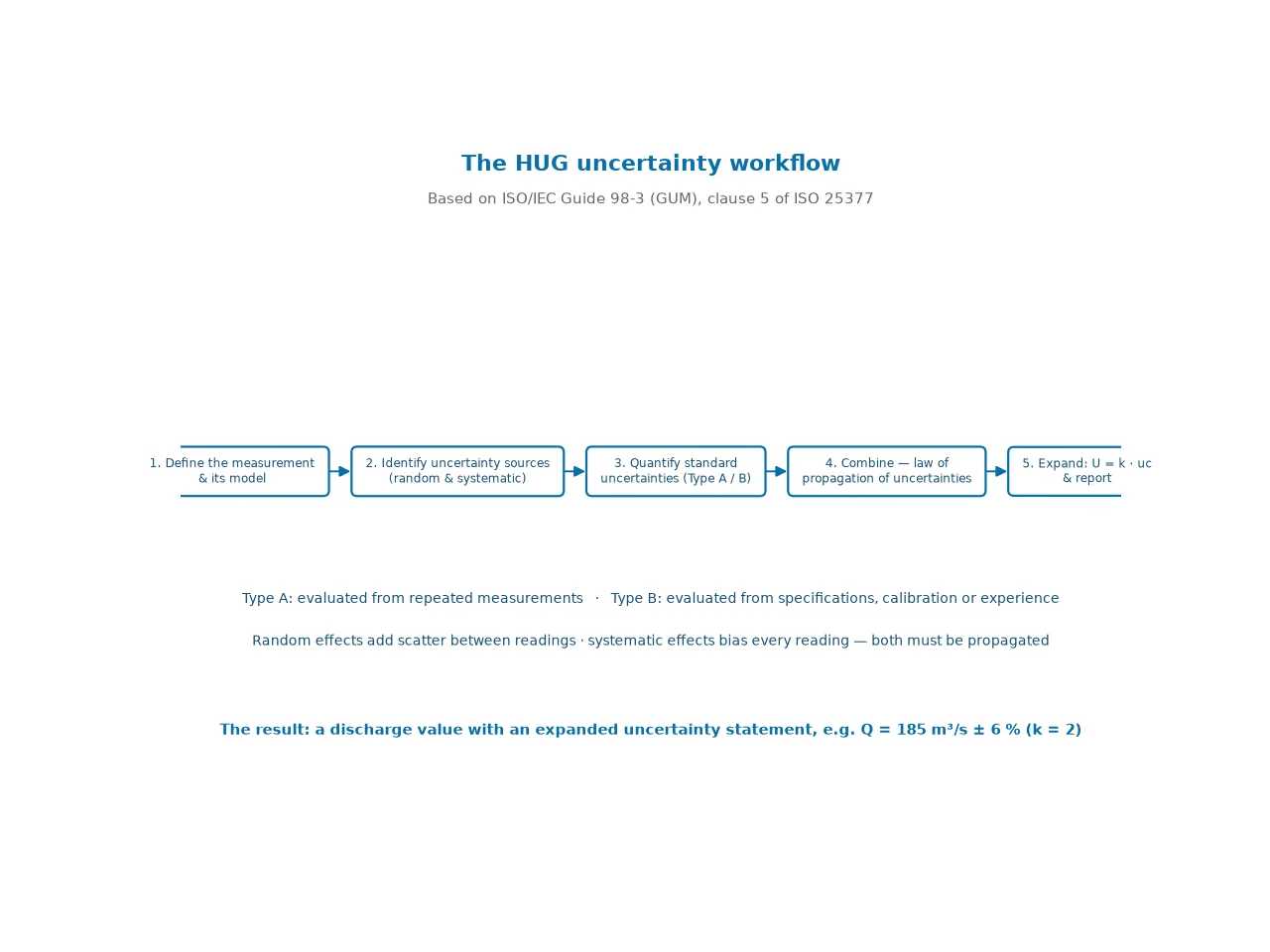
- Random and systematic effects (5.3) — random effects add scatter between readings; systematic effects bias every reading in the same direction. Both must be propagated into the result.
- Probability distributions (5.4) — each uncertainty source is modelled by a distribution (normal, rectangular, triangular…) appropriate to what is known about it.
- Law of propagation of uncertainties (5.5) — standard uncertainties are combined in quadrature to give the combined standard uncertainty.
- Expressing results (5.6) — the combined value is expanded by a coverage factor k (typically 2, about 95 % confidence) to give the expanded uncertainty you report.
HUG for velocity-area discharge
Chapter 6 applies the framework to the method most hydrologists use — the velocity-area method of ISO 748:
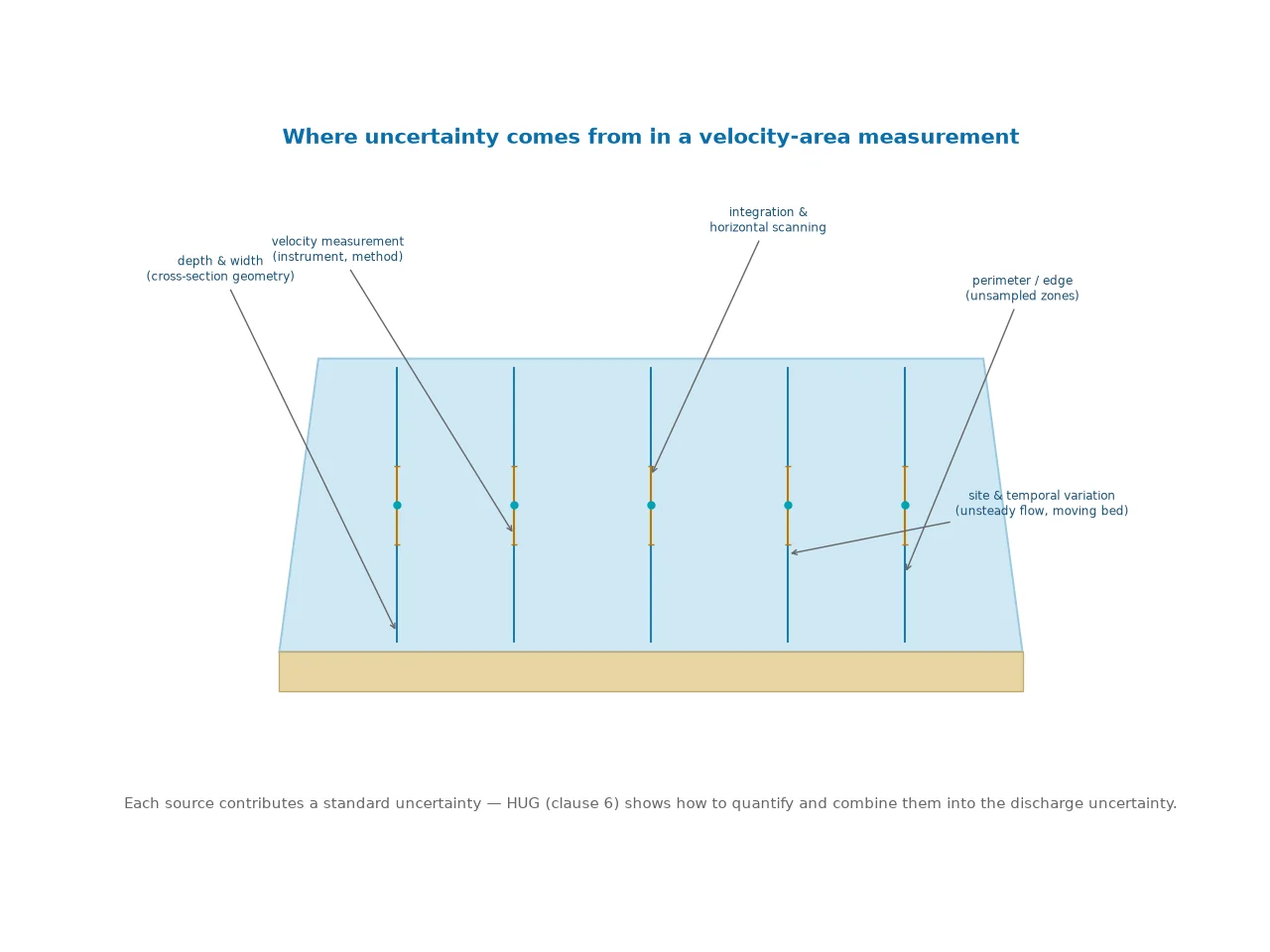
- Mean velocity (6.2) and the velocity-area discharge calculation (6.3);
- Measurement of velocity (6.4) — instrument and method contributions;
- Uncertainty of the velocity-area method (6.5) — split into random and systematic effects;
- Integration uncertainties (6.6) — including vertical integration and horizontal scanning (6.6.3);
- Perimeter flow uncertainties (6.7) — the unsampled edge and boundary zones.
For ADCP users, the same logic carries into ISO 24578‘s uncertainty chapter and HUG’s measurement-of-velocity annex (Annex F).
HUG for structures and dilution methods
HUG is not only for velocity-area gauging:
- Critical-depth (structure) methods (Chapter 7) — weirs and flumes where discharge is computed from head and geometry. HUG covers head and geometry determination, iterative calculation and uncertainty evaluation.
- Dilution methods (Chapter 8) — tracer dilution gauging by continuous feed or transient (gulp) injection, with their own uncertainty treatment.
Instrumentation and manufacturer specifications
Chapter 9 tackles a practical question: how much can you trust a manufacturer’s accuracy statement? HUG asks instrument suppliers to state performance in terms that feed directly into an uncertainty budget, and it warns that published specifications are only valid when the instrument is used as specified and properly maintained.
For buyers, this is a powerful checklist: does the supplier’s specification tell you what it contributes to your measurement uncertainty, in a form you can combine? Annex D provides a performance guide for hydrometric equipment to support exactly that.
Drafting uncertainty clauses
Chapter 10 guides the drafting of uncertainty clauses in hydrometric standards — helping future standards say precisely what they mean about uncertainty, and helping users interpret the clauses they read. It distinguishes equipment, methods and measurement systems (10.2).
Worked examples
Chapter 11 is where HUG becomes concrete. The worked examples include:
- Water level measurement — a float/shaft-encoder sensor in a stilling well versus a pressure transmitter in a tube (11.2);
- Flow measurement structures (11.3);
- Current-meter gauging (11.4) — a complete velocity-area uncertainty budget.
These examples are an excellent starting point for building your own uncertainty spreadsheet.
Advanced tools: MCS, IVE and stage-discharge
Three annexes extend the analytical approach:
- Annex B — Monte Carlo simulation (MCS): propagate distributions numerically when the measurement model is too complex for the analytical GUM approach.
- Annex C — Interpolated variance estimation (IVE): estimate variance directly from repeated field measurements, a practical alternative for moving-boat and integration methods.
- Annex E — Stage-discharge relation: how uncertainty in individual gaugings propagates into the rating curve used for continuous records.
How to report uncertainty
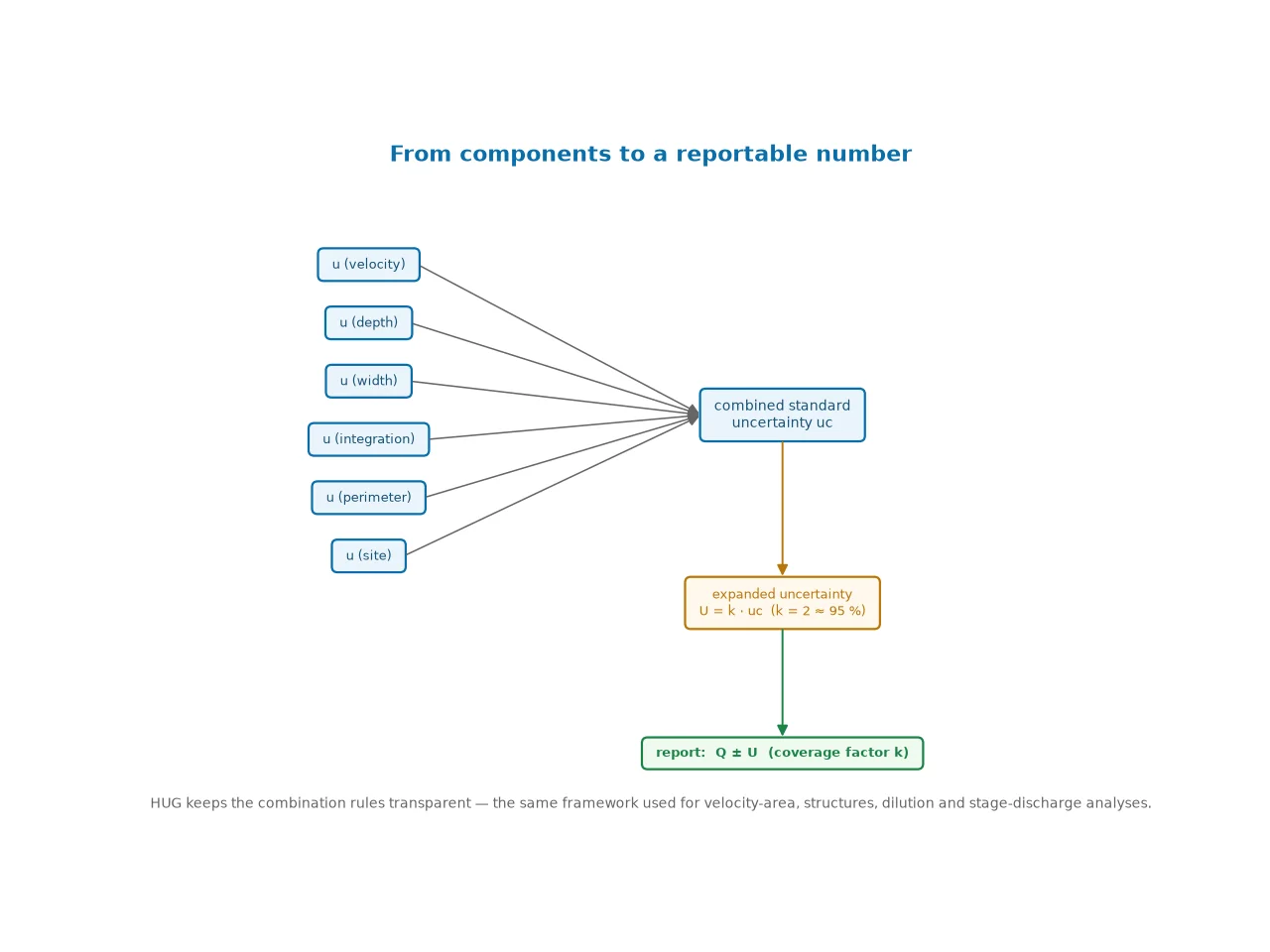
A defensible uncertainty statement has three parts: the value, the expanded uncertainty, and the coverage factor — for example Q = 185 m³/s ± 6 % (k = 2). HUG’s rules ensure the ±6 % was derived the same way your partner agency would derive theirs.
HUG and the ISO 748 / ISO 24578 family
| Document | Role | Where uncertainty appears |
|---|---|---|
| ISO 24578:2021 | Moving-boat ADCP discharge method | Chapter 8 + Annex F of that standard |
| ISO 748:2021 | Velocity-area discharge method | Chapter 9 + Annex D of that standard |
| ISO 25377:2020 (HUG) | Overarching uncertainty framework | The whole standard — the common language |
Think of it as: ISO 748 and ISO 24578 define how to measure; HUG defines how much to trust the result — and how to say so.
Working to HUG: a practical checklist
| Phase | Key actions |
|---|---|
| Plan | Write down the measurement model (e.g., velocity-area discharge equation); list every contributing quantity. |
| Quantify | Assign each source a standard uncertainty (Type A from repeats, Type B from calibration/specifications); check manufacturer statements against clause 9. |
| Combine & report | Propagate by the GUM rules (or MCS/IVE for complex cases); expand with k; report value ± expanded uncertainty (k), per the Chapter 11 examples. |
| Maintain | Re-evaluate when instruments change, ratings shift or procedures evolve; document everything for audit. |
What this means for equipment
HUG puts the spotlight on specifications you can use. When we design ADCPs and DVLs at Oceantek, we aim for performance that is stated in terms engineers can feed into an uncertainty budget — instrument accuracy, mounting effects, and documented field performance — rather than vague marketing numbers.
If you are building a gauging programme, our River ADCP M9 and HADCP-600 are designed for standard-based discharge work, and our team can help you interpret their specifications in an uncertainty framework. Start with our standards overview to see where each document fits.
FAQ
What is ISO 25377 (HUG)?
ISO 25377:2020, Hydrometric uncertainty guidance (HUG), is the international standard for evaluating and reporting uncertainty in hydrometric measurements such as water level, velocity and discharge, built on the GUM framework.
What does HUG stand for?
Hydrometric Uncertainty Guidance. It began as ISO/TS 25377:2007 and became the full international standard ISO 25377:2020.
How does HUG relate to ISO 748 and ISO 24578?
ISO 748 and ISO 24578 describe how to measure discharge and include their own uncertainty guidance. ISO 25377 provides the overarching framework that keeps method-specific uncertainties consistent and comparable.
What is expanded uncertainty and the coverage factor k?
Expanded uncertainty U = k × uc, where uc is the combined standard uncertainty and k is the coverage factor (typically 2, ≈95 % confidence). Reporting U with k is what makes discharge numbers comparable.
Do I need Monte Carlo simulation to use HUG?
No. The analytical GUM approach is the baseline. Monte Carlo simulation (Annex B) is an option for complex models, and IVE (Annex C) is an alternative built on field data.
This guide is provided for general information and does not replace the official standard, which you should obtain from ISO and follow for any regulated or contractual measurement work.
© 2026 Ocean (Hangzhou) Technology Co., Ltd.All rights reserved. Last updated: September 3, 2026.