Executive summary
USGS Techniques and Methods 3-A22 — Measuring Discharge with Acoustic Doppler Current Profilers from a Moving Boat (2009; version 2.0 in 2013) — is the reference that USGS field offices and most US water-resource teams follow for moving-boat ADCP discharge measurements. It covers everything from predeployment preparation and instrument tests to moving-bed checks, edge discharge estimation and office data review. If you work on US projects, TM 3-A22 is your field manual — and it is highly consistent with the international standard ISO 24578:2021.
Contents
What is USGS TM 3-A22?
USGS Techniques and Methods 3-A22, Measuring Discharge with Acoustic Doppler Current Profilers from a Moving Boat, is the US Geological Survey’s guidance for streamflow measurement with boat-mounted ADCPs. It was written by USGS scientists — David S. Mueller, Chad R. Wagner, Michael S. Rehmel, Kevin A. Oberg and Francois Rainville — and draws on decades of USGS field experience.
The report is published in the USGS Techniques and Methods series (2009, with version 2.0 in 2013) and is free to download from the USGS Publications Warehouse. It builds on earlier USGS ADCP guidance and is the document most US agencies, consultants and universities treat as the moving-boat field manual.
Why USGS guidance matters
If you measure streamflow for a US agency, a FEMA study, a state or municipal contract, or a university research project, chances are the work is expected to follow TM 3-A22 procedures. The report matters because:
- it turns ADCP field experience into a repeatable, documented method;
- its moving-bed, edge-discharge and data-quality guidance prevents the systematic errors that otherwise bias ADCP measurements;
- it is the common language US teams use to review each other’s work.
For international projects, TM 3-A22 and ISO 24578:2021 describe the same technique in the same way — see our standards overview for where each fits.
Scope and structure at a glance
| Part | What it covers |
|---|---|
| Introduction | Purpose and scope, applications, and how ADCPs differ from mechanical current meters |
| Predeployment preparation | Data management, instrument limitations (sediment, unmeasured areas), configuration, compass, quality assurance, instrument tests, ancillary equipment (GPS, echo sounder), deployment and mounts |
| Field procedures | Site selection, pre-measurement checks (clock, diagnostics, sound speed, compass calibration), moving-bed tests, discharge-measurement procedures, boat operation, edge discharge, field notes |
| Office procedures | Preventive maintenance, data storage, measurement review |
| Data-quality indicators | The QA flags used to judge whether a measurement is acceptable |
| Common problems | Frequently observed measurement problems and how to recognise them |
Predeployment preparation
TM 3-A22 is emphatic that a good measurement starts before you reach the river. The preparation phase covers:
- Data management — file naming conventions, storage and archival so measurements can be traced and reviewed;
- Instrument limitations — how sediment affects the ADCP and which parts of the profile are unmeasured (the blank and side-lobe zones);
- Configuration and compass considerations — correct settings and compass calibration are prerequisites for reliable data;
- Instrument quality assurance — software and firmware procedures, the beam-alignment test and periodic instrument checks;
- Ancillary equipment — GPS requirements and specifications, echo sounder, mounts for manned, tethered and remote-controlled boats.
Field procedures
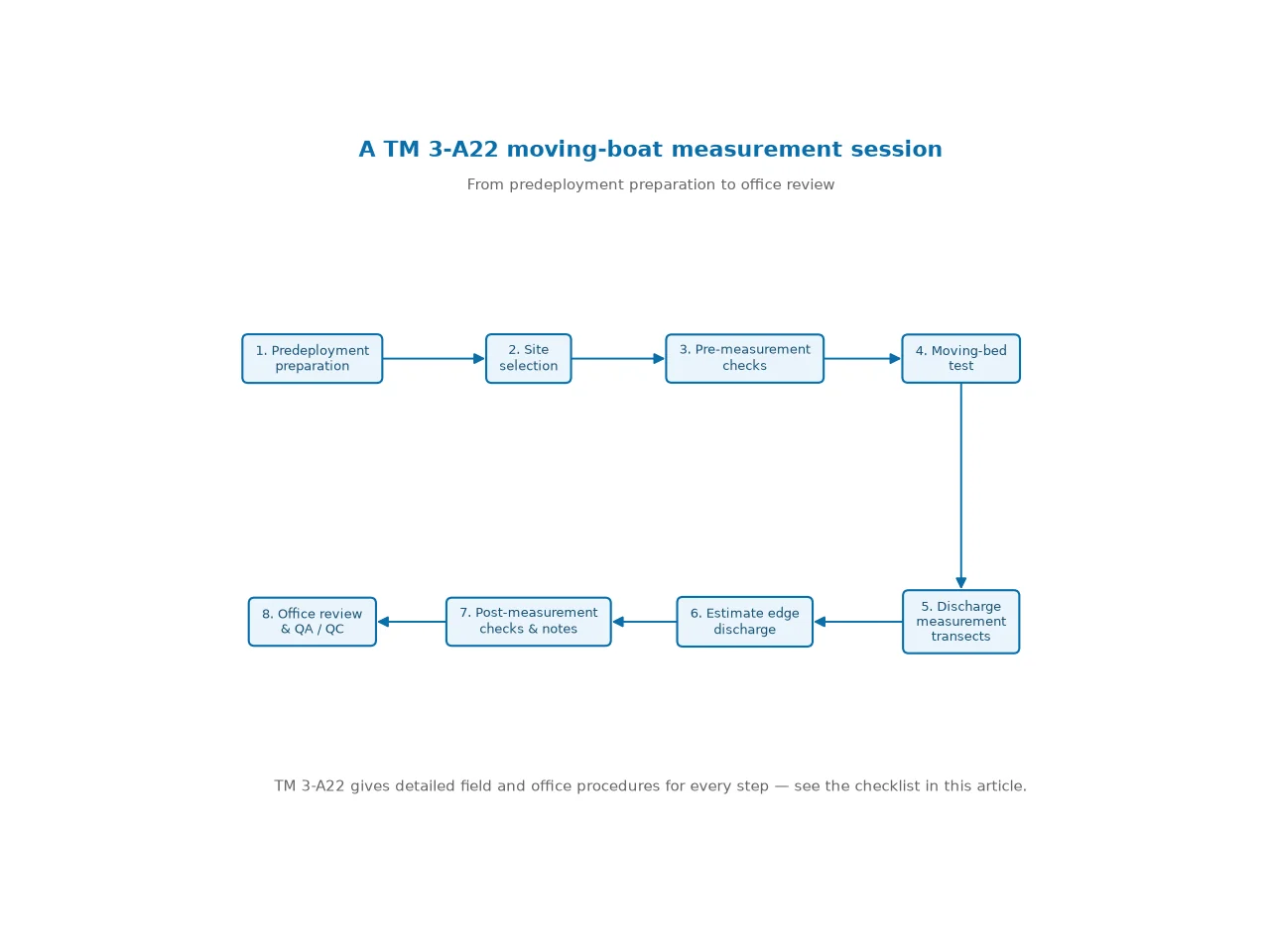
The field phase in TM 3-A22 is highly structured:
- Site selection — a section that is straight, uniform and measurable;
- Pre-measurement checks — set the internal clock, run instrument diagnostics, set the speed of sound from water temperature and salinity, calibrate the compass, configure the instrument;
- Moving-bed tests — before the measurement, check whether the bed is moving (see below);
- Discharge-measurement procedures — transects under steady-flow and unsteady-flow conditions, and how to recognise critical data-quality problems;
- Boat operation and edge discharge — how to drive the transect and how to handle the unsampled banks;
- Field notes and post-measurement checks — document everything before leaving the site.
Moving-bed tests and navigation
An ADCP measures water velocity relative to the boat and boat velocity relative to the bed (bottom-track) or to GPS. If the bed itself is moving — common on sandy, alluvial rivers — bottom-track navigation is biased and so is the discharge.
TM 3-A22’s field procedure therefore includes a moving-bed test before the measurement. If the test shows the bed is moving, the team either switches to a GPS-referenced measurement, corrects for the moving bed, or moves to a more stable section. This mirrors the moving-bed methods in ISO 24578 and is one of the most important quality gates in the whole procedure.
Estimating edge discharge
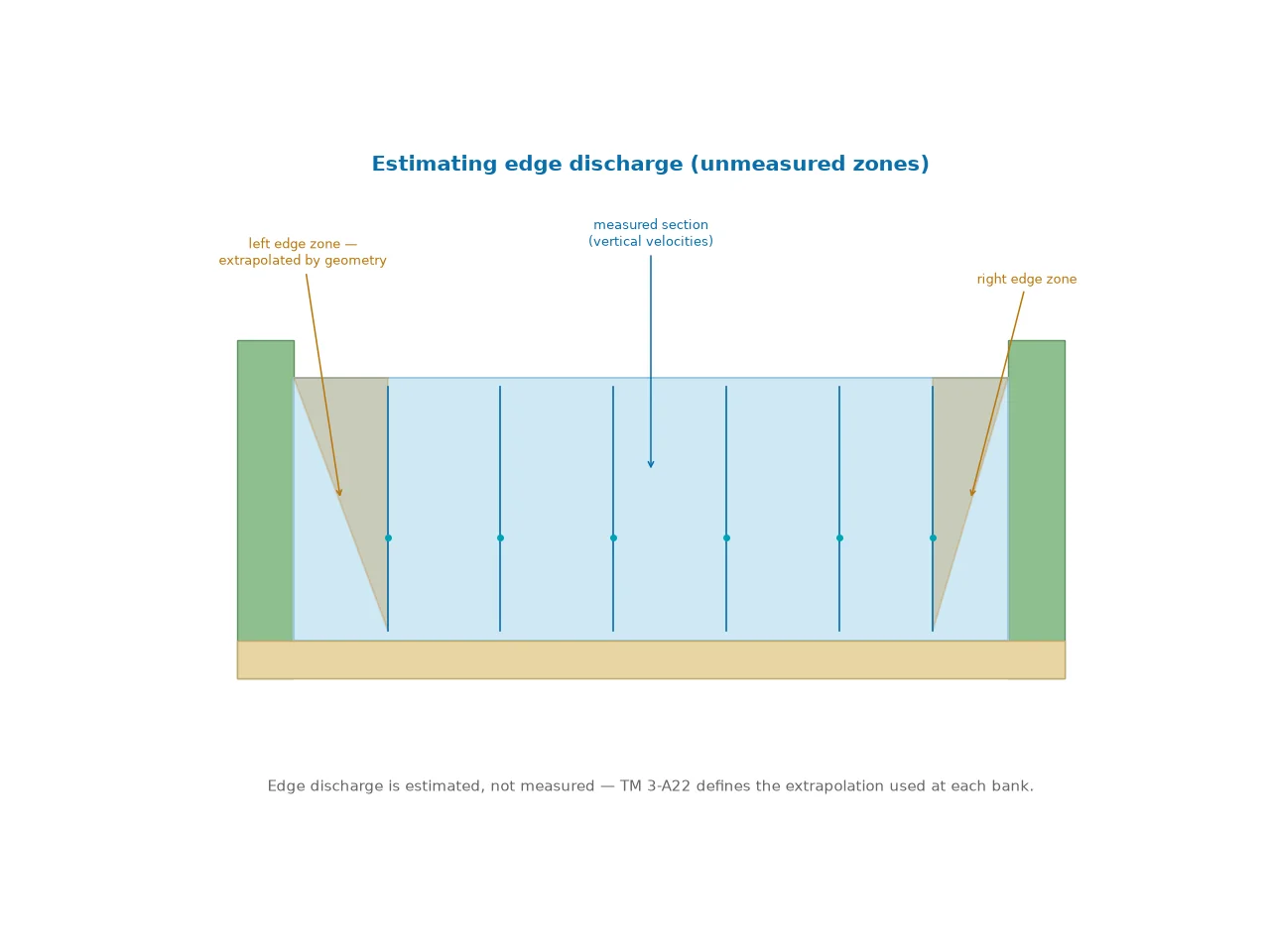
The ADCP cannot measure right up to the banks, so the flow in each edge zone must be estimated. TM 3-A22 defines how the edge discharge is extrapolated from the nearest measured velocities and the channel geometry — the “triangle” of unsampled flow at each bank. Getting the edges wrong matters more than teams expect: on wide rivers with significant shallow margins, edge estimates can be a meaningful share of total discharge.
Office review and data quality
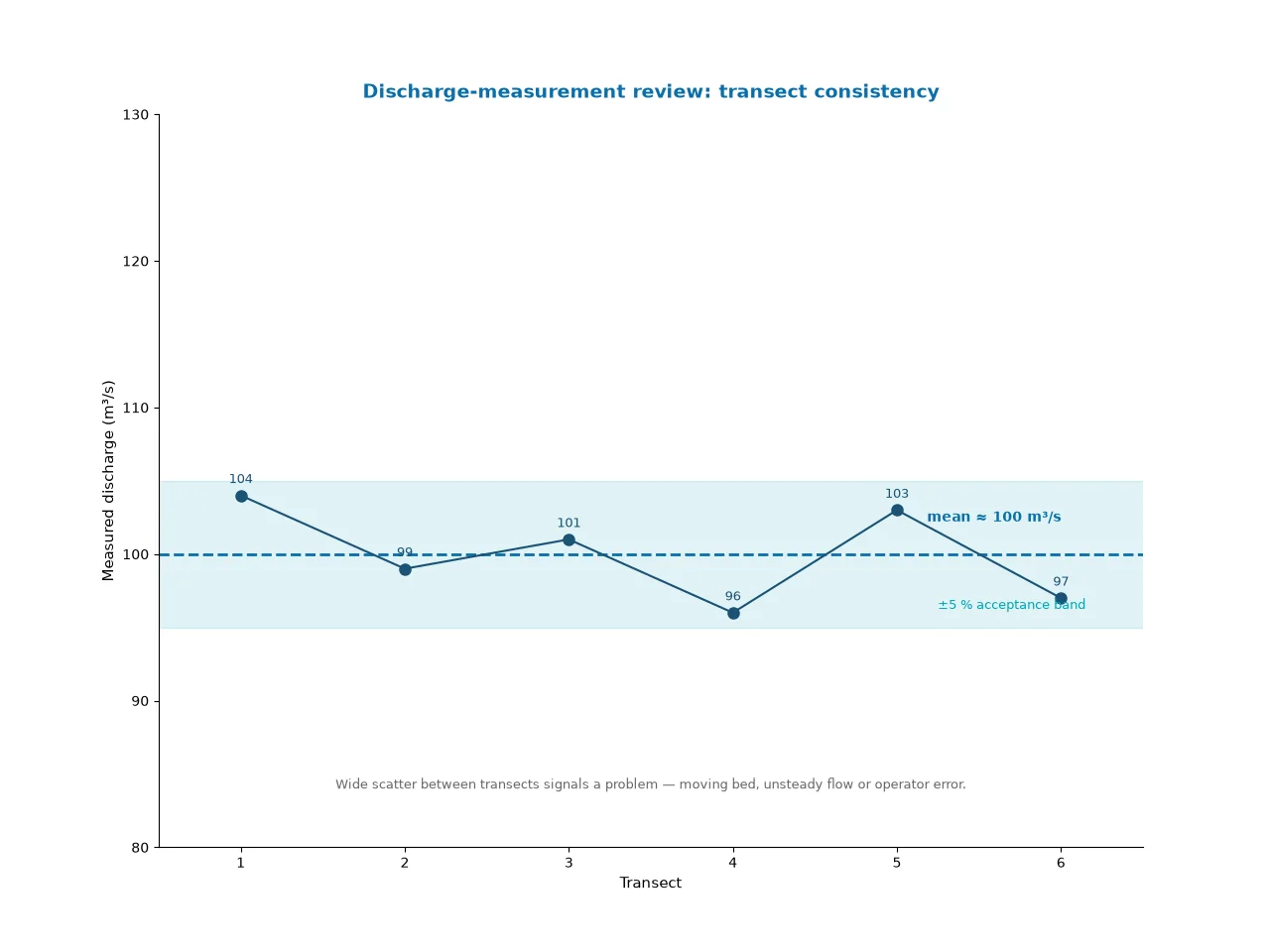
After the field day, TM 3-A22 requires an office phase:
- Preventive maintenance — cleaning and checking the instrument;
- Data storage — archiving raw and processed files under the naming convention;
- Measurement review procedures and data-quality indicators — reviewing transects for consistency, checking quality flags, and deciding whether the measurement is acceptable or must be repeated.
The report’s data-quality indicators and its catalogue of commonly observed measurement problems make it effectively a troubleshooting manual — invaluable for teams training new hydrographers.
TM 3-A22 vs ISO 24578
| USGS TM 3-A22 | ISO 24578:2021 | |
|---|---|---|
| What it is | USGS field manual (public domain, free) | International standard (ISO, purchased) |
| Method | Moving-boat ADCP discharge measurement | Moving-boat ADCP discharge measurement |
| Coverage | Preparation, field, office, QA, common problems | Principles, site selection, deployment, moving-bed, uncertainty |
| Typical use | USGS and US agency projects | International projects and procurement |
| Approach | Highly consistent with ISO 24578 | Highly consistent with TM 3-A22 |
Practical rule: on US projects, follow TM 3-A22 as the field manual; on international tenders, cite ISO 24578. Both are grounded in the same method, and our ISO 24578 guide explains the international side.
A practical field checklist
| Phase | Key actions from TM 3-A22 |
|---|---|
| Before the trip | Review data naming and storage; run diagnostics and the beam-alignment test; check firmware and battery; prepare GPS and echo sounder; inspect mounts. |
| At the site | Select the section; set the clock; run diagnostics; set speed of sound (temperature/salinity); calibrate the compass; configure the ADCP; run the moving-bed test. |
| During measurement | Collect the required transects (steady or unsteady procedures); watch data-quality indicators; drive consistent boat speed and path. |
| After measurement | Estimate and record edge discharge; complete field notes; run post-measurement checks; archive data; review transects and quality flags in the office. |
What this means for equipment
TM 3-A22 demands instruments that support the procedures it describes: reliable bottom-track and GPS navigation, beam configurations suited to moving-boat profiling, configurable depth-cell settings, and documented diagnostics including beam-alignment checks.
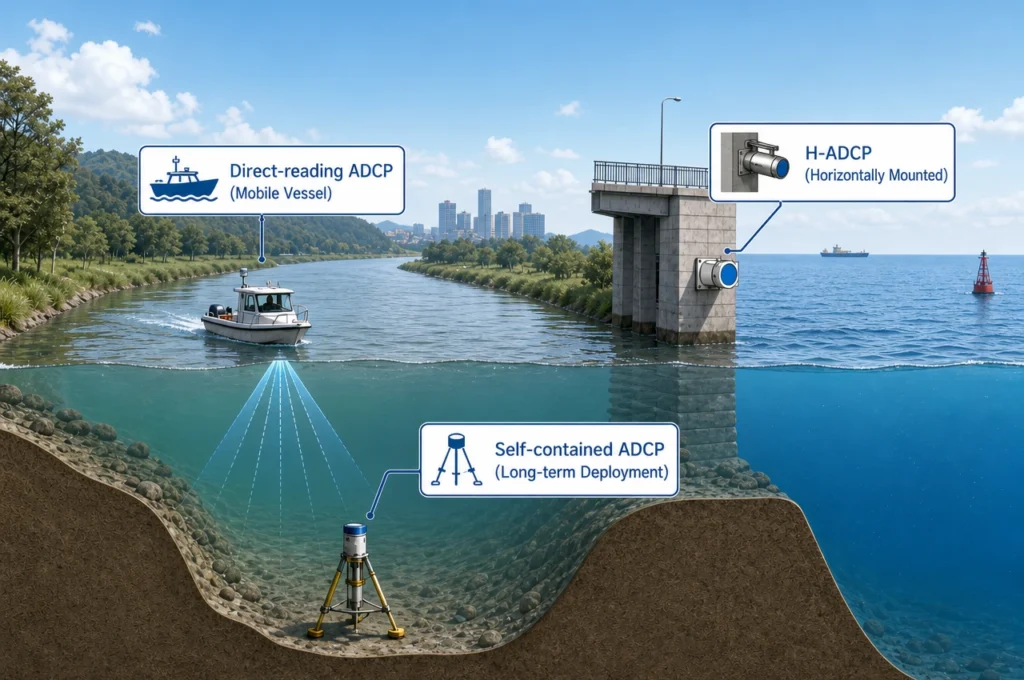
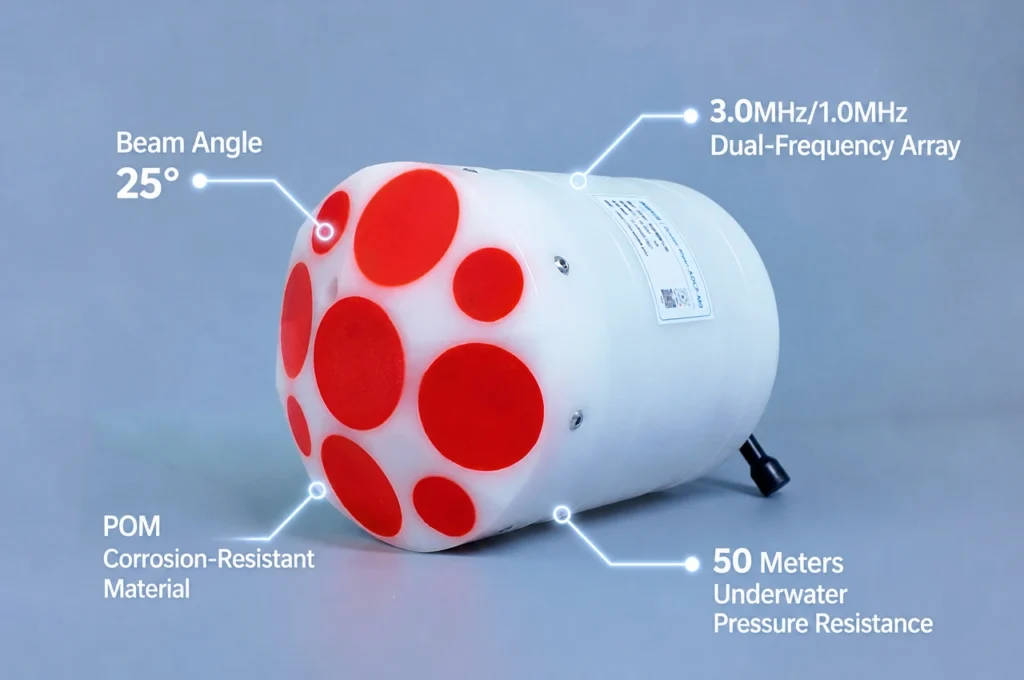
Our River ADCP M9 9-beam system is designed for exactly this kind of standard-based moving-boat work, and the HADCP-600 covers the fixed-station side of gauging programmes. If you are setting up or upgrading a US streamflow programme, our engineers can help you match the instrument to the procedures.
FAQ
What is USGS TM 3-A22?
USGS Techniques and Methods 3-A22, Measuring Discharge with Acoustic Doppler Current Profilers from a Moving Boat (2009; version 2.0 in 2013), is the US reference for moving-boat ADCP discharge measurement.
Who uses USGS TM 3-A22?
USGS field offices and many US water-resource agencies, consultants, universities and contractors. US projects, FEMA studies and many state and municipal contracts expect its procedures.
How does TM 3-A22 differ from ISO 24578?
ISO 24578:2021 is the international standard for the same method; TM 3-A22 is the free US field manual. They are highly consistent — US teams follow TM 3-A22 and cite ISO 24578 for international work.
What is a moving-bed test in TM 3-A22?
A check of whether the river bed is moving during the measurement, which would bias bottom-track navigation. TM 3-A22 tells you how to run the test and how to correct or avoid moving-bed conditions.
This guide is for general information. For official procedures, download TM 3-A22 from the USGS Publications Warehouse and follow the applicable agency manual for your project.
© 2026 Ocean (Hangzhou) Technology Co., Ltd.All rights reserved. Last updated: September 7, 2026.