In this post
- Introduction
- What Makes a River ADCP Different from an Oceanographic ADCP?
- Frequency Selection for Rivers: 1200 kHz, 600 kHz, or 300 kHz?
- Deployment Configurations: Moving-Boat, Stationary, and Horizontal
- Top ADCP Models for River Flow Measurement
- A Closer Look at Key River ADCP Models
- Real-World River ADCP Challenges (and How the Right Model Helps)
- Software and the Discharge Workflow
- Budget: What You Get at Each Price Tier
- Quick Decision Guide
- Frequently Asked Questions
Introduction
Measuring river discharge accurately is not just about dropping an instrument in the water. It is about matching the right ADCP to your river’s width, depth, velocity, and sediment load — then getting a repeatable discharge number that stands up to scrutiny. Choose the wrong model and you spend more time fighting the instrument than collecting data.
This article covers the ADCP models that river hydrologists actually use, what makes them different, and how to decide which one fits your field conditions. We focus on real-world river work: moving-boat discharge transects, fixed horizontal installations, and wading measurements in shallow channels.
1. What Makes a River ADCP Different from an Oceanographic ADCP?
Oceanographic ADCPs are built for depth and endurance. River ADCPs are built for resolution and agility. In a river, you rarely need more than 50 meters of profiling range — but you need centimeter-scale velocity resolution, because the channel bed can change by half a meter in a single flood season and your discharge uncertainty needs to stay below 5%.
The key differences boil down to four things:
- Frequency. River ADCPs operate at 600 kHz or 1200 kHz, sometimes 300 kHz for larger rivers. Higher frequency means smaller cells (down to 0.1 m) and better shallow-water performance.
- Bottom tracking. River discharge by the moving-boat method requires rock-solid bottom tracking. Without it, your boat velocity reference drifts and your measured discharge is wrong. This is non-negotiable.
- Form factor. River ADCPs are smaller and lighter — they mount on small survey boats, tethered trimarans, or even a wading rod. A 40-kg deep-ocean transducer is useless on a 3-meter inflatable.
- Software integration. River ADCPs ship with or integrate into discharge computation software (WinRiver II, Q-View, SxS Pro, or manufacturer-specific equivalents) that handles edge extrapolation, compass calibration, and moving-bed tests automatically.
2. Frequency Selection for Rivers: 1200 kHz, 600 kHz, or 300 kHz?
River depth dictates frequency just as it does in the ocean — but the depth bands are much shallower. Here is how the three common river frequencies map to real field conditions:
| Frequency | Max Depth | Min Depth | Best For |
|---|---|---|---|
| 1200 kHz | 15–25 m | 0.2 m | Shallow streams, wading measurements, small channels, irrigation canals |
| 600 kHz | 50–75 m | 0.8 m | Medium-to-large rivers, standard USGS-style discharge transects, flood monitoring |
| 300 kHz | 100–150 m | 2 m | Very large rivers (Amazon, Mississippi, Yangtze), deep estuaries, tidal reaches |
The 600 kHz sweet spot. For the majority of river gauging stations worldwide, 600 kHz is the right answer. It profiles deep enough for most channels, the minimum depth is usable from a small boat, and the cell size (typically 0.5–1 m) gives you enough vertical bins for a clean discharge integration even in channels only 2–3 meters deep. If you are buying one river ADCP and your rivers vary from 1 m to 30 m deep, start with 600 kHz.
When to go 1200 kHz. If your work is predominantly in streams under 3 meters deep — wadeable channels, mountain headwaters, irrigation networks — the 1200 kHz instrument gives you finer cells and a shallower blanking distance. The trade-off is that it will lose bottom lock beyond about 20–25 m, so it is a specialist tool, not a general-purpose one.
When 300 kHz earns its place. Very large, deep rivers — the lower Amazon, the Congo, the St. Lawrence below Montreal — can exceed 50 m in the thalweg. A 600 kHz unit may struggle to maintain bottom track at those depths, especially in soft sediment. A 300 kHz ADCP reaches 100+ m and is the right tool for these mega-rivers, at the cost of coarser vertical resolution.
3. Deployment Configurations: Moving-Boat, Stationary, and Horizontal
Moving-Boat Method (The Standard)
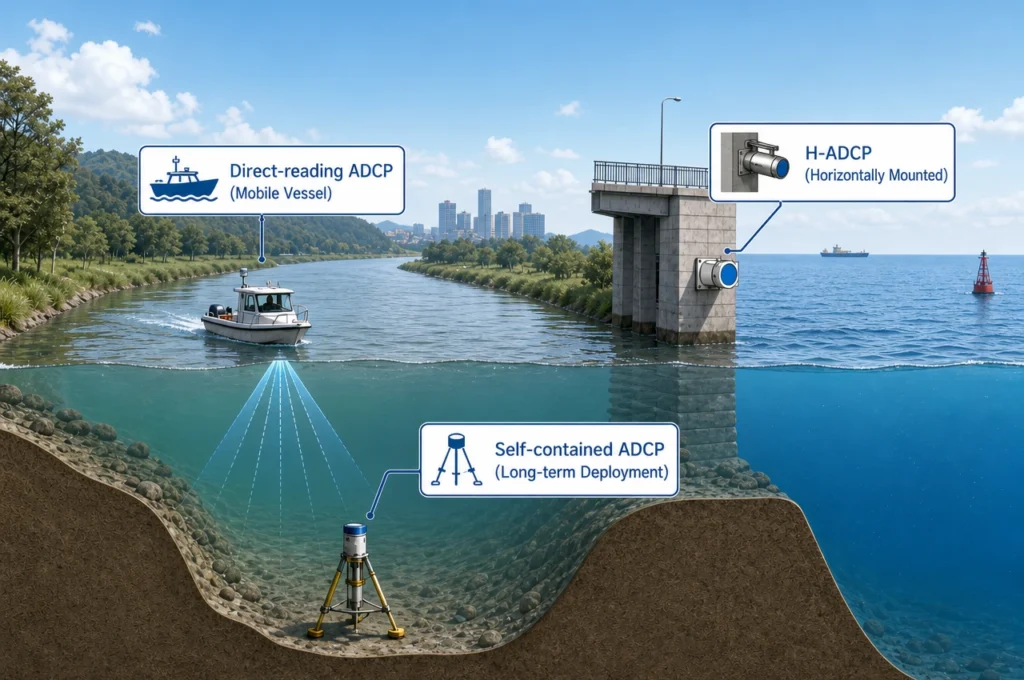
This is the method behind the vast majority of ADCP river discharge measurements worldwide. The ADCP is mounted on a small boat or tethered trimaran, the boat crosses the river from bank to bank, and the instrument measures both water velocity and boat velocity (via bottom tracking) simultaneously. The discharge software integrates velocity × area across the transect. Four to six transects give you a mean discharge with an uncertainty typically under 5% — provided your bottom tracking holds, your compass is calibrated, and the moving bed is either absent or corrected for.
Fixed Horizontal ADCP (H-ADCP)
For continuous, real-time discharge monitoring — think USGS streamgage with an index-velocity rating — a horizontal ADCP is mounted on one bank, typically near the channel thalweg, pointed across the flow. It measures a horizontal slice of velocity, which is then correlated with periodic moving-boat measurements to produce a continuous discharge record. This is a different instrument class from the moving-boat ADCP: it is fixed, often powered by shore power with cellular or satellite telemetry, and optimized for a single horizontal beam plane rather than a full vertical profile.
Vertical Beam / Stationary Profiling
In very narrow, turbulent channels where a boat transect is impractical — or for turbulence studies — an ADCP can be deployed looking vertically from a fixed mount, bridge pier, or cableway. This gives you a single vertical profile of velocity, which can be indexed to discharge if the channel geometry is stable and the velocity-to-discharge relationship is well calibrated.
4. Top ADCP Models for River Flow Measurement
The table below compares the most commonly used river ADCP models. These are instruments you are likely to encounter in bids, on boats, and in agency equipment pools.
| Model | Frequency | Max Depth | Deployment | Strengths |
|---|---|---|---|---|
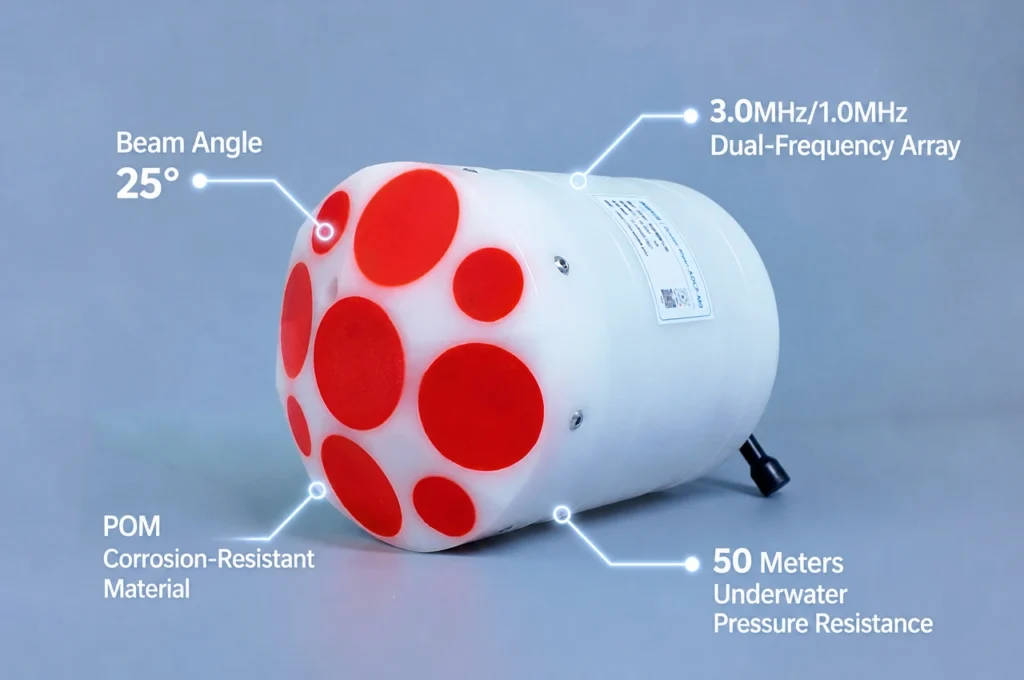
| River-ADCP-M9 | 3000 / 1000 /500 kHz | ~40 m | Moving-boat, trimaran | Nine-beam array for 3D velocity; compact and portable; strong bottom tracking across varied substrates; compatible with standard discharge software |
| HADCP-600 | 600 kHz | ~90 m (horizontal) | Fixed bank-mount, real-time | Purpose-built for continuous index-velocity monitoring; low power draw for solar-powered stations; cellular/satellite telemetry output |
| ADCP-600-DR-FA4 | 600 kHz | ~75 m | Moving-boat, direct-reading | Four-beam piston array; proven accuracy; field-swappable mounting plates; works with standard WinRiver II workflow |
| ADCP-300-DR-FA4 | 300 kHz | ~160 m | Moving-boat, direct-reading | Deep-river capability; reaches thalweg depths that 600 kHz cannot; suitable for large rivers and estuaries |
| RiverRay | 600 kHz | ~60 m | Moving-boat, trimaran | Phased-array; auto-adaptive ping; widely used in USGS and WMO networks |
| Rio Grande | 600 / 1200 kHz | ~50 / ~20 m | Moving-boat, wading | Dual-frequency option; shallow-water specialist; decades of field history |
| StreamPro | 2000 kHz | ~2 m | Wading, tether, ultra-shallow | Ultra-shallow specialist; smallest blanking distance; ideal for streams under 1 m deep |
Disclaimer: Specifications listed above are based on manufacturer-published data as of 2026. Actual depth range, accuracy, and feature availability may vary depending on firmware version, deployment conditions, and regional configuration. Always confirm current specifications directly with the manufacturer or an authorized distributor before making a purchase decision.
5. A Closer Look at Key River ADCP Models
River-ADCP-M9: The Nine-Beam Advantage
Most ADCPs use four beams. The River-ADCP-M9 uses nine — four traditional Janus beams plus five additional beams at different angles. The extra beams serve two purposes: they improve the spatial sampling of velocity in non-uniform flow (think near-bank shear layers and bridge-pier eddies), and they provide redundancy — if one beam is partially blocked by debris or sediment, the velocity solution degrades gracefully rather than dropping out entirely.
For a working hydrologist, the practical benefit is cleaner discharge transects in complex channels. The M9 pairs well with a tethered trimaran for single-person operation and comes with a deck box that handles real-time discharge computation. It is a tool built for the person who needs to collect 10 discharge measurements today and drive to the next station tomorrow — portable, quick to deploy, and forgiving of less-than-ideal conditions.
HADCP-600: The Set-It-and-Forget-It Solution
The HADCP-600 is a different animal entirely. Instead of a boat-mounted profiling instrument, it is a fixed horizontal ADCP installed on a riverbank, bridge pier, or piling, measuring a horizontal layer of water velocity continuously — 24/7, 365 days a year. The output is an index velocity that correlates with discharge via a rating curve developed from periodic moving-boat check measurements.
Why this matters: moving-boat measurements capture a single discharge value at a single moment. An H-ADCP captures the full hydrograph — rising limb, peak, falling limb — without anyone being on site. For flood forecasting, water resource operations, and sediment-transport timing, that continuous record is far more valuable than a handful of spot measurements. The HADCP-600 is designed for low-power operation (solar panel + battery bank) and outputs data over cellular modem, satellite, or direct cable to a datalogger — the kind of setup that water agencies install and then visit once a year for maintenance.
ADCP-600-DR-FA4: The Workhorse Four-Beam
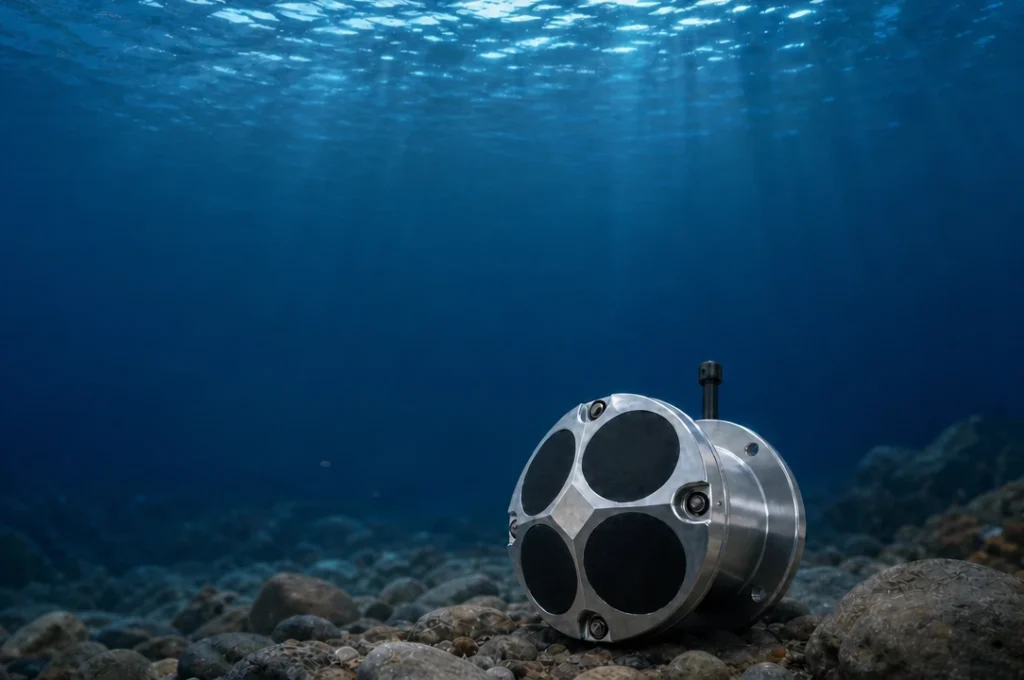
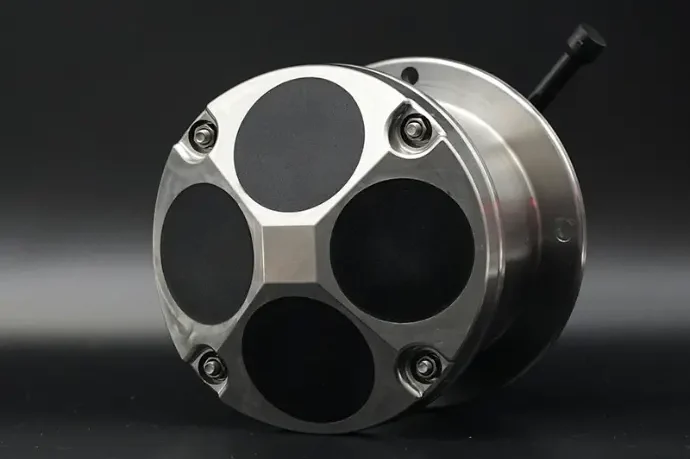
For labs and agencies that already have a boat, a GPS, and a Windows laptop running WinRiver II or similar, the ADCP-600-DR-FA4 is the straightforward choice. Four-beam piston array, 600 kHz, direct-reading via cable to a deck unit or laptop. It does not have the nine-beam sophistication of the M9 or the continuous-monitoring capability of the HADCP — but it does one thing reliably: it measures velocity profiles and bottom-tracks well, in a workflow that thousands of hydrologists already know.
6. Real-World River ADCP Challenges (and How the Right Model Helps)
Moving Bed
When the riverbed itself is moving — sand-bed rivers during high flow, gravel during floods — bottom tracking gives a false boat-velocity reference. You think the boat is stationary relative to the bed, but the bed is moving downstream, so your measured discharge is biased low. The standard fix is a loop method (stationary moving-bed test) or, better, GPS-compensated bottom tracking. Some ADCPs integrate RTK GPS input directly, computing boat velocity from satellite fixes rather than bottom track. If you work in sand-bed rivers, look for an instrument with native GPS integration — it is worth every dollar.
Shallow Edges and Extrapolation
Every discharge transect misses the water near the banks — the ADCP cannot profile in depths less than its blanking distance plus one cell. This unmeasured edge discharge must be estimated (extrapolated), typically as a power-law fit. The quality of that extrapolation depends on how close to the bank you can measure. A 1200 kHz instrument with a 0.2-m minimum depth gets you closer to the bank than a 600 kHz instrument with a 0.4-m minimum. For channels where a significant fraction of the discharge is in shallow margins, the higher-frequency instrument may give a more accurate total despite profiling less of the deep channel.
Sediment and Signal Attenuation
Highly turbid rivers attenuate the acoustic signal. A 600 kHz ADCP that profiles 50 m in clear water may lose bottom at 30 m in a sediment-laden flood. This is where a 300 kHz instrument — with its longer wavelength and greater penetration — can hold bottom track when a 600 kHz unit cannot. If your river carries high suspended-sediment loads during the events you most need to measure, factor this into your frequency choice.
7. Software and the Discharge Workflow
The ADCP hardware is half the system. The other half is the discharge computation software. In practice, the software determines your field workflow as much as the transducer does.
Most river ADCPs in the Anglophone world output to WinRiver II (Teledyne RDI) or an equivalent manufacturer tool. These packages handle:
- Compass calibration — done at the start of each field session; a bad compass calibration is the single most common source of discharge error.
- Moving-bed detection and correction — loop tests or GPS input.
- Edge extrapolation — power-law or constant-fit extrapolation of unmeasured top, bottom, and bank regions.
- Discharge uncertainty estimation — typically computed from transect-to-transect variability.
Before buying any ADCP, confirm that the raw data format is compatible with your agency’s discharge software. PD0 binary output remains the closest thing to a universal standard, but some instruments output proprietary formats that require a specific (often Windows-only) processing application. If your team works in Python or R, check that a PD0 reader is available — the open-source community has largely solved this, but it is worth verifying before purchase.
8. Budget: What You Get at Each Price Tier
River ADCP pricing is more accessible than deep-ocean ADCPs, but the spread is still significant. Here is what to expect:
- Entry tier ($): A basic 600 kHz direct-reading ADCP with deck cable and standard software license. No trimaran, no GPS, no telemetry — you supply the boat, mounting, and positioning. Suitable for a university lab or small consulting firm with existing field gear.
- Mid tier ($$): A 600 kHz ADCP with trimaran, RTK GPS option, and a ruggedized field laptop or tablet with discharge software pre-installed. This is the “turnkey” package that a water agency or mid-size consultancy buys so a technician can be measuring within an hour of unboxing.
- Upper tier ($$$): A nine-beam or dual-frequency instrument, trimaran, full GPS integration, plus advanced software features. The extra beams and frequency flexibility pay off in complex channels and varied deployment conditions.
- Fixed H-ADCP station ($$$$): The instrument itself plus mounting hardware, solar power system, cellular/satellite telemetry, and enclosure. Installation cost varies enormously with site access and permitting.
Rental is also an option: many instrument manufacturers and distributors rent ADCPs by the week or month. If your river measurement needs are seasonal — a few flood campaigns per year — renting may cost less over three years than buying. It also transfers calibration and maintenance responsibility to the rental provider.
9. Quick Decision Guide
Answer these questions in order to narrow your shortlist:
- What is your typical river depth range? Under 3 m → 1200 kHz. 3–30 m → 600 kHz. Over 30 m → 300 kHz.
- Are you doing spot discharge measurements or continuous monitoring? Spot measurements → moving-boat ADCP (M9, ADCP-600-DR-FA4). Continuous → horizontal H-ADCP (HADCP-600) plus periodic moving-boat checks.
- How complex is your channel geometry? Straight, uniform channel → four-beam is fine. Braided, highly non-uniform, or with bridge piers → nine-beam adds value.
- Do you have a sand or gravel bed that moves during high flow? Yes → budget for RTK GPS integration alongside your ADCP.
- What software does your agency or lab require? Check PD0 output compatibility. Confirm the instrument works with WinRiver II, Q-View, or your in-house processing scripts.
- What is your total budget — including boat, GPS, software, and training? The ADCP itself is roughly 50–70% of the full initial system cost. The trimaran, cables, GPS receiver, field laptop, and software license add up.
10. Frequently Asked Questions
What is the best ADCP for shallow river measurement?
For rivers under 2 meters deep, a 1200 kHz or 2000 kHz ADCP is the right tool. The higher frequency gives a smaller blanking distance (the unmeasured zone immediately in front of the transducer) and smaller cell sizes, so you resolve more vertical bins even in shallow water. The StreamPro (2000 kHz) is built specifically for this use case, while a 1200 kHz Rio Grande or equivalent handles moderate-shallow channels well.
Can I use the same ADCP for rivers and coastal surveys?
Not in practice, no. A 600 kHz river ADCP profiles to roughly 75 m at best, which is sufficient for an estuary but not for shelf or deep-coastal work. Conversely, a 75 kHz or 150 kHz oceanographic ADCP has cells too coarse (4–12 m) to compute accurate river discharge in a channel only 3–5 meters deep. These are different instruments for different environments. If your work spans both, you need two ADCPs — or an instrument that is explicitly designed for dual use, which is rare.
What is a horizontal ADCP and when should I use one?
A horizontal ADCP (H-ADCP) is permanently mounted on a riverbank or structure and measures water velocity along one or two horizontal beams across the channel. It does not produce a vertical profile — it produces a continuous index-velocity record that is calibrated to discharge via periodic moving-boat measurements. Use an H-ADCP when you need real-time, year-round discharge data — for flood warning systems, reservoir operations, or long-term water resource monitoring. It is not a replacement for a moving-boat ADCP; it is a complementary tool for permanent stations.
What accuracy can I expect from a river ADCP discharge measurement?
Under good conditions (stable bed, calibrated compass, 4–6 transects, well-defined edges), a moving-boat ADCP discharge measurement has an uncertainty of 3–5% at the 95% confidence level. Conditions that degrade that: moving bed (add 2–5% unless GPS-corrected), highly turbulent flow, very shallow or very deep water, and operator inexperience. The instrument itself is capable of sub-1% velocity accuracy; the dominant error sources are deployment-related, not hardware-related.
Do I need training to operate a river ADCP?
Yes. The instrument is easy to turn on; getting a defensible discharge number is a learned skill. A two- to three-day training course — covering compass calibration, transect strategy, moving-bed detection, edge estimation, and data QA/QC — is standard for new operators. Most manufacturers and distributors offer training as part of the purchase package. If you are writing the purchase order, include training as a line item, not an afterthought.
Still Evaluating? Talk to a River Gauging Specialist
Every river is different, and a spec-sheet comparison only goes so far. If you want to discuss your specific sites — channel dimensions, flow regime, access constraints, and budget — the applications team at Oceantek can walk you through the options and help you build a system that works the first time. No generic recommendations, just practical advice from people who have spent time on the bank.