Accurate, real-time river discharge data is essential for flood forecasting, water resource management, and hydroelectric operations. Among the technologies available today, the Horizontal Acoustic Doppler Current Profiler (H-ADCP) stands out as one of the most reliable tools for continuous, unattended river monitoring. This article draws on hydrometric best practices and field experience to present a comprehensive guide to H-ADCP-based discharge monitoring—covering everything from instrument selection to advanced data modeling.
What Is a Horizontal ADCP (H-ADCP)?
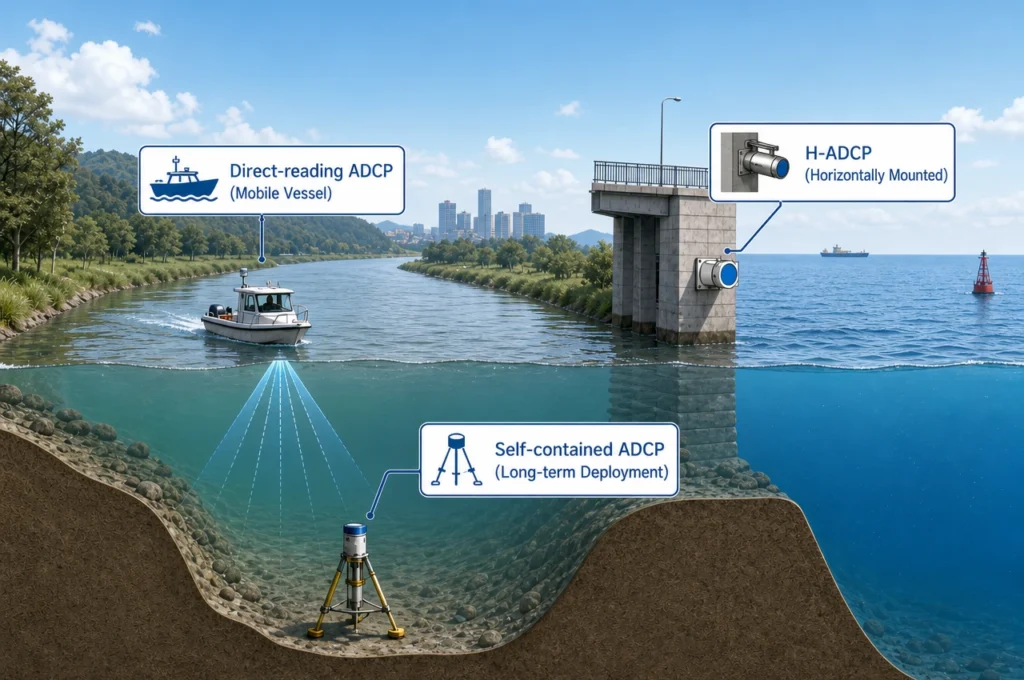
A Horizontal ADCP (H-ADCP) is a fixed-mount acoustic Doppler current profiler that transmits acoustic beams horizontally across a river channel to measure water velocity at multiple points (cells) along the beam path. Unlike conventional moving-boat ADCP surveys—which provide a snapshot in time—an H-ADCP delivers continuous, real-time velocity profiles, making it the instrument of choice for permanent or semi-permanent river gauging stations.
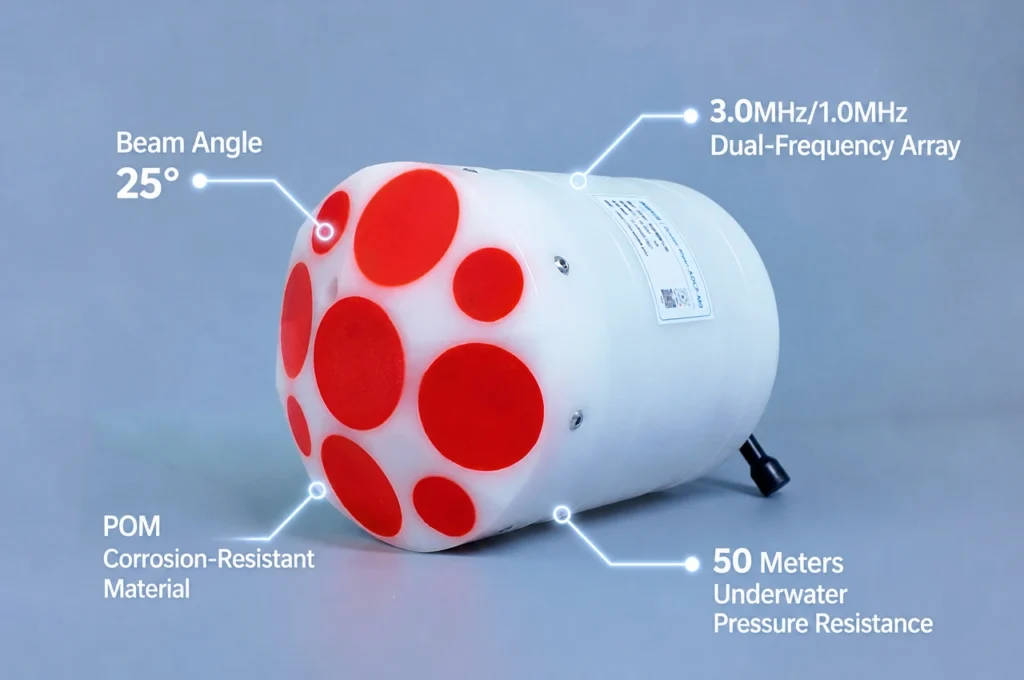
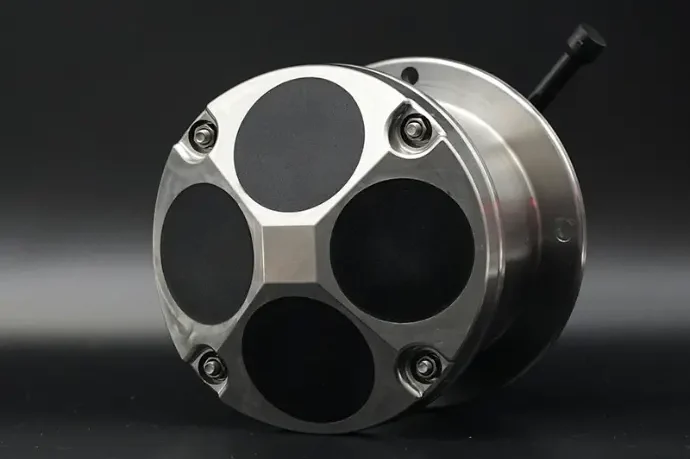
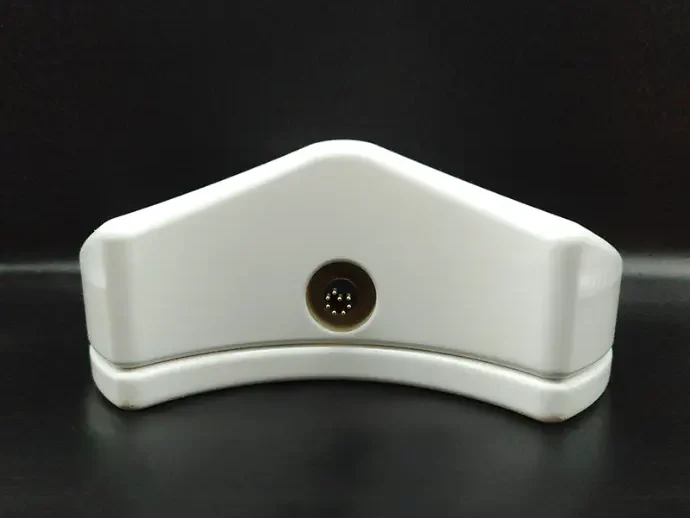
The HADCP-600 from Oceantek is a purpose-built 600 kHz horizontal ADCP designed specifically for river discharge monitoring. Its dual horizontal beams plus a center vertical beam provide cross-channel velocity profiling with the accuracy and reliability required by modern hydrological networks.

Why Choose H-ADCP Over Conventional Stage-Discharge Methods?
Traditional stage-discharge rating curves (HQRC) rely on a single variable—water stage—to estimate discharge. While adequate for stable, uniform channels, HQRC methods break down when backwater effects, unsteady flows, tidal influences, or hydraulic structure interference are present. In these scenarios, the index-velocity method using an H-ADCP is the recommended alternative (Muste et al., 2015).
The index-velocity method leverages two directly measured variables—stage and cross-sectional velocity—to compute discharge. This dual-input approach captures dynamic flow conditions that a stage-only rating curve cannot resolve, yielding more accurate discharge estimates under non-standard hydraulic conditions.
- Continuous data stream: 24/7 velocity monitoring without personnel on site
- Backwater resilience: Functions accurately where conventional rating curves fail
- Low operational cost: Once installed, recurring measurement costs drop sharply compared to manned gauging
- Flood-safe operation: Bank-mounted deployment keeps instruments secure during extreme events
Key Specifications of the HADCP-600
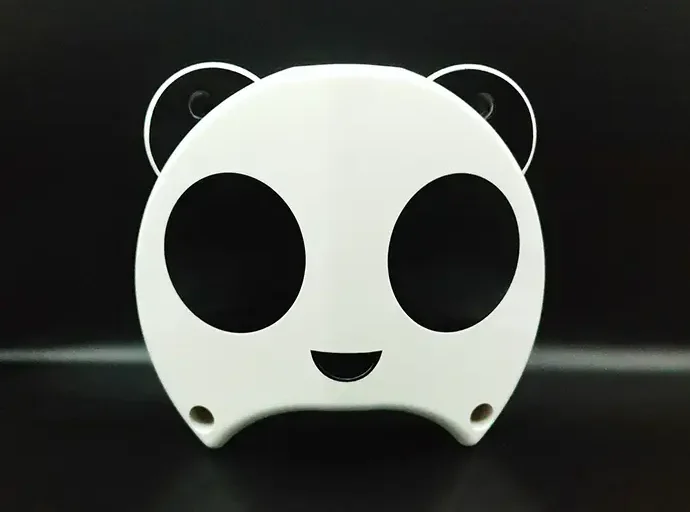
Selecting the right instrument is the foundation of a successful monitoring program. The Oceantek HADCP-600 offers the following core specifications for river discharge applications:
| Parameter | Specification |
|---|---|
| Acoustic Frequency | 600 kHz |
| Beam Configuration | 2 horizontal beams (20° beam angle) + 1 vertical center beam |
| Horizontal Profiling Range | Up to 90m |
| Velocity Accuracy | ±0.3 % ± 3 mm/s |
| Velocity Resolution | 1 mm/s |
| Velocity Range | ±5.0 m/s default; up to ±20.0 m/s maximum |
| Number of Cells | 1–255 (user-configurable) |
| Cell Size | 0.5–4 m |
| Ping Rate | 2 Hz |
| Communication Interfaces | RS-232, RS-422 |
| Internal Storage | Up to 64 GB Micro SD |
| Power Consumption | 3.5–10 W (average, operating mode) |
| Power Supply | 10–26 V DC |
| Integrated Sensors | Temperature (±0.1°C), Pressure, Tilt/Heading/Roll/Pitch compass |
| Housing Material | POM engineering plastic |
| Depth Rating | 20 m (standard) |
| Operating Temperature | −5°C to 45°C |
These specifications place the HADCP-600 firmly in the class of professional-grade river-type ADCPs suitable for medium to large river systems. For wider channels exceeding 120 m, a lower-frequency unit such as a 300 kHz ADCP may be considered; for narrower channels or canals, the 600 kHz frequency provides an optimal balance of range and spatial resolution.
Installation Best Practices
1. Site Selection and Cross-Section Assessment
A successful H-ADCP deployment begins with careful site selection. The ideal cross-section should exhibit:
- Straight channel reach: A uniform channel section at least 5–7 channel widths in length upstream, free of major bends, confluences, or hydraulic structures that create complex secondary flows.
- Stable cross-section geometry: Minimal scour and deposition; cross-section surveys should be repeated after major flood events to verify stability.
- Adequate acoustic penetration: Sufficient suspended sediment concentration to ensure acoustic backscatter, but not so turbid that signal attenuation becomes problematic. The 600 kHz frequency performs well in most natural river conditions.
- Accessible bank for mounting: A solid mounting structure—bridge pier, staff gauge foundation, or dedicated mounting frame—on one bank with line-of-sight across the channel.
2. Mounting Configuration and Beam Alignment
Mount the H-ADCP near the bank, at a fixed elevation, with the acoustic beams aligned horizontally across the channel. Key considerations include:
- Sensor depth: Position the transducer head below the minimum expected water level to ensure continuous submersion. A pressure sensor integrated into the HADCP-600 provides real-time depth verification.
- Beam orientation: Align one horizontal beam as close as possible to perpendicular to the mean flow direction. The second beam (at a 20° angle) provides the orthogonal velocity component needed for vector reconstruction.
- Blank distance: Configure a minimum blanking distance of 1.0 m to exclude near-field acoustic interference from the velocity profile.
- Anti-fouling measures: In biologically productive waters, plan for periodic cleaning or apply anti-fouling coatings compatible with the POM transducer housing.
3. Multi-Angle Inclined Deployment (Advanced)
Recent research (2024) has demonstrated that deploying two H-ADCP units at complementary frequencies and tilt angles along the same cross-section creates a multi-angle collaborative observation system. This configuration enhances the representativeness of index velocities, improves adaptation to backwater effects and low-flow conditions, and increases fault tolerance. Studies report that dual-device schemes can achieve R² values up to 0.9903, versus 0.9880–0.9893 for single-device configurations.
For sites with complex hydraulics, combining the HADCP-600 with a multi-frequency river ADCP or a vertical-beam ADCP provides complementary velocity data that can significantly improve discharge model accuracy.
Data Collection and Parameter Configuration
| Parameter | Recommended Setting | Notes |
|---|---|---|
| Cell Size | 1.0 m (typical) | Adjust based on channel width; finer cells for narrow channels |
| Number of Cells | 80–128 | Configure to span at least 60–80% of channel width |
| Blank Distance | 1.0 m minimum | Larger in highly turbulent near-field zones |
| Averaging Interval | 5–10 minutes | Shorter for highly dynamic flows; longer for stable baseflow |
| Ping Ensemble | 60–120 pings per ensemble | Higher pings reduce uncertainty but increase power consumption |
| Data Output Rate | Match averaging interval | Synchronize with telemetry schedule for remote stations |
Proper cell configuration is essential—the active cells should cover the main flow conveyance zone (typically 5–30 cells from the transducer face, beyond the blank zone and extending across the majority of the channel). Cells too close to the opposite bank may suffer from side-lobe interference and should be excluded from index-velocity calculations.
Discharge Calculation Methodologies
Index-Velocity Rating Curve (IVRC)
The index-velocity method is the foundational approach for H-ADCP discharge estimation. It establishes a statistical regression between the index velocity (the representative velocity measured by the H-ADCP at one or more optimally selected cells) and the cross-sectional mean velocity derived from concurrent moving-boat ADCP transects or current-meter gaugings.
The general form is:
Q = A(h) × Vmean where Vmean = f(Vindex)
Under good site conditions, well-constructed IVRC models achieve R² > 0.98 and discharge errors within ±5% for runoff volume over effective monitoring periods. First-class hydrological station standards typically demand errors under 3% for representative periods.
Machine Learning and Deep Learning Approaches
For sites with complex hydraulics—tidal backwater, channel siltation, or hydraulic structure influence—machine learning models have emerged as the state of the art:
- Deep Characteristic Learning (DCL): Integrates multiple intelligent algorithms to extract nonlinear relationships between H-ADCP cell velocities and cross-sectional discharge. Demonstrated R² values of 0.93 under challenging conditions, with strong self-learning capability even with limited training data.
- Feature Adaptive Optimization (FAO): Uses Principal Component Analysis for dimensionality reduction of up to 128 velocity cells, runs multiple ML models in parallel (BP, Elman, RBF, GRNN, SVM), and employs Particle Swarm Optimization to auto-select optimal cell combinations. Achieves RMSE of approximately 6 m³/s.
These advanced techniques are particularly valuable when the relationship between index velocity and mean channel velocity becomes nonlinear due to changing flow conditions.
Calibration and Validation Protocol
A rigorous calibration protocol is essential for defensible discharge data. Oceantek’s ADCP consistency test methodology provides a proven framework that can be adapted to individual monitoring sites:
- Synchronous comparative measurements: Perform moving-boat ADCP transects (or Price-type current-meter verticals) concurrently with H-ADCP data collection over a wide range of flow conditions—low flow, medium flow, bankfull, and flood stages if possible. A minimum of 8–12 paired measurements spanning the full discharge range is recommended.
- Cross-section survey: Conduct a detailed bathymetric survey of the gauging cross-section. Repeat after major floods to verify geometric stability.
- Cell selection optimization: Use automated methods (PCA, correlation analysis, or PSO-based optimization) to identify the velocity cells most representative of the cross-sectional mean velocity. Manual cell selection based on experience alone is increasingly being replaced by data-driven approaches.
- Model building and validation: Reserve 20–30% of paired measurements as an independent validation dataset. The remaining data are used to build the IVRC or machine-learning model.
- Uncertainty quantification: Report 95% confidence intervals for all discharge estimates. Standard ISO 748 and ISO/TS 24154 provide accepted frameworks for ADCP discharge uncertainty analysis.
- Ongoing verification: Periodically (at minimum annually, or after major channel-altering events) re-validate the rating by collecting new moving-boat transects under varied flow conditions.
Data Quality Assurance and Maintenance
Continuous H-ADCP operation generates large data volumes, and quality assurance cannot be an afterthought. Implement the following QA/QC measures from day one:
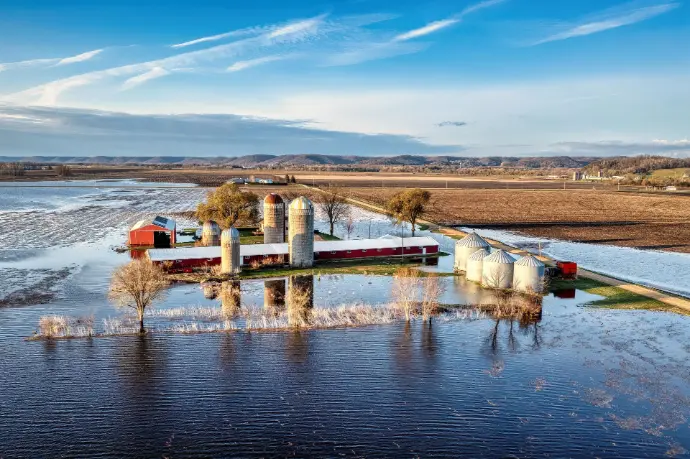
Real-time H-ADCP discharge monitoring supports flood forecasting and emergency response during extreme hydrological events (Image: Oceantek)
- Real-time diagnostics monitoring: Track signal-to-noise ratio (SNR), correlation values, and percent-good pings across all active cells. The HADCP-600’s integrated sensors can alert operators to instrument tilt, pressure anomalies, or temperature drift.
- Redundancy where possible: A self-contained ADCP deployed as a secondary reference provides independent validation of H-ADCP discharge estimates during field visits.
- Fouling inspections: In productive waters, schedule transducer-face inspections at 3–6 month intervals. Bio-fouling degrades acoustic performance progressively, and early detection prevents extended data gaps.
- Firmware and software updates: Maintain current firmware versions. Oceantek provides technical support resources including product manuals, firmware updates, and direct engineering support.
Advanced Application: Real-Time Sediment Monitoring
Beyond velocity and discharge, the H-ADCP platform supports surrogate sediment monitoring through analysis of acoustic backscatter intensity. Research has demonstrated that H-ADCP backscatter can be correlated with suspended sediment concentration (SSC) using Support Vector Regression (SVR), achieving R² values of approximately 0.885 for SSC and 0.860 for total sediment load when integrated with a modified Einstein procedure.
This capability enables real-time detection of sediment hysteresis loops and sensitive sediment flux fluctuations—critical data for reservoir sedimentation management, dredging operations, and environmental monitoring programs in regulated rivers.
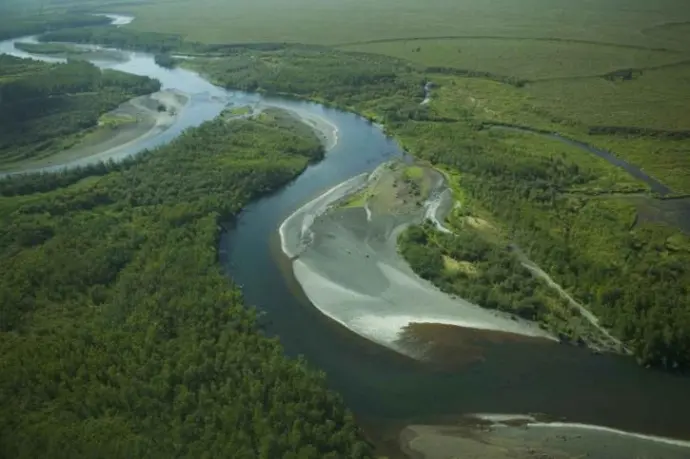
Aerial view of a meandering river — straight reach sections (foreground) provide optimal cross-sections for H-ADCP deployment (Image: Oceantek)
Common Challenges and Mitigation Strategies
| Challenge | Symptom | Mitigation |
|---|---|---|
| Backwater / tidal influence | Hysteresis or scatter in stage-discharge relationship | Use index-velocity method (IVRC) instead of simple HQRC |
| Subjective cell selection | Suboptimal R² or biased discharge estimates | Apply automated PCA + PSO optimization (FAO model) |
| Nonlinear velocity-discharge mapping | Systematic bias at flow extremes | Replace linear regression with machine learning (DCL model) |
| Sensor fouling or bio-growth | Progressive SNR degradation; data dropout | Schedule regular cleaning; use anti-fouling coating |
| Data gaps from power/telemetry failure | Incomplete discharge record | Multi-angle redundant deployment; solar+battery backup power |
| Low-flow representativeness | Increased relative error at minimum stages | Multi-frequency deployment (e.g., 300 kHz + 600 kHz) |
| High suspended sediment / turbidity | Range reduction due to acoustic attenuation | Use lower frequency transducer (300 kHz) for better penetration |
| Channel geometry change after floods | Systematic discharge bias | Re-survey cross-section; re-calibrate rating curve |
H-ADCP vs. Alternative River Monitoring Technologies
Hydrologists and water-resource engineers have several technology options. The following comparison situates H-ADCP within the broader instrumentation landscape:
| Technology | Best For | Limitations |
|---|---|---|
| H-ADCP (fixed horizontal) | Permanent gauging stations; continuous real-time discharge | Requires index-velocity calibration; single cross-section coverage |
| Moving-boat ADCP | Discharge measurements; site surveys; calibration references | Manual operation; snapshot data only; unsafe at high flows |
| V-ADCP (upward-looking) | Deep or wide rivers; mid-channel velocity profiling | Difficult installation in navigable channels; cable vulnerability |
| Non-contact radar / SVR | Surface velocity measurement; rapid deployment | Surface-only measurement; requires velocity-index calibration; wind-sensitive |
| Ultrasonic Time-of-Flight (TOF) | Very accurate in clear water; no moving parts | Requires paired transducers on both banks; sensitive to aquatic vegetation; limited to shallow channels |
| Camera-based (LSPIV) | Surface flow visualization; flood documentation | Surface-only; lighting-dependent; requires fixed camera geometry |
Recommended Deployment Workflow Summary
The following end-to-end workflow captures the best practices discussed in this article:
- Site Assessment → Evaluate cross-section geometry, hydraulic conditions, and identify the dominant challenges (backwater, tides, sediment).
- Instrument Selection → Choose the HADCP-600 for channels up to ~120 m; consult Oceantek’s FAQ or contact their engineering team at sales@oceanadcp.com for site-specific guidance.
- Installation → Mount at optimal depth and alignment; configure blank distance, cell size, and averaging interval per the guidelines above.
- Synchronous Calibration → Collect 8–12+ paired moving-boat ADCP transects spanning the full flow range.
- Cell Selection → Use data-driven optimization (PCA/PSO) to identify the best index-velocity cells.
- Model Development → Build the IVRC or machine-learning model; validate against held-out data.
- Continuous Operation → Monitor data quality in real time; investigate and address anomalies promptly.
- Periodic Re-Validation → Re-survey and re-calibrate after major floods or annually, whichever comes first.
Conclusion
The Horizontal ADCP has transformed river discharge monitoring from a labor-intensive, episodic activity into a continuous, real-time data stream that supports flood forecasting, water allocation, and environmental compliance. By following the best practices outlined in this article—from careful site selection and rigorous calibration to advanced machine-learning modeling—hydrological agencies and engineering firms can achieve discharge accuracies that meet first-class national standards.
The Oceantek HADCP-600, with its robust 600 kHz acoustic platform, integrated sensor suite, WiFi connectivity, and low power consumption, provides a versatile foundation for modern river gauging networks. When paired with sound hydrometric practice and intelligent data processing, it delivers the real-time discharge intelligence that water-resource decision-makers increasingly depend upon.
For more information on H-ADCP technology, river discharge monitoring applications, or product specifications, visit the Oceantek website, browse the product manual library, or explore the Oceantek news section for the latest field studies and technical updates.
References and Further Reading
- Muste, M., et al. (2015). “Considerations on Discharge Estimation Using Index-Velocity Rating Curves.” IAHR Congress Proceedings.
- Li, Y., et al. (2025). “Deep Characteristic Learning Model for Real-Time Flow Monitoring Based on H-ADCP.” Water Resources Research.
- Wang, J., & Chen, J. (2025). “H-ADCP-Based Online Discharge Monitoring Model Using Feature Adaptive Optimization.” Journal of Hydrology.
- Nihei, Y., & Kimizu, A. (2007). “A New Discharge Monitoring System Using H-ADCP and a Data Assimilation Technique.” River Flow 2007.
- ISO 748:2007. Hydrometry — Measurement of liquid flow in open channels using current-meters or floats.
- ISO/TS 24154:2005. Hydrometry — Measuring river velocity and discharge with acoustic Doppler profilers.
- Oceantek. (2026). ADCP Equipment Consistency Test Report.
- Oceantek. (2026). Chinese ADCP Manufacturer Selection Guide.
- Oceantek. (2026). USV-ADCP: How Unmanned Boats Are Revolutionizing Intelligent River Monitoring Operations.