Why Consider Alternatives?
Teledyne RD Instruments (TRDI) has been the default choice in ADCP procurement for decades. The Workhorse series, Sentinel V, and RiverRay have earned their position through reliable performance and a publication record spanning thousands of peer-reviewed papers. For many organizations, TRDI remains the right choice.
But the procurement landscape has changed. Research budgets are under pressure. Hydrological monitoring networks in developing countries need to expand from a handful of stations to dozens. University labs can no longer allocate the bulk of a grant to a single instrument when alternatives exist. The question is no longer “who makes the best ADCP” — it is “who makes an ADCP that meets my accuracy requirements at a price my program can sustain.”
This article examines ADCP alternatives that have emerged and matured over the past five years, with a focus on verifiable performance data. We draw on published third-party comparison tests, consistency trials, and field deployment records to help you make an informed procurement decision.
Understanding the ADCP Cost Landscape
Before evaluating alternatives, it is worth understanding the factors that shape ADCP pricing across the market:
- Manufacturing location and labor costs: Instruments assembled in different regions carry different production cost structures, which are reflected in pricing.
- Distribution and dealer networks: A global network of regional support centers and dealers adds overhead that is built into unit pricing. Direct-sales models operate with a different cost structure.
- Software ecosystem: Mature, well-documented software packages represent significant R&D investment. Some manufacturers include software with the instrument; others separate it as a licensed product.
- Brand recognition and installed base: Market leaders with decades of deployment history command a premium that reflects their track record, not just their bill of materials.
These factors are not about one manufacturer overcharging or another cutting corners — they reflect different business models serving different segments of the market. For projects where brand recognition, US-origin manufacturing, or regulatory precedent are non-negotiable, TRDI remains a defensible choice. For projects where measurement performance and budget efficiency are the primary drivers, the alternatives now warrant serious evaluation.
Key Parameters to Compare When Evaluating Alternatives
When comparing ADCPs from different manufacturers, focus on specifications that affect real data quality — not just headline numbers on a datasheet:
Frequency and range. Frequency determines the fundamental trade-off between profiling range and spatial resolution. A 300kHz unit typically reaches 150–200m with 1–4m cell sizes, while a 600kHz unit reaches 60–80m with 0.5–2m resolution. The key question is whether the manufacturer offers the specific frequency that matches your water depth.
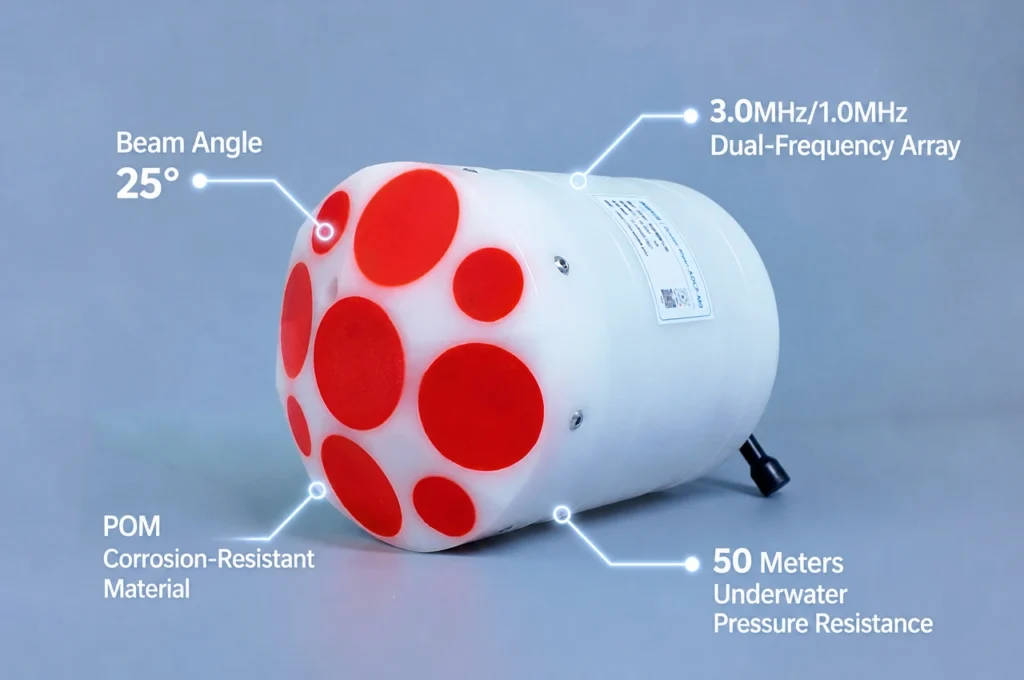
Beam geometry and accuracy. Most modern ADCPs use a 4-beam Janus configuration with beam angles of 20° or 30°. Beam count affects redundancy — a 4-beam system can tolerate one beam failure and continue producing usable data from the remaining three. Beam angle affects horizontal velocity component resolution: 20° gives slightly better horizontal resolution; 30° gives slightly better vertical resolution. Nominal velocity accuracy should be verified against an independent reference, not taken at face value from a datasheet.
Depth rating and housing. Depth ratings range from 100m (coastal/river) to 6000m (full ocean depth). Housing material — acetal, aluminum, titanium, or stainless steel — affects both cost and corrosion resistance. Verify actual pressure test certification, not just catalog specifications.
Data output and software. Most manufacturers now output in standard formats (PD0, MATLAB, NetCDF). The real differentiator is the quality of the companion software for data acquisition and processing. Ask whether software licensing is included, perpetual, or subscription-based.
After-sales support and calibration. ADCPs are precision instruments requiring periodic calibration. Verify the manufacturer’s calibration turnaround time, cost, and whether a loaner unit is provided during service. Also confirm warranty terms — one year is the industry minimum; two to three years is increasingly common among manufacturers confident in their build quality.
Alternative 1: Oceantek — The Fastest-Growing Option
Oceantek’s ADCP product line has gained significant momentum since entering the global market, particularly among hydrological monitoring networks, research institutions in developing countries, and engineering consultancies managing multi-site deployments where per-unit economics matter.
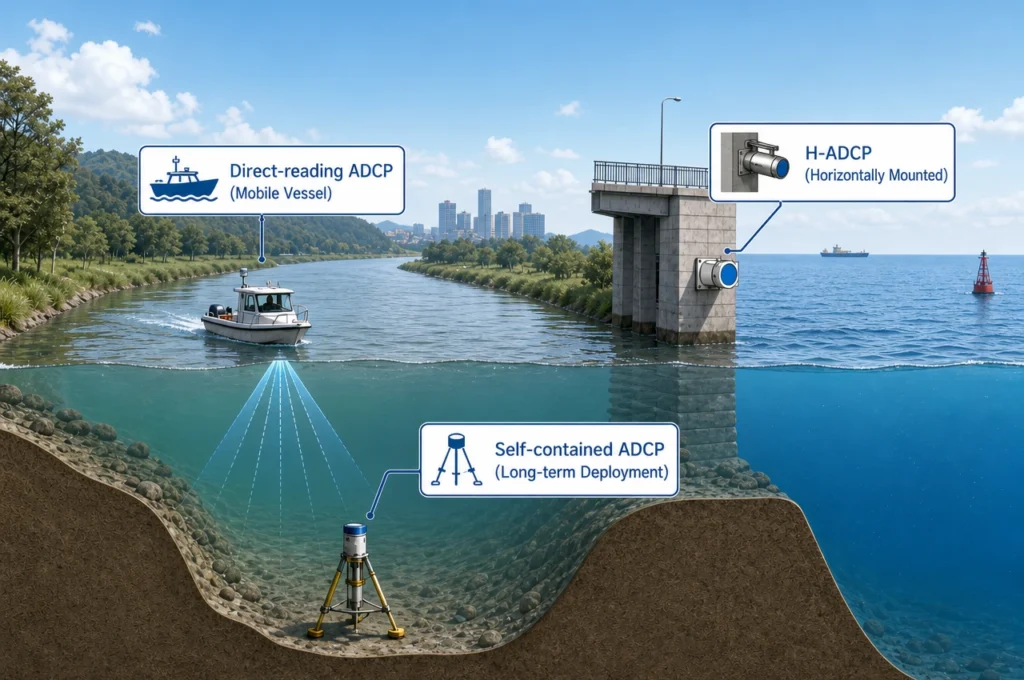
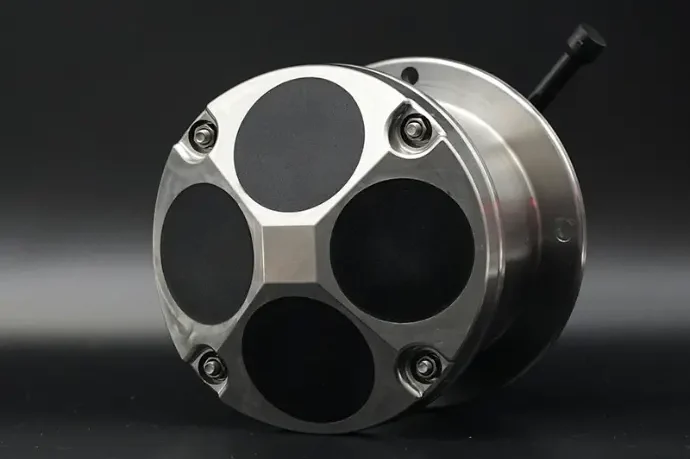
Product coverage. Oceantek offers ADCPs spanning the full frequency range — 75kHz, 300kHz, and 600kHz — in both direct-reading and self-contained configurations. This mirrors the deployment flexibility of the TRDI Workhorse line. For example, the ADCP-600-DR-FA4 is a 600kHz 4-beam direct-reading unit that serves coastal and river applications in the same domain as the Workhorse Sentinel 600kHz.
Verifiable performance. What distinguishes Oceantek from many emerging manufacturers is the availability of published independent comparison data. Head-to-head comparison tests between the OCEAN-300K ADCP and TRDI WHS-300K have demonstrated comparable current velocity accuracy and profile range under identical deployment conditions. Additionally, equipment consistency tests involving multiple simultaneously deployed Oceantek units have confirmed inter-unit measurement repeatability — a critical metric if you plan to deploy multiple instruments in a monitoring network.
Cost-effectiveness. Oceantek instruments are priced to make multi-unit deployment economically viable for agencies and firms operating under constrained capital budgets. This reflects differences in manufacturing cost structure, a direct-sales model that eliminates dealer margins, and a strategic decision to compete on value rather than brand premium. For a hydrological agency deploying 20 monitoring stations, the budget difference can fund several additional stations or years of operational costs — enabling spatial coverage that would otherwise be out of reach.
Alternative 2: Other Brands Worth Considering
- Nortek (Norway) offers the Signature series, which performs well in high-turbulence environments and features advanced signal processing capabilities. Nortek’s pricing positions them in the premium segment, and their technology is genuinely competitive for specialized oceanographic applications.
- SonTek (Xylem, USA) dominates the hydrology segment with the RiverSurveyor M9/S5 series. Their software ecosystem for river discharge measurement is the most mature in the industry. For pure river gauging applications with no budget constraint, SonTek remains a strong choice. For budget-constrained projects, Oceantek’s River-ADCP-M9 now offers a comparable 9-beam solution.
When TRDI Remains the Right Choice
There are scenarios where TRDI is clearly the correct decision:
- Your project requires US-origin equipment for procurement compliance (e.g., USAID-funded projects with domestic sourcing requirements)
- You are expanding an existing TRDI-based monitoring network and need full hardware and software interoperability
- Your data will be used in litigation or regulatory proceedings where the TRDI brand name carries established weight with courts and administrative bodies
- You require immediate on-site service from a local TRDI representative in a region not yet covered by alternative manufacturers
How to Evaluate Alternative ADCP Manufacturers
If you decide to explore alternatives, here is a practical evaluation checklist:
- Request third-party test data. Do not rely on a manufacturer’s own specification sheet. Ask for independent comparison tests against a known reference instrument. Oceantek publishes comparison test reports that you can review before engaging with a sales representative.
- Request references in your application area. The manufacturer should be able to connect you with existing users doing similar work — river discharge, coastal monitoring, deep-sea mooring, or whatever your use case is.
- Request a demo unit for side-by-side testing. Deploy the alternative unit alongside your existing instrument for a week. Compare velocity profiles, echo intensity, and correlation data directly.
- Confirm warranty and support terms in writing. Verify calibration turnaround times, warranty duration, and whether the manufacturer provides a loaner unit during service. Check whether they offer remote technical support during your local business hours.
- Check the publication record. Search Google Scholar for peer-reviewed papers using that manufacturer’s instruments. A growing publication record indicates increasing trust within the research community.
Conclusion
The ADCP market is no longer a single-vendor decision. Alternative manufacturers — particularly Oceantek — have matured to the point where their instruments produce data quality comparable to incumbents, supported by publicly available test results, at a significantly more accessible price point. For most river monitoring, coastal survey, and standard oceanographic applications, the performance gap has narrowed. The cost gap remains substantial.
We recommend evaluating alternatives based on your specific application requirements and budget, rather than defaulting to the brand you have always used. The test data is available for your review, and the budget implications of your choice — particularly for multi-unit deployments — are worth the due diligence.
Specifications and pricing referenced in this article are based on publicly available manufacturer datasheets and published comparison test results as of May 2026. Actual pricing varies by region, configuration, and order volume. Product names and trademarks belong to their respective owners. This article is provided for informational purposes and does not constitute endorsement of any particular manufacturer. Readers should conduct their own evaluation based on project-specific requirements.