ADCP stands for Acoustic Doppler Current Profiler. It is a sonar-based instrument that measures water current velocities over a depth range using the Doppler effect—the same principle that makes a passing ambulance sound different as it approaches and moves away.
| Letter | Word | What It Means |
|---|---|---|
| A | Acoustic | Uses sound waves—the only practical way to “see” underwater, since light and radio signals are absorbed within centimeters of water.1 |
| D | Doppler | Based on the Doppler principle: frequency shift of sound bouncing off moving particles in the water column. |
| C | Current | Measures water flow velocity—both speed and direction—in three dimensions. |
| P | Profiler | Measures across a depth profile, not just a single point. A typical ADCP divides the water column into multiple depth “cells” and reports velocity for each one.2 |
What Is an ADCP? (In Plain English)
When I first started working in this industry, “ADCP” was just another piece of jargon I had to memorize. What changed everything was watching an engineer deploy one during a field demonstration: the instrument went into the water, and seconds later, a live velocity profile appeared on the laptop screen—current speed and direction at every depth, updating in real time. That moment made the “profiler” part click in a way no datasheet could.
Here is the simplest way to think about it: if you wanted to measure how fast a river flows, you could stand at the bank with a stopwatch and a floating stick. An ADCP does the same thing—but across dozens of depths simultaneously, in three dimensions, without ever getting wet.
Technically, an ADCP sends out pulses of sound and listens to echoes bouncing back from tiny particles suspended in the water—sediment, plankton, bubbles. By measuring the frequency shift between what was transmitted and what returned, it calculates water velocity at each depth. The method is called acoustic Doppler current profiling, and it has become the dominant technique for river discharge measurement: the U.S. Geological Survey reports that well over half of its streamflow measurements are now made with ADCPs.3
Related Acronyms You Should Know
| Acronym | Full Form | Direction | Primary Use |
|---|---|---|---|
| ADCP | Acoustic Doppler Current Profiler | Vertical profile | General current measurement |
| HADCP | Horizontal ADCP | Horizontal (bank-to-bank) | Real-time river discharge monitoring from a fixed mount4 |
| DVL | Doppler Velocity Log | Bottom-track | Underwater vehicle navigation (AUVs, ROVs) |
| ADV | Acoustic Doppler Velocimeter | Single point | High-precision spot measurement for turbulence research |
DVL — Doppler Velocity Log
DVL uses the same acoustic Doppler principle but serves a different purpose: instead of profiling water currents, it tracks the vehicle’s movement relative to the seafloor. When an AUV or ROV needs to know exactly where it is underwater—where GPS does not work—a DVL provides that answer.
→ Read more: What Is a DVL? Difference Between DVL and ADCP
HADCP — Horizontal ADCP
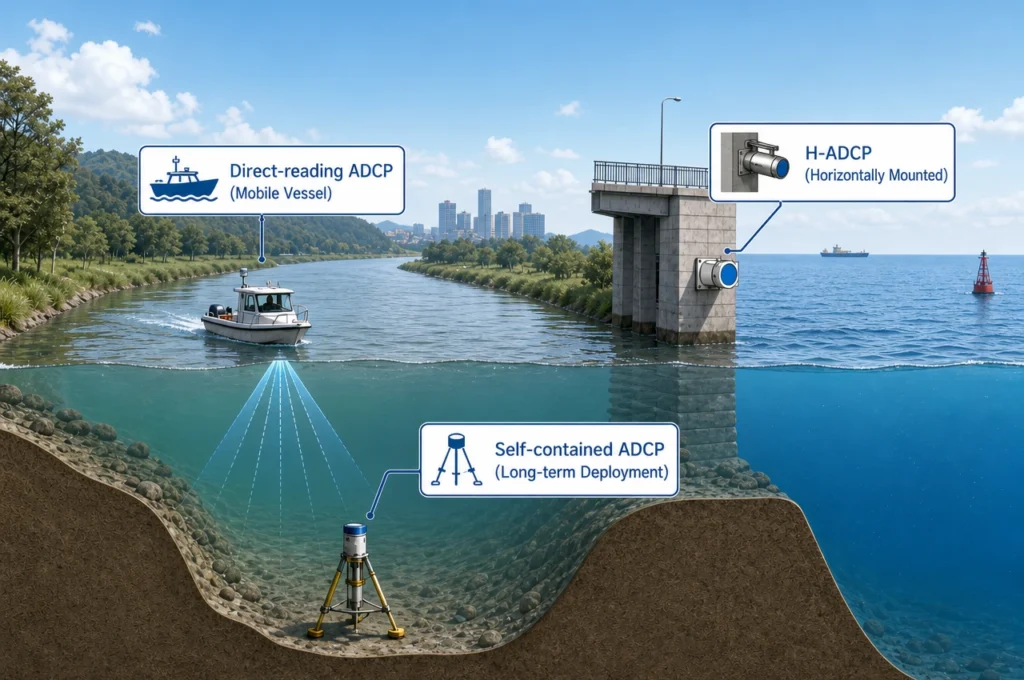
Unlike a standard ADCP that profiles vertically from a boat or buoy, an HADCP is mounted horizontally on a riverbank, bridge pier, or channel wall. It sends acoustic beams across the river to measure flow continuously—making it ideal for real-time flood warning and water resource management.
ADV — Acoustic Doppler Velocimeter
ADV measures velocity at a single point with extremely high precision. It is the tool of choice for laboratory flume studies and turbulence research where you care about one precise location rather than a full depth profile.
More Acronyms
| Acronym | Full Form | Relevance |
|---|---|---|
| CTD | Conductivity, Temperature, Depth | Often deployed alongside ADCPs on research cruises |
| USBL | Ultra-Short Baseline | Underwater acoustic positioning; complementary to DVL |
| GNSS | Global Navigation Satellite System | Provides position reference for boat-mounted ADCP surveys |
| TRDI / RDI | (Teledyne) RD Instruments | One of the earliest ADCP manufacturers; pioneered the technology in the 1980s5 |
| BT | Bottom Tracking | Measuring sensor movement relative to the riverbed |
| WT | Water Tracking | Measuring water velocity relative to the sensor |
| PAM | Passive Acoustic Monitoring | Related hydrophone technology for underwater sound surveillance |
How Old Is the Term?
The first ADCP was developed in the late 1970s by Fran Rowe and Kent Deines at what would become RD Instruments (later acquired by Teledyne).5 The acronym entered scientific literature in the 1980s and has been industry-standard ever since—making the ADCP a technology with over four decades of continuous development.
→ Read more: From Lab Curiosity to AI-Powered Ocean Sensor: How ADCP Technology Evolved Across Four Phases
Frequently Asked Questions
What does ADCP stand for?
ADCP stands for Acoustic Doppler Current Profiler—a sonar instrument that uses sound waves to measure water current speed and direction across multiple depths.
What is the full form of ADCP in hydrology?
In hydrology and water resources, the full form is the same: Acoustic Doppler Current Profiler. National hydrology agencies—including the USGS, which has published extensive technical guidance on ADCP discharge measurements3—use ADCPs as standard equipment for river flow monitoring.
What is the difference between ADCP and DVL?
An ADCP is designed primarily for current profiling—measuring how water moves at many depths. A DVL (Doppler Velocity Log) is designed for vehicle navigation—it tracks how fast an underwater vehicle moves relative to the seafloor. Same physics, different application.
Why does ADCP use sound instead of light or radio?
Water absorbs electromagnetic energy extremely efficiently. Radar and visible light penetrate only millimeters to centimeters of water before attenuating.1 Sound, by contrast, travels kilometers through water—making acoustics the only practical way to remotely sense underwater currents at operational ranges.
What does “profiler” mean in ADCP?
“Profiler” refers to the instrument’s ability to measure across a vertical profile—a column of water from near-surface to near-bottom—rather than at a single point. The water column is divided into depth “cells,” and the ADCP reports a velocity vector for each cell independently.2
Where does the term ADCP appear most often?
You will see it in: government tender documents for hydrological equipment, environmental impact assessments for offshore wind farms, academic papers in journals like the Journal of Atmospheric and Oceanic Technology, and product specifications from acoustics manufacturers.
Learn More
- How ADCP Works — Acoustic Doppler Current Profiler Explained
- ADCP Beam Configurations: 4-Beam vs 5-Beam vs 9-Beam
- ADCP Price: 7 Hidden Costs That Determine What You’ll Actually Pay
- ADCP Manufacturers Comparison: 2026 Guide
- ADCP for River Flow Measurement: A Complete Guide
References
- Urick, R.J. (1983). Principles of Underwater Sound, 3rd ed. McGraw-Hill. — Standard reference on acoustic propagation in water; explains why electromagnetic waves are impractical for underwater remote sensing.
- Teledyne RD Instruments (2011). Acoustic Doppler Current Profiler: Principles of Operation — A Practical Primer. — Industry-standard document explaining how ADCPs divide the water column into depth cells to produce a velocity profile.
- Mueller, D.S., Wagner, C.R., Rehmel, M.S., Oberg, K.A., and Rainville, F. (2013). Measuring Discharge with Acoustic Doppler Current Profilers from a Moving Boat. U.S. Geological Survey Techniques and Methods, book 3, chap. A22. https://pubs.usgs.gov/tm/3a22/
- Le Coz, J., Pierrefeu, G., and Paquier, A. (2008). “Evaluation of river discharges monitored by a fixed side-looking Doppler profiler.” Water Resources Research, 44(4). — Peer-reviewed study validating HADCP technology for continuous river discharge monitoring.
- Rowe, F.D. and Young, J.W. (1979). “An Ocean Current Profiler Using Doppler Sonar.” Proceedings of OCEANS ’79, IEEE. — The paper that introduced the ADCP concept; the technology’s origin point.
Disclaimer: Oceantek is a manufacturer of ADCP and DVL instruments. This page is part of our effort to make acoustic Doppler knowledge accessible to students, engineers, and procurement professionals. Product links on this page point to oceanadcp.com, our company website.