There is a quiet assumption in oceanographic instrumentation that more beams, more depth cells, and more data always add up to a better measurement. They do not. For a large class of in-situ current monitoring tasks — buoy-mounted sensors, aquaculture net pens, effluent outfall monitoring, tidal harmonic stations — a full water-column velocity profile from an ADCP is not better data. It is the wrong instrument, solving a problem you do not have, at a cost you do not need to pay. This article compares the single-point current meter (SPCM) with the acoustic Doppler current profiler (ADCP) across real-world deployment scenarios, so you can choose the right tool — not the more expensive one.
What Is a Single-Point Current Meter?
A single-point current meter measures water velocity at one fixed depth. It uses a compact acoustic transducer — typically operating at 1–2 MHz — to transmit and receive a short-range Doppler pulse from a small sampling volume (a few centimeters across) directly in front of the sensor head. The result is a single velocity vector: speed and direction at that depth, at that moment.
The OCEAN-SPCM is a single-point current meter in Oceantek’s product line. It outputs real-time velocity data over RS-232 or RS-422, runs on low DC power, and is designed for deployment on mooring lines, buoy hulls, bottom frames, and vessel-mounted profiling systems where a single depth is the only depth that matters.
Think of an SPCM as a surgical instrument. An ADCP is a full-body scan. Both have their place. The mistake is ordering the full-body scan when you know exactly which organ you are looking at.
What Is an ADCP (and Why It Is Usually Over-Specified)?
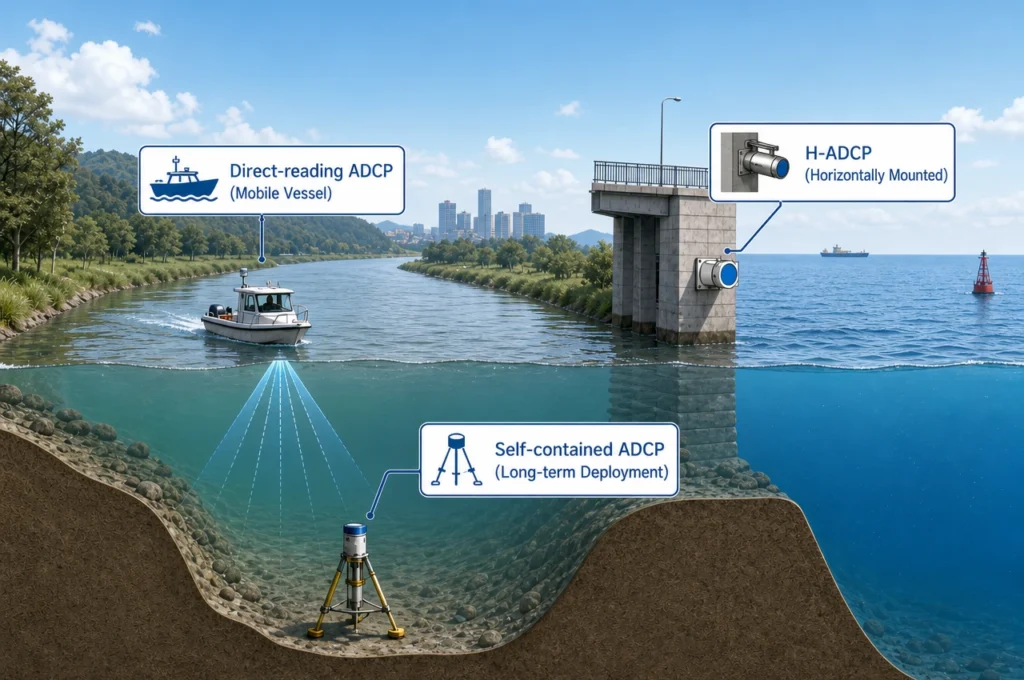
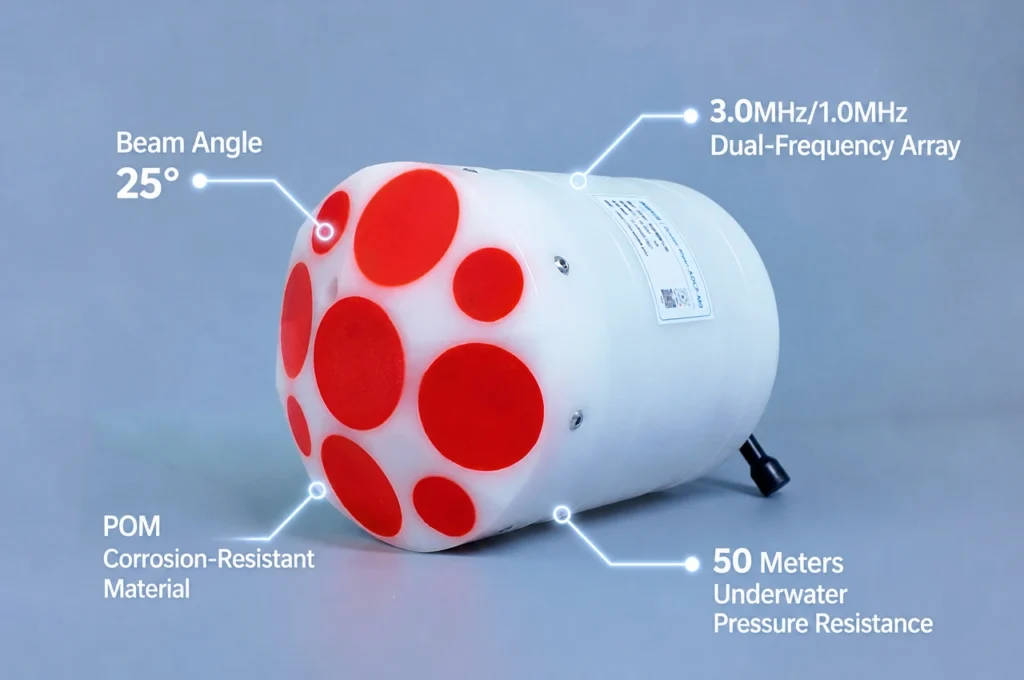
An Acoustic Doppler Current Profiler divides the water column into many depth cells — anywhere from 20 to 128 bins, each 1–8 meters thick — and measures velocity independently in each cell. A 600 kHz ADCP can profile from 55 m to 70 m of water depth; a 300 kHz unit reaches 120–160 m. This is indispensable for river discharge measurement, coastal oceanography, and any application where the velocity structure across the entire water column is the measurement objective.
But if your question is “what is the current speed at 5 meters depth on this mooring?” — an ADCP is measuring 50 depth cells and throwing away 49 of them. You are paying for hardware, power, data storage, and processing complexity that contribute nothing to your answer.
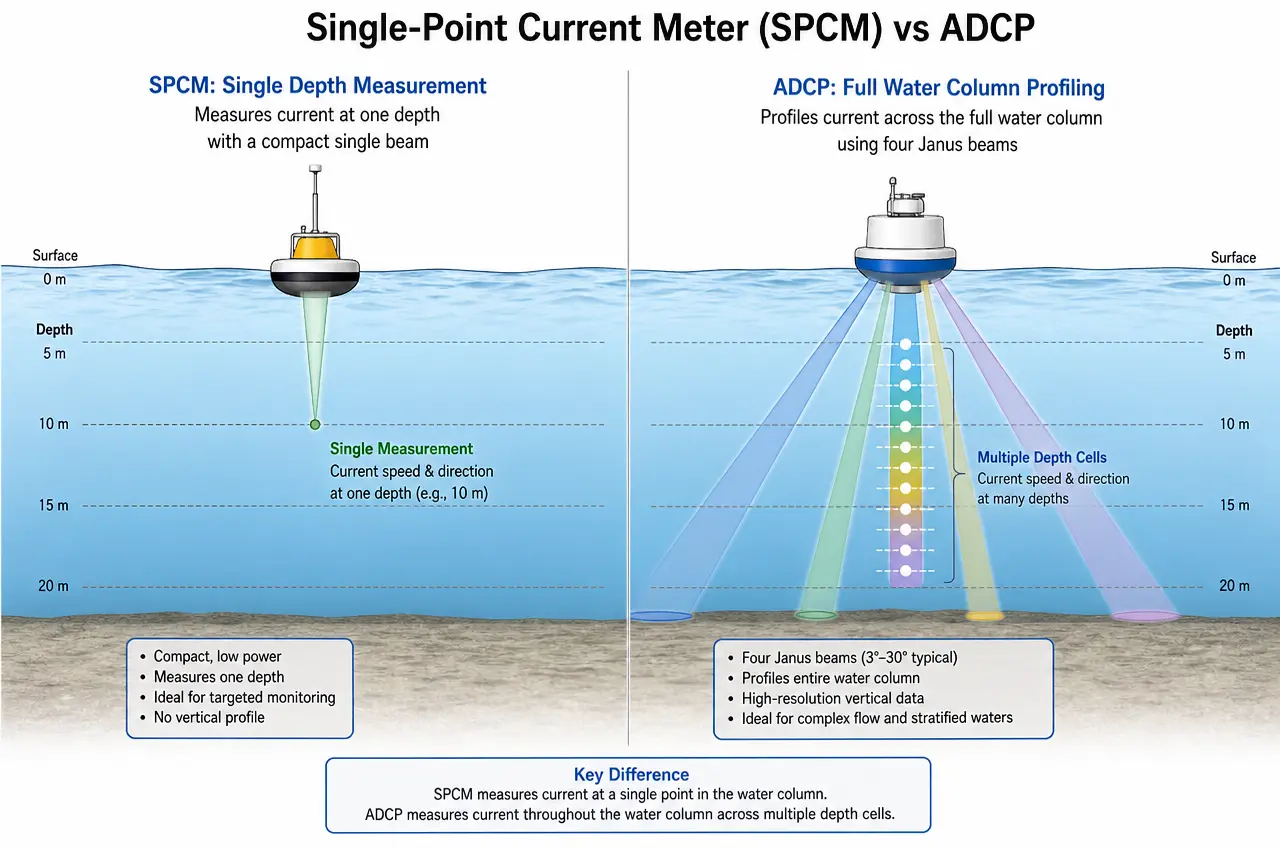
Single-Point Current Meter vs ADCP: Key Differences
| Feature | Single-Point Current Meter (OCEAN-SPCM) | ADCP (e.g., ADCP-600-DR-FA4) |
|---|---|---|
| Measurement volume | Single depth — one sampling volume (~cm scale) | Full water-column profile — 20–128 depth cells |
| Acoustic frequency | 1–2 MHz (high resolution, short range) | 300–600 kHz (longer range, coarser per-cell resolution) |
| Typical deployment | Mooring line, buoy hull, bottom frame, fixed structure | Vessel-mounted, towed body, bottom-mounted upward-looking |
| Power consumption | Very low (≤ 1–2 W typical) | Moderate (≤ 10 W typical at 600 kHz) |
| Data volume | Minimal — one speed/direction pair per sample | High — velocity vector per cell per sample |
| Physical size | Compact, typically < 0.5 kg, hand-deployable | Larger, 3.5–5 kg, requires mounting hardware |
| Approximate cost | Lower — single-channel acoustic front-end | Higher — multi-beam phased array, multi-channel DSP |
| Best for | Fixed-depth monitoring where only one layer matters | Discharge measurement, full-column surveys, navigation |
5 Scenarios Where a Single-Point Current Meter Is the Smarter Choice
1. Buoy-Mounted Current Monitoring
A data buoy sitting at a fixed station needs to report current speed and direction at one depth — typically 2–5 meters below the surface, where the buoy hull itself sits. This data feeds into weather models, port operations, and maritime safety broadcasts. Deploying an ADCP on a buoy gives you a velocity profile from the surface to the seafloor, but the surface layer is contaminated by wave orbital velocity, the mid-column data is redundant for the station’s reporting requirements, and the deep bins consume battery and telemetry bandwidth that the buoy does not have to spare.
An SPCM at the target depth draws less power, produces less data, costs less to replace if the buoy breaks free in a storm, and answers the only question the station is required to answer: what is the current doing right here, right now?
2. Aquaculture Net Pen and Fish Farm Monitoring
Fish farmers care about current speed at net depth. Too little flow, and dissolved oxygen drops, waste accumulates, and fish stress increases. Too much flow, and the net deforms, feed washes out, and fish expend energy swimming against the current instead of growing.
In a typical salmon farm, the net pen extends from 5 m to 25 m depth. The farmer needs to know the current at 15–20 m — the core of the pen volume. One SPCM at that depth delivers actionable data. An ADCP would profile the entire water column above and below the pen, none of which changes the operational decision. The SPCM costs less to purchase, less to power, and less to maintain when biofouling inevitably coats the sensor face after weeks in nutrient-rich fish-farm water.
3. Effluent Outfall and Industrial Discharge Monitoring
Regulatory permits for coastal outfalls — from desalination plants, power station cooling-water returns, and wastewater treatment facilities — typically require current monitoring at the discharge depth. If the outfall diffuser sits at 30 m, the regulator wants to know the current speed and direction at 30 m, because that determines the dilution and transport of the effluent plume.
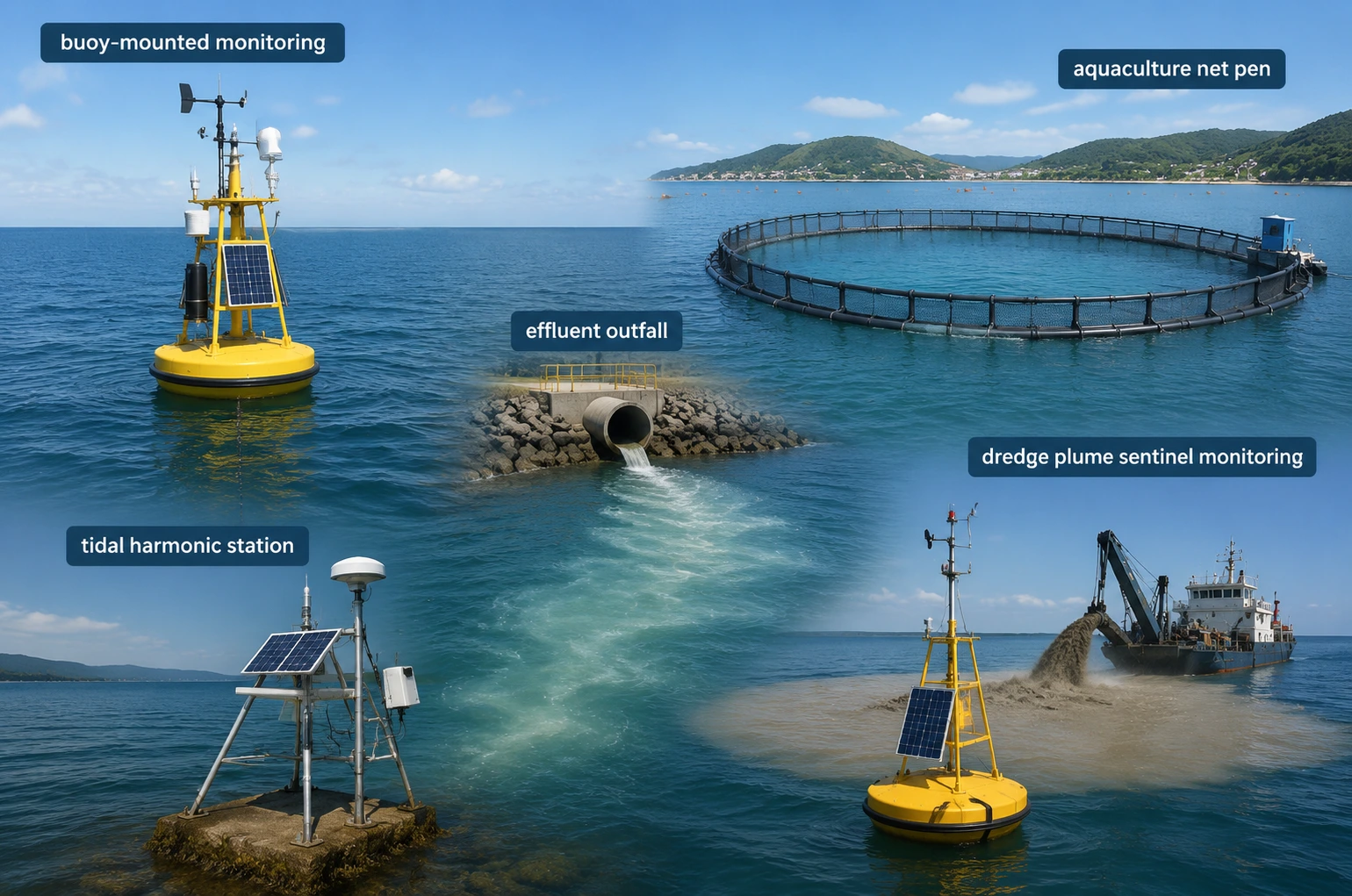
An SPCM deployed on a bottom frame next to the diffuser measures exactly what the permit requires. An ADCP mounted nearby would generate a beautiful velocity profile from the diffuser depth to the surface — but the regulator is not asking for that data, and the extra information does not change the compliance status. In a permitting context, simpler is better: fewer data channels mean fewer questions during audit.
4. Tidal Harmonic Analysis Stations
Tidal current prediction relies on harmonic analysis of long-term velocity records at fixed locations. The standard requirement is a current measurement at one representative depth — typically mid-water or near-surface — for a minimum of 30 days to resolve the principal lunar and solar constituents.
An SPCM deployed on a taut-line mooring at the target depth for 30–90 days produces a clean velocity time series with minimal post-processing. An ADCP on the same mooring would consume more power (requiring a larger battery pack or more frequent service visits), generate more data (most of which is discarded during harmonic analysis), and introduce additional quality-control steps for each depth cell. For tidal analysis, the extra profile data is not just unnecessary — it is a processing burden.
5. Dredge Plume and Suspended Sediment Monitoring
During dredging operations, environmental monitoring plans often require current measurement at a fixed depth near the dredge head or at a sentinel station downstream of the work area. The objective is to verify that currents are not transporting suspended sediment toward a sensitive habitat (coral reef, seagrass bed, or shellfish lease).
One SPCM at the depth of the sediment plume gives the dredge operator real-time go/no-go data. If the current is running toward the exclusion zone at a speed above threshold, operations pause. An ADCP on the same station would add a depth-resolved picture above and below the plume — interesting to the project oceanographer but irrelevant to the operational decision. The SPCM’s simplicity also makes it easier to deploy in multiples: three SPCMs at three depths for the same budget as one ADCP, giving you better spatial coverage of the plume transport pathway.
The Hidden Costs of Choosing an ADCP When an SPCM Will Do
The purchase price difference is the obvious factor. The less obvious costs compound over the life of a deployment:
| Cost Factor | SPCM Impact | ADCP Impact |
|---|---|---|
| Battery sizing | Small battery pack; months to years on a single set | Larger bank; higher continuous draw shortens deployment endurance |
| Data telemetry | Low bandwidth — transmits easily over satellite or cellular | High bandwidth — full profile data strains Iridium/SBD links |
| Post-processing time | Near-zero — one time series, one QA/QC pass | Significant — per-cell QC, side-lobe exclusion, correlation filtering |
| Biofouling maintenance | One transducer face to clean; small surface area | Four transducer faces; larger housing; more frequent cleaning |
| Replacement risk | Lower financial exposure if instrument is lost or damaged | Higher financial exposure — losing an ADCP to a trawler or storm is costly |
| Training requirement | Minimal — install, power on, record | Moderate — configuration, compass calibration, deployment geometry |
When You Actually Need an ADCP Instead
Being fair: there are scenarios where an SPCM is the wrong instrument and an ADCP is mandatory:
- River discharge measurement requires the full velocity profile across the cross-section to compute total flow. A single-point measurement cannot substitute. See our guide on ADCP for river flow measurement.
- Subsea vehicle navigation (DVL mode) needs bottom-track velocity, which requires four beams and sufficient acoustic power to reach the seafloor — beyond the capability of a single-point sensor.
- Coastal oceanographic surveys where the scientific objective is the vertical structure of currents (shear, stratification, internal wave propagation) demand the full water-column profile.
- Sediment flux studies that combine velocity profiles with acoustic backscatter calibration to estimate suspended sediment concentration through the water column.
The line is clear: if your question is “how fast is the water moving at this specific depth?” — SPCM. If your question is “how does velocity vary from surface to seabed?” — ADCP.
Where OCEAN-SPCM Fits
The OCEAN-SPCM is a direct-reading single-point acoustic current meter designed for the scenarios described above. It connects to a surface data logger, PLC, or telemetry modem over RS-232/RS-422 serial interface, delivers real-time velocity at a user-configurable sampling rate, and operates on low DC power (suitable for solar-powered buoy stations and battery-backed mooring deployments).
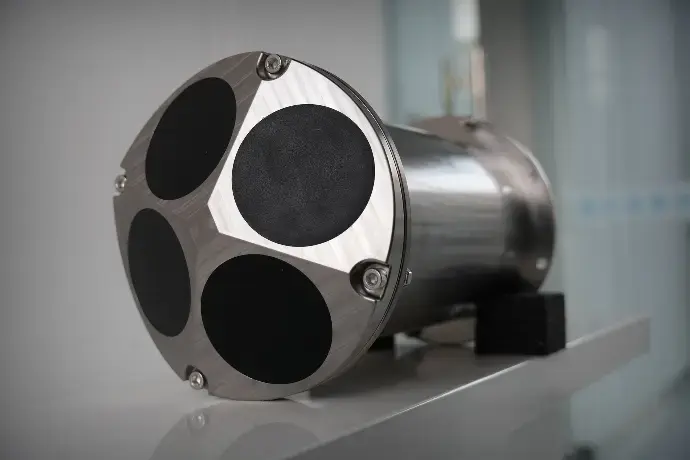
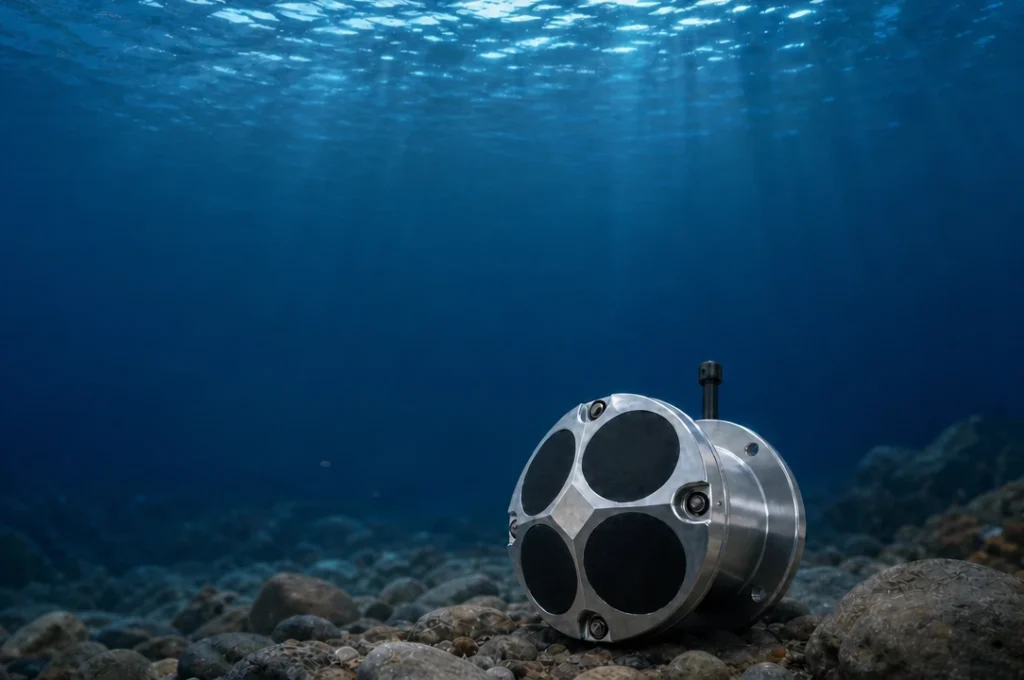
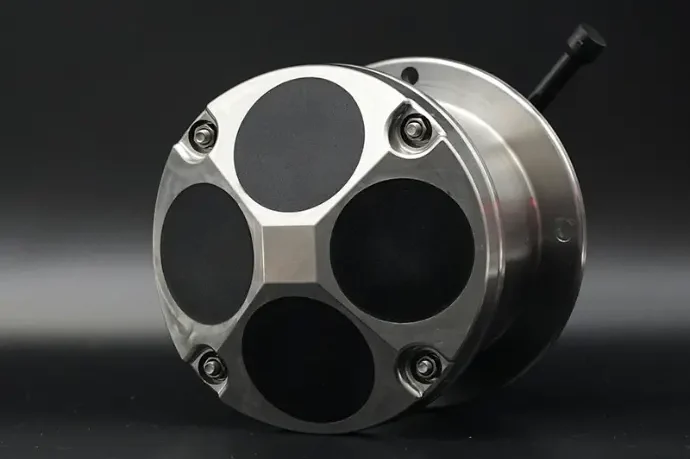
It shares the same titanium alloy transducer housing and acoustic engineering DNA as Oceantek’s direct-reading ADCP product family, which means the velocity accuracy and long-term stability are built on the same calibration infrastructure — just focused on one depth, not a hundred.
If you are already running an Oceantek ADCP on your survey vessel and need a complementary fixed-point current sensor for your mooring program, the OCEAN-SPCM talks the same data protocol and integrates into the same post-processing workflow.
Decision Guide: SPCM or ADCP?
| Your Application | Recommended Instrument | Why |
|---|---|---|
| Buoy-mounted surface current reporting | SPCM | One depth, low power, small data footprint |
| Fish farm net pen current monitoring | SPCM | Only pen depth matters; biofouling management is simpler |
| Outfall diffuser compliance monitoring | SPCM | Regulatory requirement is single-depth; simplicity aids audit |
| Tidal harmonic station (1-depth requirement) | SPCM | Long-duration deployment; minimal post-processing |
| Dredge plume sentinel monitoring | SPCM (multiple units) | Three SPCMs at three depths > one ADCP for plume tracking |
| River discharge measurement | ADCP | Full velocity profile required for cross-section integration |
| AUV/ROV subsea navigation | DVL (ADCP) | Bottom-track velocity reference required |
| Coastal oceanographic profiling survey | ADCP | Vertical structure of currents is the scientific objective |
Frequently Asked Questions
Can a single-point current meter measure direction as well as speed?
Yes. The OCEAN-SPCM and most modern acoustic single-point current meters measure both speed and direction using a 2D or 3D acoustic sensing volume. The instrument outputs velocity in vector components (east, north, up) or polar coordinates (speed, direction), same as an ADCP — just at one depth instead of many.
What is the accuracy difference between an SPCM and an ADCP?
At the single-point scale, an SPCM operating at 1–2 MHz can achieve comparable or better velocity resolution than an ADCP at its native depth-cell resolution, because the higher acoustic frequency produces a larger Doppler shift per unit of water velocity. The ADCP’s advantage is in covering many depths simultaneously, not in per-point accuracy. A well-calibrated SPCM and a well-calibrated ADCP agree within their published accuracy specifications at overlapping depths.
Can I deploy multiple SPCMs at different depths instead of buying an ADCP?
Yes — and for some applications this is the superior approach. Three SPCMs mounted at 5 m, 15 m, and 30 m on a mooring line give you current data at three key depths for less than the cost of a single ADCP. The trade-off: you get discrete measurements, not a continuous profile. If your application needs to know the velocity at every meter of the water column (e.g., discharge computation), the ADCP is the correct tool. If you only need to know the velocity at a few depths of interest, multiple SPCMs are more cost-effective, more power-efficient, and provide redundancy — if one SPCM fails, the other two continue collecting data.
What is the typical deployment duration for an SPCM?
With a properly sized external battery pack, an SPCM can operate continuously for months. Because power consumption is low (≤ 1–2 W), a modest lithium battery pack (e.g., 50–100 Ah at 12V) can sustain a deployment for 30–90 days with continuous sampling at 1 Hz. Self-contained variants with internal logging and battery compartments can be pre-configured for 6–12 month autonomous deployments, making them suitable for long-term ocean observatory moorings where annual service cruises are the norm.
Is an SPCM affected by biofouling?
Yes, all underwater acoustic sensors are susceptible to biofouling. However, an SPCM has a smaller transducer face than a four-beam ADCP, which means a smaller surface area to foul and easier cleaning. For long-duration deployments in high-fouling environments (tropical coastal waters, aquaculture sites), copper bezels, anti-fouling transducer coatings, or mechanical wiper systems can extend service intervals. The OCEAN-SPCM’s titanium housing is inherently corrosion-resistant and compatible with standard anti-fouling measures.
How do I choose between direct-reading and self-contained SPCM?
Direct-reading (OCEAN-SPCM) outputs data in real time over a cable to a surface display, data logger, or telemetry system. Choose this for buoy stations with satellite or cellular telemetry, vessel-mounted real-time monitoring, and any application where you need to see the data while the instrument is in the water. Self-contained SPCMs log data internally to flash memory and are recovered for data download after the deployment. Choose this for long-term moorings without surface expression, deep-water deployments, and applications where real-time access is not required. For more on this distinction, see our article on direct-reading vs self-contained instrument architectures.
Summary
| If You Need… | Choose | Because |
|---|---|---|
| Current speed and direction at one depth | SPCM | That is exactly what it is designed to do |
| Lowest total cost of ownership over 5-year deployment | SPCM | Cheaper to buy, power, maintain, and replace |
| Real-time telemetry over satellite or cellular | SPCM | Small data packets; a full ADCP profile may exceed bandwidth caps |
| Velocity at multiple depths for discharge or oceanography | ADCP | SPCM fundamentally cannot produce a profile |
| Underwater vehicle navigation (DVL) | DVL | Bottom-track velocity requires four-beam Janus geometry |
The right instrument is not the one with the most features. It is the one whose capabilities match the question you are asking. For a large and growing class of fixed-depth current monitoring applications, a single-point current meter is not a compromise — it is the instrument of choice. The OCEAN-SPCM exists precisely because not every deployment needs a profile. Some need a single, reliable, accurate number at one depth. And that is exactly what it delivers.
For product specifications and deployment inquiries, contact sales@oceanadcp.com. To compare the complete Oceantek product family, visit the products page. For the ADCP side of the story, see our ADCP working principle guide and 600 kHz ADCP specifications deep-dive.