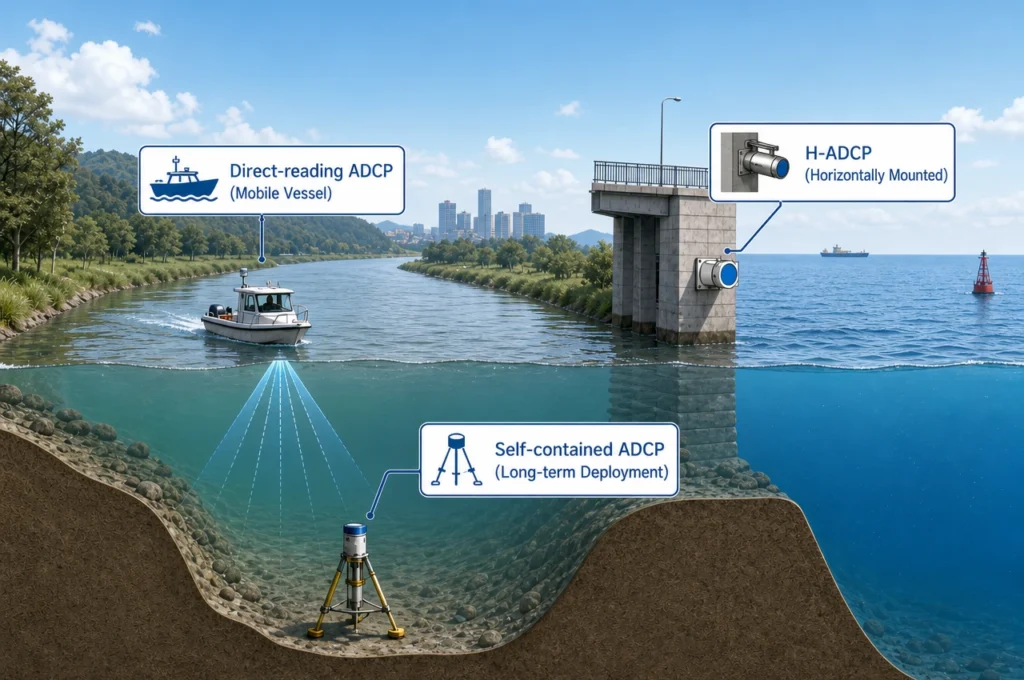
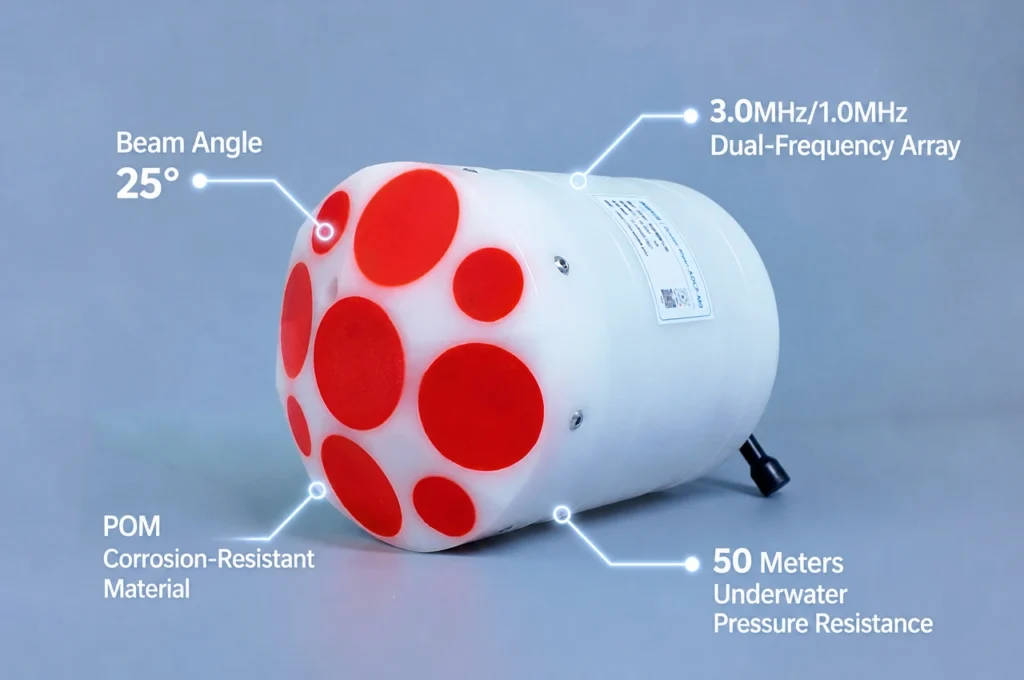
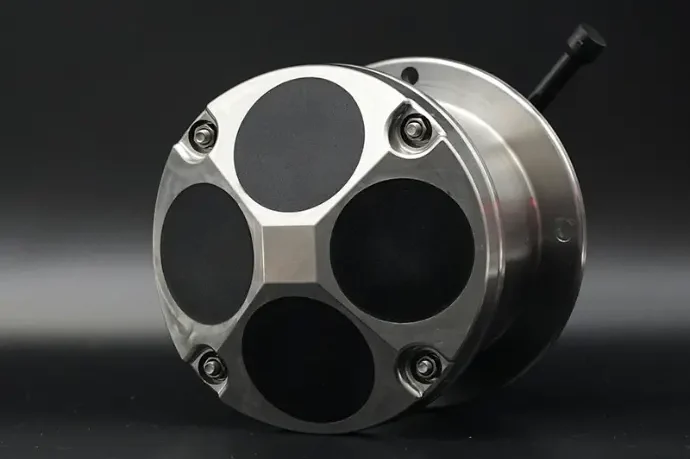
The same ADCP transducer head can be deployed in two fundamentally different ways: connected to the surface by a cable for real-time data access, or sealed with an internal battery and left alone on the seafloor for months at a time. The transducer technology — the acoustic beams, the signal processing, the velocity measurement principle — is identical. What changes is how you get data out of the instrument and how you keep it powered. And that choice has more impact on your project’s logistics, budget, and risk profile than most first-time buyers realize.
This is not a “better versus worse” comparison. Direct-reading and self-contained configurations each solve different operational problems, and many monitoring programs end up using both. The key is matching the configuration to your specific deployment scenario — and understanding the hidden costs and failure modes of each approach before you commit budget.
How Direct-Reading ADCPs Work
A direct-reading ADCP sends velocity data to the surface in real time through a physical cable — typically RS-232, RS-485, or Ethernet depending on the instrument model and cable length. Power is supplied continuously from the surface through the same cable or a separate power conductor, so there is no battery to exhaust and no deployment duration limit imposed by the instrument itself. The operator sits at a surface computer (a deck unit or ruggedized laptop) and watches velocity profiles appear in real time as the instrument collects them.
The operational advantage of real-time data access is difficult to overstate. If the instrument is misconfigured — wrong profiling range, too coarse a cell size, interference from a nearby structure — you discover the problem immediately, adjust settings, and resume data collection. If data quality degrades because of a shifting deployment frame or biofouling on the transducer face, you see it in the live display and can take corrective action. In a self-contained deployment, those problems go undetected until recovery day, at which point you may discover you have months of unusable data with no opportunity to redeploy.
The trade-off is the cable. Subsea cables add cost, weight, and failure risk to any deployment. A cable for a 300-meter deployment is heavy and requires a winch for handling. Cables are vulnerable to abrasion on rocky bottoms, snagging by fishing gear, and fatigue at the connector where the cable enters the instrument housing. The cable and its handling equipment — winch, slip rings, deck leads — often cost as much as the ADCP itself. For vessel-mounted surveys where the instrument is over the side for hours to days, the cable is a manageable inconvenience. For permanent installations, it is a structural element of the deployment that requires as much engineering attention as the instrument.
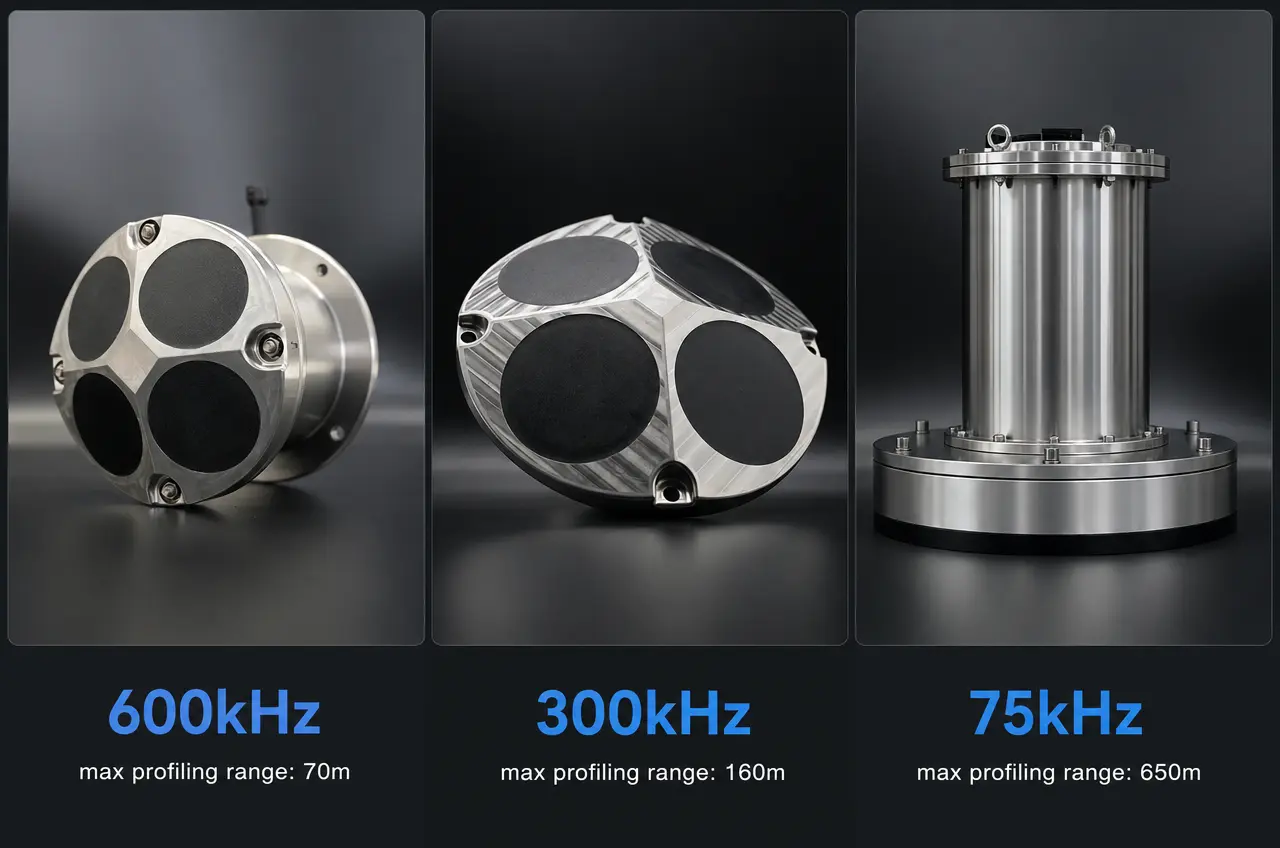
The Oceantek direct-reading ADCP series covers all standard frequencies (75kHz , 300kHz, 600kHz and dual frequency M9) in this configuration, with cable options matched to deployment depth and data bandwidth requirements. For vessel-mounted discharge measurements, real-time monitoring stations with shore power, and any application where you need to see the data now — not after a recovery cruise scheduled three months from now — direct-reading is the configuration you want.
How Self-Contained ADCPs Work
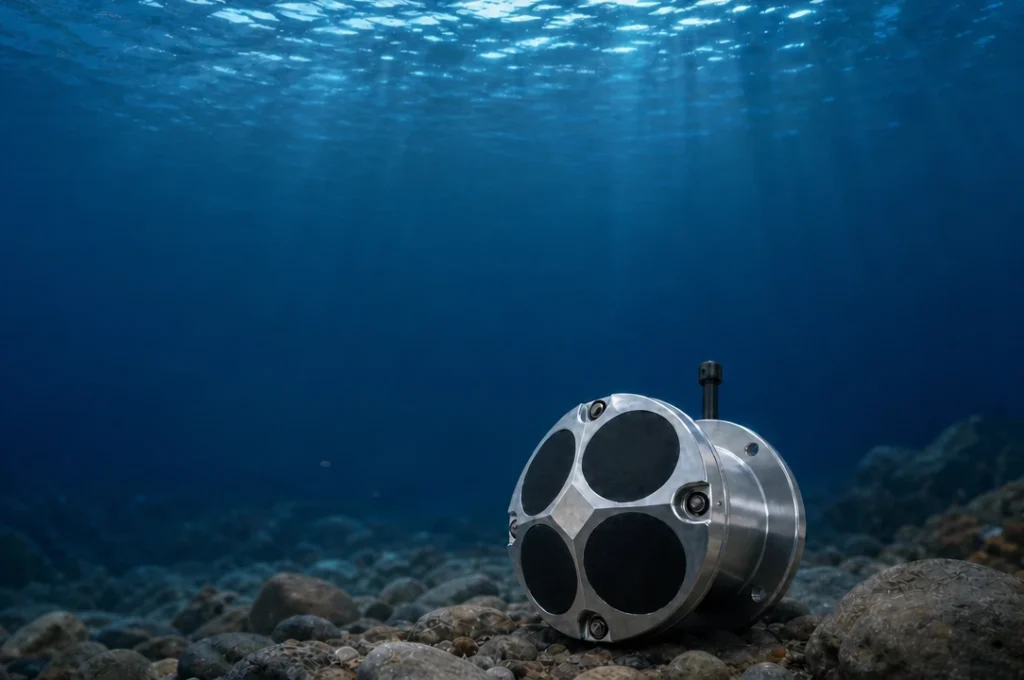
A self-contained ADCP carries its own battery pack and internal data storage — typically a solid-state memory card or built-in flash storage with capacity for months of continuous recording. It is deployed on a mooring, a seabed frame, or inside a buoy, and left to record autonomously for weeks to months. Data is retrieved only after the instrument is physically recovered. There is no real-time telemetry, no way to check on data quality mid-deployment, and no ability to adjust settings without retrieving the instrument.
What you give up in real-time access, you gain in deployment flexibility. A self-contained ADCP can be deployed anywhere you can lower a mooring — deep water, remote locations, under ice, in shipping lanes where a surface cable would be impossible. The absence of a cable simplifies deployment logistics dramatically: no winch, no slip rings, no cable terminations. A two-person team in a small boat can deploy a self-contained mooring that would require a dedicated survey vessel and crew if a cable were involved.
The fundamental constraint is the battery. Every sample costs energy — transmitting an acoustic ping, receiving the return signal, processing the Doppler shift, writing data to storage. The faster you sample, the shorter your deployment endurance. At one profile per hour, a self-contained ADCP with a standard battery pack might run for six to twelve months. At one profile per second, it might exhaust its battery in two weeks. The art of autonomous deployment planning is balancing sampling frequency against required endurance, and understanding that you cannot have both maximum temporal resolution and maximum deployment duration from the same instrument.
The Oceantek self-contained series supports deployments of up to 12 months depending on sampling interval, battery configuration, and water conditions. For hydrographic monitoring networks that need long-term current data from sites visited only once or twice per year, this is the only practical configuration.
Key Comparison at a Glance
| Factor | Direct-Reading | Self-Contained |
|---|---|---|
| Data access | Real-time, continuous | Ethernet, RS serial port, SD card |
| Power source | Surface supply (unlimited) | Internal battery (finite endurance) |
| Max deployment duration | Indefinite (with shore power) | 1–12 months (sampling-rate dependent) |
| Cable required | Yes — significant cost and handling complexity | No — simpler logistics, smaller vessel required |
| Live QA/QC | Yes — detect and correct problems immediately | No — data quality issues discovered only after recovery |
| All-in system cost | Higher (cable + winch + deck unit) | Lower (no cable, no deck unit) |
| Typical applications | Vessel surveys, real-time monitoring stations, short-term deployments | Long-term moorings, remote sites, deep-water deployments |
| Failure modes | Cable damage, connector fatigue, winch failure | Battery exhaustion, memory full, undetected biofouling |
The Hidden Cost: Cable Infrastructure
Many first-time buyers compare direct-reading and self-contained ADCP costs by looking at the instrument price alone. This is a mistake. A direct-reading system requires a cable — and cable costs scale non-linearly with deployment depth. A 50-meter cable for shallow-water work costs hundreds of dollars. A 500-meter armored cable rated for open-ocean deployment costs thousands to tens of thousands, and requires a powered winch, slip ring assembly, and deck leads to route the signal to the surface computer. The cable, winch, and handling gear often exceed the cost of the ADCP for deep-water direct-reading systems.
The self-contained configuration eliminates all of these costs. The instrument, battery pack, and mooring hardware are the complete system. For programs with budget constraints — and that describes most programs — self-contained deployment is often the only way to afford the instrument in the first place. The price you pay is not in dollars but in operational risk: if the instrument fails silently, you lose the deployment.
Deployment Scenarios: Which Configuration Fits Your Project
Choose Direct-Reading When:
Your deployment is short-term — hours to days — and you need to see data in real time to make operational decisions. This covers vessel-mounted discharge measurements, tidal stream energy site surveys, and dredge plume monitoring where the survey plan adapts to what the currents are actually doing. It also covers permanent monitoring stations with shore power where the cable is installed once and left in place for years. In these scenarios, the cable cost is amortized over many deployments or years of continuous operation.
Choose Self-Contained When:
Your deployment is long-term — weeks to months — and visiting the site daily is impractical or impossible. Deep-water moorings, remote coastal stations, under-ice deployments, and monitoring programs where the instrument is recovered by a different team on a different cruise months later all demand self-contained configuration. If the cable logistics would dominate your deployment budget, self-contained is your answer.
The Hybrid Approach: Self-Contained with Acoustic Telemetry
There is a middle ground that is increasingly common in modern monitoring programs. A self-contained ADCP stores full-resolution data internally for the entire deployment, but an acoustic modem periodically transmits summary data — mean velocity, direction, significant wave height — to a surface buoy that relays it via satellite or cellular telemetry. You get near-real-time situational awareness (enough to know if the instrument is still working and whether currents are within expected ranges) without the cost and vulnerability of a physical cable.
This approach is well suited to tsunami early warning systems, offshore wind farm current monitoring, and any application where losing a few months of data before discovering an instrument failure is unacceptable, but the full resolution of a direct-reading cabled system is not required. The acoustic modem and surface buoy add cost, but far less than a cable-to-shore installation at a remote site.
Making the Final Decision
Start with your deployment logistics. How often can you physically visit the instrument? If the answer is “daily” or “continuously,” direct-reading makes sense. If the answer is “seasonally” or “annually,” self-contained is your only option. Next, ask whether you need data in real time for decision-making — closing a shipping channel, adjusting a dredge operation, triggering a flood warning. If yes, direct-reading (or self-contained with telemetry) is required. If you can wait for post-processing, self-contained saves money and simplifies logistics.
Finally, be realistic about your budget — not just for the instrument, but for the complete deployed system including cables, winches, moorings, and vessels. A direct-reading ADCP that requires a $30,000 winch and a dedicated survey vessel to deploy is not a cheaper alternative to a self-contained unit just because the instrument price was lower. Total cost of ownership over the full deployment lifecycle is what matters.
If you are still unsure which configuration fits your specific project, contact Oceantek with your deployment details — depth, duration, desired sampling rate, and site accessibility — for a configuration-specific recommendation.