Executive Summary
Vietnam operates 2,807 hydro-meteorological stations, but hydrological observation is only 69% automated — one of every three stations still depends on manual discharge measurement. After Typhoon Yagi’s 2024 catastrophe, modernization money is moving, and the procurement trail is public. This article assembles the evidence: the 2019 NBD-TB2 package in which Vietnam’s hydro-meteorological administration bought ADCPs for its southern reference stations (review panel: Teledyne RDI), a 2021 Nortek Signature 1000 award, the World Bank pipeline (US$310 million Mekong Delta project, US$116 million Can Tho project), and the non-ADCP competitors (surface-velocity radar). For an ADCP supplier, this is the map of who buys, what they buy, and how bids are won in Vietnam.
Table of Contents
- The Institutional Landscape: Who Owns Vietnam’s Water Data
- The Network by the Numbers
- The ADCP Evidence Trail: What Vietnam Has Actually Bought
- The Non-ADCP Competition: Radar, SVR and Where ADCPs Win
- The World Bank Pipeline: Mekong Delta and Can Tho
- How Bids Are Won: Channels, Integrators and the Replacement Cycle
- The Procurement Map in One Table
- FAQ
1. The Institutional Landscape: Who Owns Vietnam’s Water Data
Vietnam’s hydrometeorological system is a three-tier pyramid under the Ministry of Agriculture and Environment (MONRE), and every tier is a potential buyer:
- Tier 1 — VNMHA (Vietnam Meteorological and Hydrological Administration): the national regulator and asset owner, which procures at national scale and sets technical standards.
- Tier 2 — NCHMF and 9 regional centres: the National Centre for Hydro-Meteorological Forecasting (est. 2003) issues forecasts for the north, centre and south river basin systems, while the nine regional hydro-meteorological centres — such as the Southern Regional Centre that received the 2019 ADCP package — operate the field stations.
- Tier 3 — 53 provincial centres: the operational layer for local flood warnings, and the fastest-growing segment of small-scale instrumentation demand.
Two agencies complete the buyer map. NAWAPI (the national water resources planning and investigation centre) runs surface-water flow surveys — and in June 2026 signed a memorandum with engineering firm TECOTEC on digitizing its measurement equipment, signalling a fleet-replacement cycle. And the World Bank project management units for the Mekong Delta and Can Tho programmes procure through international lending rules (Section 5).
2. The Network by the Numbers
The most recent official count, published by Nhan Dan on 3 October 2025, puts the national network at 2,807 stations with strikingly uneven automation:
| Observation type | Automation rate |
|---|---|
| Rainfall / thunderstorm | 100% |
| Marine observation | 74% |
| Hydrological observation | 69% |
| Meteorological observation | 65% |
The 69% hydrological figure is the market signal: roughly one in three river gauging stations still runs on manual discharge measurement — crews, cableways and current meters, exactly the workload an ADCP fleet eliminates. Two caveats for suppliers who quote these numbers. First, historical counts differ by vintage: a MRC country report listed 186 hydrological stations and a JAXA-era national report about 232 — the 2,807 figure reflects the expanded all-purpose network of the 2020s, so always cite the year. Second, the flood-forecasting system draws on about 195 river data stations per the Typhoon Committee mission report — a smaller, higher-value subset where accuracy upgrades matter most.
3. The ADCP Evidence Trail: What Vietnam Has Actually Bought
Vietnam’s public procurement record contains two concrete ADCP transactions — enough to confirm the market is real, and to show how it works.
3.1 NBD-TB2 (2019): the reference-station package
In June 2019, under the national project for building the climate-change and sea-level-rise monitoring network, VNMHA procured ADCP flow-measurement equipment for the reference hydrological stations of the Southern Regional Hydro-Meteorological Centre (package NBD-TB2). The published evaluation record is unusually informative: the review panel recommended Teledyne RDI instruments of the low-water-depth model class, and required the supplier to design a purpose-built mounting frame for the measurement boat (VNMHA evaluation record).
Three takeaways. One: “reference station” means the sites whose stage–discharge rating curves anchor the whole network — the accuracy-critical tier where buyers accept no compromise. Two: the panel named a brand, which tells suppliers the competitive benchmark set in Vietnam. Three: the mounting-frame requirement shows procurement is outcomes-driven — the boat, the frame and the training are part of the deal, not afterthoughts.
3.2 The 2021 Nortek award and the muasamcong channel
The second public record: a Nortek Signature 1000 (1 MHz) ADCP procured in December 2021 for VND 2.08 billion, awarded to Vietnamese integrator Hai Au Technology JSC (award record on dauthau.asia). Public tenders flow through the national e-procurement system muasamcong (now muasamcong.mpi.gov.vn), where “ADCP” is a searchable keyword — the practical first step for any supplier tracking the market (search guide).
4. The Non-ADCP Competition: Radar, SVR and Where ADCPs Win
Vietnam is not defaulting to ADCPs for every site — and suppliers who understand the split win more bids.
The clearest counter-case is the World Bank–funded VN-Haz project in the Central Highlands: 14 new automatic stations (water level + rainfall, GPRS telemetry), of which 8 carry surface-velocity radar sensors with cameras and water-temperature probes — Vietnam’s first deployment of surface-velocity measurement, delivered by Italy’s CAE (CAE case study). Separately, Finland funded US$30.75 million of dual-polarization weather radar (2016–2020), upgrading Vietnam’s precipitation sensing (JICA record).
The resulting division of labour, visible in Vietnam’s own procurement choices:
| Technology | Where Vietnam deploys it | Why |
|---|---|---|
| Surface-velocity radar | Continuous flood stations, remote/hazardous sites | Low cost per station, no moving parts, 24/7 |
| Weather radar | Rainfall nowcasting | Basin-scale precipitation input |
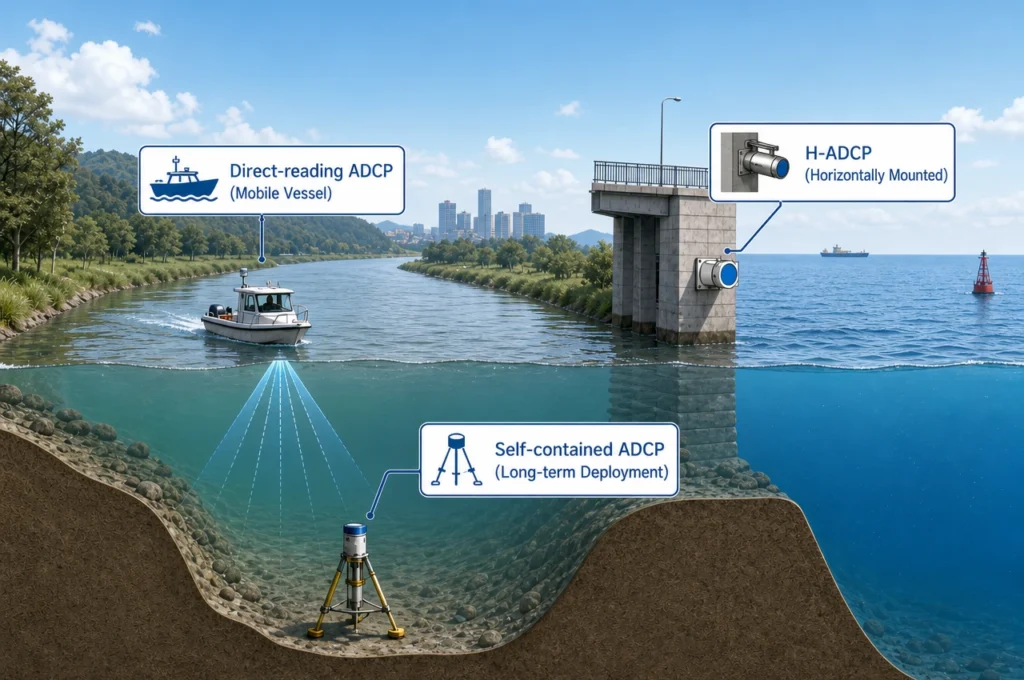
| ADCP (moving-boat) | Reference stations, rating-curve development, flood verification | Full-profile accuracy, moving-bed correction, mobility across stations |
| Fixed H-ADCP | Permanent discharge stations at control sections | Continuous velocity-index discharge without crews |
The radar deployments are the complement, not the threat: surface-velocity sensors still need ADCP-based calibration against the true mean velocity, and every rating curve they feed requires periodic re-verification by a profiler. Vietnam’s own HUNRE research used ADCP measurements at 17 tidal stations precisely to build surface-to-mean velocity relationships — the standard method for making radar data trustworthy.
5. The World Bank Pipeline: Mekong Delta and Can Tho
The next ADCP-scale purchases will ride on two World Bank programmes with public budgets and defined monitoring components.
MDICRSLP — the Mekong Delta Integrated Climate Resilience and Sustainable Livelihoods Project (P153544, approved 2016): IDA financing of US$310 million against a total cost of about US$387 million, including a ~US$14.5 million regional environmental data centre for the delta, upper-delta flood protection around An Giang’s An Phu area, estuary salinity adaptation and peninsula coastal protection (project appraisal document). Every monitoring component — salinity, flood and coastal — consumes discharge and current data.
Can Tho climate resilience and integrated transformation project (2026): announced in July 2026 at about VND 2,999 billion (≈US$116 million), with World Bank ODA of roughly US$77 million, expected to be signed in Q3 2026 (reported by Thoi Bao Tai Chinh).
Together with the post-Yagi warning upgrades now rolling out — including the national marine buoy station standard (TCVN/QCVN) announced in November 2025 by VNMHA (VNMHA notice) — the 2026–2030 window is the densest Vietnamese instrument procurement cycle in a decade.
6. How Bids Are Won: Channels, Integrators and the Replacement Cycle
Five practical observations for a supplier entering this market:
- The channel is muasamcong — the national e-procurement portal. World Bank–financed packages add international competitive bidding rules; the rest are domestic tenders where a local bidder structure matters.
- Integrators win; OEMs partner. The 2021 Nortek award went to Hai Au Technology, not to the manufacturer. The winning model in Vietnam is an OEM–integrator alliance covering bid documents, service, training and warranty.
- Reference stations buy accuracy; networks buy reliability. Frame your offer to the tier: profiler-class instruments for the anchor stations, continuous fixed stations for the network, calibration services for everything.
- The replacement cycle is starting. NAWAPI’s June 2026 digitization memorandum with TECOTEC is the clearest signal that legacy survey equipment is being replaced — with the 69% automation figure as the size of the remaining gap.
- Budget is project-tied. Vietnam funds instrumentation through named projects (NBD-TB2, VN-Haz, MDICRSLP, Can Tho) rather than standing budgets — so suppliers should monitor project pipelines, not just tender portals.
7. The Procurement Map in One Table
| Buyer | Need | Instrument class | Signal strength |
|---|---|---|---|
| VNMHA / regional centres | Reference-station flow accuracy, fleet renewal | Moving-boat ADCP (600 kHz class, shallow-water models) | High — NBD-TB2 precedent |
| 53 provincial centres | Local flood warning, small gauging fleets | Shallow-water ADCP + fixed H-ADCP | Medium — growing with post-Yagi budgets |
| NAWAPI | Survey fleet digitalization | Profiler + service/calibration | Medium — 2026 MOU in motion |
| World Bank PMUs (MDICRSLP, Can Tho) | Delta salinity/flood monitoring components | ADCP + telemetry, consultant-driven specs | High — 2026–2030 window |
| VN-Haz-style projects | Low-cost continuous stations | Surface-velocity radar (ADCP for calibration) | Medium — radar-first, ADCP-anchor |
FAQ
How many hydro-meteorological stations does Vietnam operate?
2,807 as of October 2025 (Nhan Dan). Automation: rainfall 100%, marine 74%, hydrology 69%, meteorology 65% — leaving roughly one in three river stations on manual discharge measurement.
Has Vietnam’s government actually purchased ADCPs?
Yes. Package NBD-TB2 (June 2019) bought ADCP equipment for the Southern Regional Hydro-Meteorological Centre’s reference stations, with the panel recommending Teledyne RDI (evaluation record); a Nortek Signature 1000 followed in December 2021 at VND 2.08 billion (award record).
Which agencies buy hydrological instruments in Vietnam?
VNMHA with its 9 regional and 53 provincial centres, the forecasting centre NCHMF, the survey agency NAWAPI, and World Bank project management units for the Mekong Delta and Can Tho programmes.
Is Vietnam choosing ADCPs or surface-velocity radar?
Both, by role. The VN-Haz project put surface-velocity radar on 8 of 14 new automatic stations (CAE case study), while ADCPs hold the accuracy-anchor role at reference stations. Radar stations still need ADCP-based calibration of their surface-to-mean velocity relationships.
How do foreign suppliers bid for Vietnamese hydrological tenders?
Through muasamcong (muasamcong.mpi.gov.vn) for public tenders and World Bank rules for financed packages. In practice awards flow through Vietnamese integrators — Hai Au Technology won the 2021 ADCP package — so OEM-level local partnerships are the effective entry path.
Sources: All figures in this article are drawn from the following primary documents, cited inline above with their institution and date.
- Nhan Dan — national network of 2,807 stations and automation rates (Oct 2025)
- NCHMF — institutional profile of the national forecasting centre
- VNMHA — NBD-TB2 package evaluation: ADCPs for southern reference stations (2019)
- dauthau.asia — Nortek Signature 1000 ADCP award, VND 2.08 billion (Dec 2021)
- dauthau.asia — guide to searching the muasamcong national procurement portal
- CAE — VN-Haz case study: 14 automatic stations, 8 with surface-velocity radar
- World Bank — VN-Haz project file E1102
- World Bank — MDICRSLP appraisal document (US$310M IDA, P153544)
- Thoi Bao Tai Chinh — Can Tho climate resilience project (≈US$116M, 2026)
- JICA — Finland’s US$30.75M weather radar assistance (2016–2020)
- Typhoon Committee — mission report: ~195 river data stations in flood forecasting
- MRC — Vietnam country report: 186 hydrological stations (historical count)
- VNMHA — national marine buoy station standard announced (Nov 2025)
Disclosure: This article describes publicly documented Vietnamese procurement records for educational purposes; it is not affiliated with VNMHA, the World Bank or any Vietnamese government agency. The June 2026 NAWAPI–TECOTEC memorandum is reported from public Vietnamese business press.
© 2026 Ocean (Hangzhou) Technology Co., Ltd.All rights reserved. Last updated: September 2, 2026.