Executive Summary
India operates one of the world’s largest river monitoring networks — 1,543 hydrological stations feeding 360 flood forecast sites across 20 river basins, run by the Central Water Commission (CWC). Until recently, most of that network measured discharge the slow way: surface floats and cup-type current meters, methods CWC itself acknowledged could carry errors of ±20%. The World Bank–funded National Hydrology Project (NHP) changed that. Between 2017 and 2025, a US$175 million IBRD loan modernized India’s hydrometry around ADCPs, telemetry and real-time data systems. This article reconstructs the rollout from official procurement records — the tenders, the specifications, the field campaigns — and explains why India’s next procurement cycle is a defining opportunity for instrument suppliers.
Table of Contents
- The Problem: A Network Built on Floats and Spinning Cups
- What the National Hydrology Project Is
- The ADCP Rollout: Tenders, States and 64+ Units
- What CWC’s Specification Demands
- ADCPs in the Field: Yamuna, Narmada and the Monsoon
- The Wider Modernization: Telemetry, Calibration and Satellites
- After 2025: India’s Next Procurement Cycle
- FAQ
1. The Problem: A Network Built on Floats and Spinning Cups
India’s hydrological network is vast, but for decades its measurement technology lagged the network’s ambition. Understanding what the NHP replaced is the key to understanding why ADCP procurement became a national priority.
1.1 The float era and its ±20% error
Until the early 2000s, much of India’s river discharge data was collected with the float method — timing surface floats across a marked section and applying a velocity correction factor (typically 0.8–0.9). Surface velocity is consistently higher than depth-averaged velocity, so the method is inherently approximate. CWC’s own hydrometry documents acknowledge that discharge figures recorded up to the year 2000 “may have larger error as compared to current meter observations,” with potential errors around ±20% relative to current-meter or ADCP values, as detailed in CWC’s training material on hydrometric data acquisition (see the NHP hydrometry workshop agenda).
1.2 Why cup-type current meters strain under monsoon conditions
The area–velocity method with cup-type current meters — still the workhorse at most CWC sites — solved the float method’s accuracy problem but introduced operational ones:
- Time: a full section measurement with 15–25 verticals takes hours, and a flood hydrograph does not wait.
- Labour: each gauging requires a crew, a cableway or boat, and manual recording.
- Safety: high monsoon flows make in-stream work dangerous precisely when data matter most.
- Night gauging is impossible: flood peaks arriving after dark simply went unmeasured.
- Point sampling: velocity is often read at a single 0.6-depth point per vertical, missing the vertical structure of unsteady flow.
Indian rivers compound every one of these problems. Alluvial channels of the Ganga–Brahmaputra system shift their beds during floods, invalidating rating curves just when they are needed. Monsoon flows are violently unsteady. And sediment concentrations — routinely above 1,000 ppm in flood season — attack mechanical instruments.
1.3 The cost of not measuring
The stakes are not abstract. The 2024 southwest monsoon delivered 934.8 mm of rainfall (107.6% of the long-period average) and extreme weather killed 1,492 people across India during the season, per IMD data reported by The Economic Times. Flood forecasts — issued at >338 sites in CWC’s 2024 SOP, rising to 360 in the 2026 SOP — are only as good as the discharge measurements that build their rating curves. Researchers evaluating alternatives such as entropy-based estimation for CWC gauging stations found errors of 11–14% versus roughly 3% for conventional velocity-area methods — and noted the deeper problem: India’s network historically could not measure at night or capture extreme events at all. For a deeper look at how these measurements feed warning systems, see our guide to ADCP-based flood early warning architecture.
2. What the National Hydrology Project Is
2.1 Three generations of World Bank hydrology projects
The NHP is the third act of a 30-year programme. Hydrology Project I (1995–2003) and Hydrology Project II (2006–2014) built India’s basic hydrological data systems; CWC’s annual reports describe NHP as the phase that “comprises institutional strengthening and vertical extensions of activities” begun under HP-II (CWC Annual Report 2019-20). Where HP-I/II laid pipes and trained staff, NHP bought modern instruments and connected everything to the internet.
2.2 The World Bank financing
The National Hydrology Project (World Bank project ID P152698) carried an IBRD loan of US$175 million (Loan No. 8725IN), approved on 15 March 2017, effective from 5 May 2017, closing on 31 March 2025. Total project cost reached approximately US$350 million including national co-financing, according to India’s DMEO national monitoring dashboard. The stated development objective: “improve the extent, quality, and accessibility of water resources information and to strengthen the capacity of targeted water resources management institutions in India.”
2.3 Four components, one goal
Per the World Bank Implementation Status Report, the project was structured in four components:
| Component | What it funded |
|---|---|
| Water Resources Monitoring System | The instrument fleet — ADCPs, stage radars, telemetry, real-time data acquisition systems (RTDAS) |
| Water Resources Information Systems | The IndiaWRIS platform and state data centres |
| Water Resources Operations & Planning | Flood forecasting, decision support and analytical tools |
| Institutional Capacity Enhancement | Training, standards, and institutional strengthening |
The executing agencies were the Ministry of Jal Shakti (Department of Water Resources, RD & GR), the Central Water Commission, and participating state water resources departments — which is why ADCP tenders appeared both nationally (CWC) and at state level (Sikkim, Uttarakhand, West Bengal and others).
3. The ADCP Rollout: Tenders, States and 64+ Units
The procurement trail is fully public, and it tells the story of the rollout in precise terms.
3.1 The two CWC national tenders
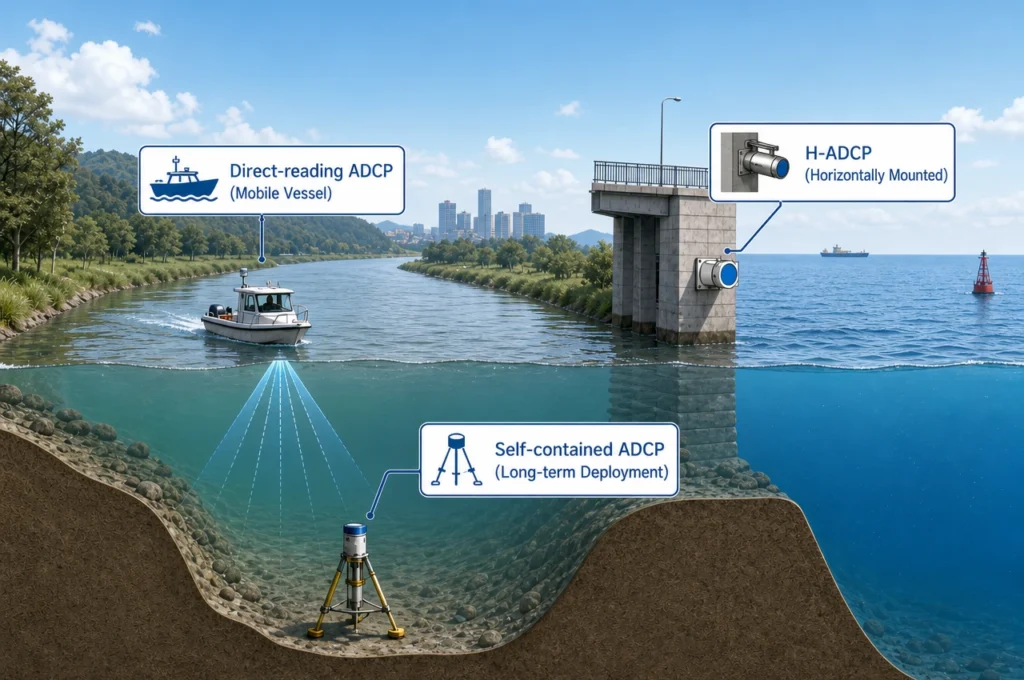
CWC ran its ADCP purchases as National Competitive Bidding (NCB) under World Bank procurement rules, through its River Data Compilation directorate:
- 2020 — 14 ADCPs: IFB No. NHP/2020/RDC-1/02/ADCP, “Supply, Installation, Testing and Commissioning of 14 nos. of Acoustic Doppler Current Profiler,” with a 90-day delivery requirement (tender document).
- 2021 — 50 ADCPs: IFB No. NHP/2021-RDC-1/03/ADCP, procurement of 50 additional ADCPs with delivery within 180 days (CWC tender notice).
Alongside the ADCPs, CWC procured 19 non-contact Discharge Measuring Systems / Velocity Radar Systems (VRS) for its regional offices. By the end of 2022, 40 ADCPs and 5 VRS had been supplied and installed at field sites, as reported in the Ministry of Jal Shakti’s Year End Review 2022.
3.2 The state-level tenders
State water resources departments ran parallel, World Bank–funded purchases — evidence that demand is institutional and distributed, not a one-off central buy:
| State / Agency | Year | Scope | Reference |
|---|---|---|---|
| Sikkim WRD | Jan 2019 | ADCP supply + installation + rating curve development for identified G&D sites (Bid No. NHP-02; bid security ₹90,000; document fee ₹4,000) | Sikkim NIT |
| Uttarakhand IRI Roorkee | Mar 2019 | ADCP procurement (Ref. NHP-2018-2019-UK-541991) | tender record |
| West Bengal IWD | Jan 2022 | World Bank–funded NCB, instrumentation for G&D sites | WBIWD tender |
Note the Sikkim scope: ADCP supply came bundled with rating curve development services — the buyer’s real goal is not hardware but a validated stage–discharge relationship at every gauging site. Suppliers who offer measurement services, not just boxes, match how Indian agencies actually buy.
3.3 How India buys: the mechanics that decide winners
Every NHP instrument purchase followed World Bank NCB procedure, and the pattern matters for any supplier planning a bid:
- Two-envelope bidding on government e-procurement portals (eprocure.gov.in and state portals), technical bid opened first, financial bid second.
- Digital Signature Certificates from Indian certifying authorities are mandatory for online bid submission.
- World Bank anti-corruption clauses: bidders must permit World Bank inspection and audit of records related to bid submission and contract performance.
- Training is contractual: tenders require vendor workshops and field training as part of delivery.
The World Bank procurement plan for P152698 sets the thresholds and review rules that still shape how these bids are run.
4. What CWC’s Specification Demands
CWC publishes its instrument specifications openly — a de facto national standard that suppliers must meet to be considered at all. The official CWC ADCP specification document defines the baseline:
| Parameter | CWC requirement |
|---|---|
| Frequency | 600 kHz — selected for wide, sediment-laden rivers |
| Velocity accuracy | ±0.25% ±2 mm/s |
| Beam configuration | Janus four-beam, 20–30° beam angle |
| Moving-bed correction | DGPS dual receiver, accuracy ≤0.5 m |
| Platform | Trimaran hull, ~10 kg, deployable from small boats |
| Telemetry | Bluetooth / radio link to field laptop |
| Warranty & support | 2-year warranty + 4–5 year comprehensive AMC |
| Budget envelope | ₹8–28.6 lakh per unit across recorded CWC tenders |
On standards: India’s legacy discharge standard is IS 1192-1981 (area–velocity method, referenced throughout the NHP hydrometry manual). For ADCP work, the applicable international standard is ISO 24578:2021, Hydrometry — Acoustic Doppler profiler — Method and application for measurement of flow in open channels from a moving boat. Indian tenders describe performance directly rather than citing a BIS ADCP standard — which is exactly why the 600 kHz / ±0.25% ±2 mm/s / DGPS trio functions as the national benchmark in practice.
Planning a bid? We have published a full vendor-side decode of CWC’s tender language, GeM mechanics and the IS 1192 / ISO 24578 standards landscape in a separate guide.
5. ADCPs in the Field: Yamuna, Narmada and the Monsoon
Procurement records show what was bought; field records show what it is now used for. Two documented campaigns illustrate operational ADCP use in Indian rivers.
5.1 The Yamuna basin, July 2025
The most recent on-the-record example: in July 2025, the Chief Engineer of CWC’s Yamuna Basin Organization carried out ADCP-based discharge measurement during a field inspection of gauge, discharge, silt and water quality sites at Delhi Railway Bridge, Palla and Baghpat (Ministry of Jal Shakti record). That is routine, operational ADCP use on the river that caused Delhi’s record 208.66 m flood in July 2023 — not a pilot study.
5.2 The Narmada SWOT calibration campaign, February 2020
Indian ADCPs are also anchoring the country’s satellite era. In February 2020, CWC and ISRO ran a synchronized field campaign on the Narmada River to calibrate the NASA–CNES SWOT altimetry mission, using ADCP measurements as ground truth: river width was measured at 510.29 m and discharge at 107.75 m³/s at the calibration site (OSTST conference abstract). When SWOT’s global river discharge products are validated against in-situ data, ADCP transects like this one are the reference.
5.3 Why ADCPs win the monsoon
Every limitation listed in Section 1 maps to a capability of a 600 kHz-class profiler:
- Unsteady flow: a full velocity profile in minutes captures the hydrograph’s shape, not a point sample of it.
- Moving bed: the DGPS bottom-tracking loop separates vessel motion from bed motion — the core correction Indian alluvial rivers demand.
- High sediment: 600 kHz bottom tracking maintains lock through the flood-season turbidity that defeats lighter instruments.
- Continuous operation: night gauging, flood peaks, and rapid redeployment between sites are all routine.
- Crew safety: measurements happen from a boat or bridge, not in the flow.
5.4 From measurement to forecast
The measurements feed directly into the forecast chain. CWC’s forecast network grew from 338 sites in the 2024 SOP to 360 in 2026 (200 level-forecast plus 160 inflow-forecast sites), and the Ministry’s 2025 achievements list Extended Hydrological Prediction — multi-week forecasts for the Yamuna, Narmada and Cauvery basins — as work in progress (PIB, DoWR achievements 2025). Multi-week forecasting multiplies the demand for accurate, frequently updated discharge data.
6. The Wider Modernization: Telemetry, Calibration and Satellites
ADCPs were one instrument family inside a much larger modernization. Suppliers who understand the full stack know where the next purchases will land.
6.1 Real-time telemetry at national scale
By March 2020, the World Bank’s Implementation Status Report counted 6,800 monitoring stations providing validated data online — against a baseline of 4,370 and an end target of 12,000 — including 1,316 surface water, 3,992 groundwater and 1,530 meteorology stations. Thirty-one agencies had integrated their data into IndiaWRIS, the national water resources information system. Every new gauging site in this network is a candidate for a fixed or survey-grade velocity instrument.
6.2 Calibration infrastructure: the CWPRS 7.5 m/s facility
Modern instruments need national calibration capacity, and India built it. Under NHP, the Central Water and Power Research Station (CWPRS) in Pune established a Testing, Calibration & Certifying Facility (TCCF), upgrading its current-meter trolley to 7.5 m/s for “calibration and performance testing of current meters, ADCPs, side-looking sensors and flow trackers”, while also assisting agencies with instrument specifications and training (CWC Annual Report 2019-20). A national ADCP calibration route means the installed fleet is expected to be serviced and re-verified — a recurring aftermarket that outlives the NHP itself.
6.3 Non-contact and satellite complements
The programme deliberately layered technologies:
- Stage radars and velocity radars (VRS): non-contact options for dangerous or inaccessible sites, 19 procured alongside the ADCP fleet.
- Satellite altimetry: SWOT and Sentinel-3 data, validated by ADCP ground truth (the Narmada campaign), for discharge estimation at sparsely gauged locations.
- Experimental methods: entropy-based discharge estimation evaluated at five CWC G&D sites in the Krishna and Godavari basins — measured at 11–14% error, notably worse than conventional velocity-area methods (NHP hydrometry study notes), reinforcing ADCP and current-meter measurements as the accuracy anchor.
6.4 The ecosystem effect
The result is a permanent institutional fleet: CWC regional offices and state departments now hold their own ADCPs, and support procurement has already begun flowing through GeM — India’s government e-marketplace — such as CWC’s March 2024 service contract for ADCP repair and maintenance worth ₹652,840. Hardware sales in India are the entry; calibration, AMC and training are the recurring revenue.
7. After 2025: India’s Next Procurement Cycle
7.1 What closed, and what continues
The NHP formally closed on 31 March 2025. What continues is the operational layer it built: IndiaWRIS, the CWPRS calibration facility, the 360-site forecast network, and the installed ADCP fleet at CWC and state departments. NHP was a construction phase; the asset base now needs feeding.
7.2 The signals pointing to the next cycle
- Forecast ambition is rising: the 2026 SOP’s 360 sites and the multi-week Extended Hydrological Prediction pilots (Yamuna, Narmada, Cauvery) imply more gauging density, not less.
- Fleet replacement and calibration: instruments procured in 2019–2022 are reaching mid-life; CWPRS calibration and GeM AMC contracts show the service market is already transacting.
- State-level follow-on: states that built capacity under NHP (Sikkim, West Bengal, Uttarakhand and others) now have their own budget lines and trained staff to procure independently.
- Every flood season renews the argument: the 2024 monsoon’s 1,492 fatalities keep flood measurement at the top of the political agenda — as does India’s GLOF early-warning build-out and its inter-state water-dispute measurement obligations, each covered in dedicated articles on this site.
7.3 What suppliers should take from this
For an instrument maker, India’s hydrology market has three concrete entry facts. One: the specification is public and stable — 600 kHz class, ±0.25% ±2 mm/s, DGPS moving-bed correction, trimaran deployability. Two: the purchase channels are defined — World Bank-style NCB for large batches, GeM for services and spares, state e-procurement portals in between. Three: the buyer buys outcomes — ADCP supply bundled with rating-curve development, training and AMC, as the Sikkim and CWC scopes show. The NHP proved the model; the next decade is about who supplies it.
FAQ
How many ADCPs has India’s National Hydrology Project procured?
The Central Water Commission ran two national competitive-bidding tenders under the NHP — 14 ADCPs in 2020 and 50 ADCPs in 2021 — plus 19 non-contact discharge measuring systems (velocity radars), with 40 ADCPs and 5 velocity radar systems installed by end-2022. Individual states including Sikkim, Uttarakhand and West Bengal ran their own World Bank–funded ADCP tenders.
What ADCP frequency does India’s Central Water Commission specify?
600 kHz, chosen for India’s wide, sediment-laden rivers, with velocity accuracy of ±0.25% ±2 mm/s, a Janus four-beam configuration (20–30° beam angle), and a DGPS dual-receiver system for moving-bed correction.
Why is ADCP measurement better than traditional current meters for monsoon rivers?
India’s legacy float method carried roughly ±20% error, and cup-type current meters are slow, labour-intensive, unsafe in floods and unusable at night. ADCPs profile the full water column in minutes, resolve unsteady monsoon hydrographs, work around the clock, and use DGPS bottom-tracking to correct for the moving beds of Indian alluvial rivers.
Which Indian agencies use ADCPs for river monitoring?
The Central Water Commission and its regional offices are the largest users, followed by state water resources departments. CWPRS Pune calibrates ADCPs at its 7.5 m/s facility, and other agencies — IWAI, NIOT and INCOIS — list ADCPs among their hydrographic instruments, with new tenders appearing in 2025.
What standards govern ADCP discharge measurement in India?
India’s traditional discharge standard is IS 1192-1981 (area–velocity method). For ADCP work the applicable international standard is ISO 24578:2021 (moving-boat ADCP measurement in open channels). Indian tenders typically specify performance parameters directly — frequency, accuracy and DGPS capability — rather than citing a BIS ADCP standard.
Disclosure: This article describes India’s public procurement records and specifications for educational purposes; it is not affiliated with or endorsed by the Government of India, the World Bank or the Central Water Commission.
© 2026 Ocean (Hangzhou) Technology Co., Ltd. All rights reserved. Last updated: August 22, 2026.