Quick Definition
A single-point current meter measures water speed and direction at one precise depth — typically using acoustic Doppler, electromagnetic, or mechanical sensors. Unlike a profiling ADCP that captures the entire water column, it focuses on a single measurement cell. The trade-off is intentional: fewer components, lower power draw, and a smaller form factor that excels in long-duration, depth-specific deployments.
“Drawing on deployments across six continents, Oceantek’s application engineering team has seen single-point current
meters solve problems that profiling ADCPs couldn’t — and vice versa. Here are six scenarios where a single-point
instrument delivers exactly what you need.”
1. Long-Term Bottom Current Monitoring on Deep-Ocean Moorings
Deep Water · 500–5000m
Oceanographic research and climate monitoring programs routinely deploy subsurface moorings that must operate autonomously for two to three years without servicing. At these depths — often below 1000 meters — the key requirement is endurance. Every milliamp of power draw compounds over a multi-year deployment.
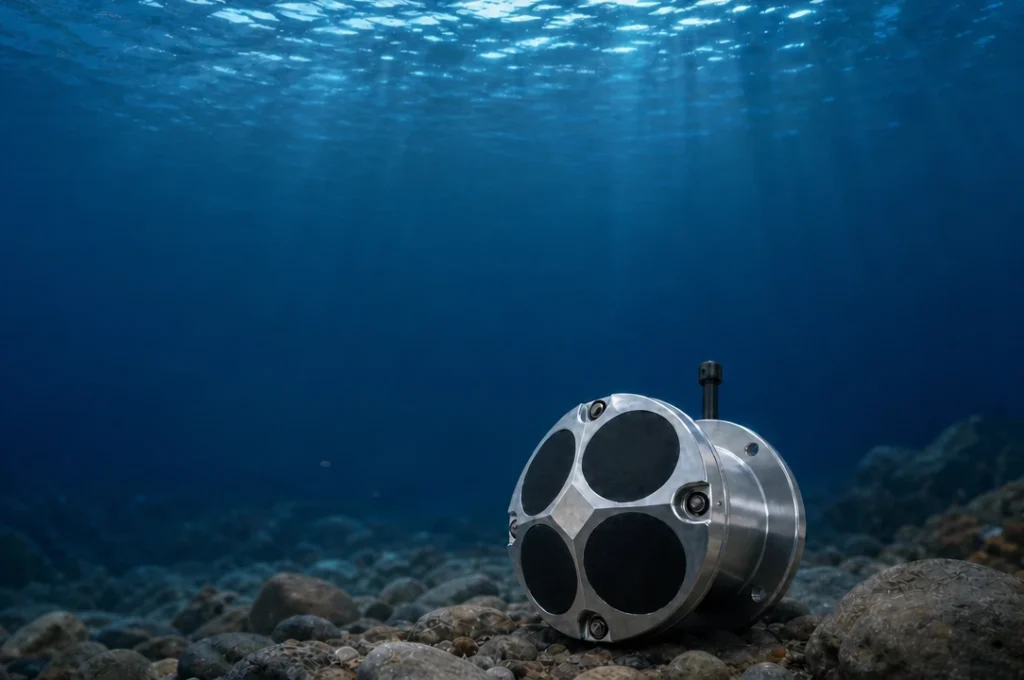
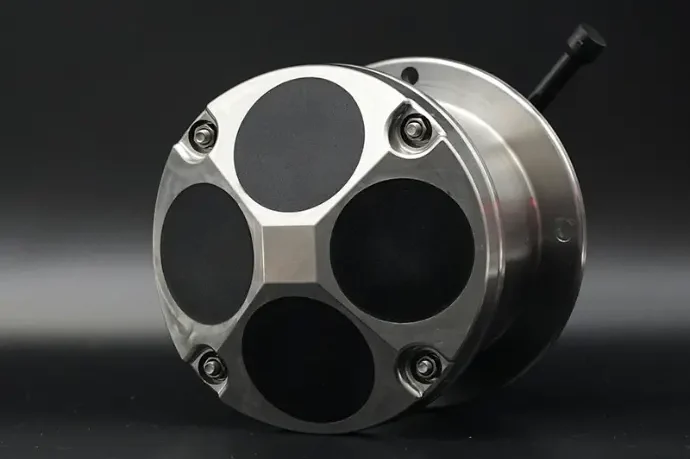
A single-point acoustic current meter, sampling at a user-defined interval and sleeping between bursts, can sustain a full deployment on internal batteries. Instruments like the Oceantek‘s H3-OCEAN are rated to 5000 meters with titanium housing and ultra-low standby consumption — purpose-built for the deep-ocean mooring use case where swapping a battery isn’t an option.
Typical customers include national oceanographic institutes, tsunami early-warning networks, and deep-water oil and gas operators monitoring loop currents near subsea infrastructure.
2. Index-Velocity River Discharge Measurement
Shallow Water · 0.5–2m
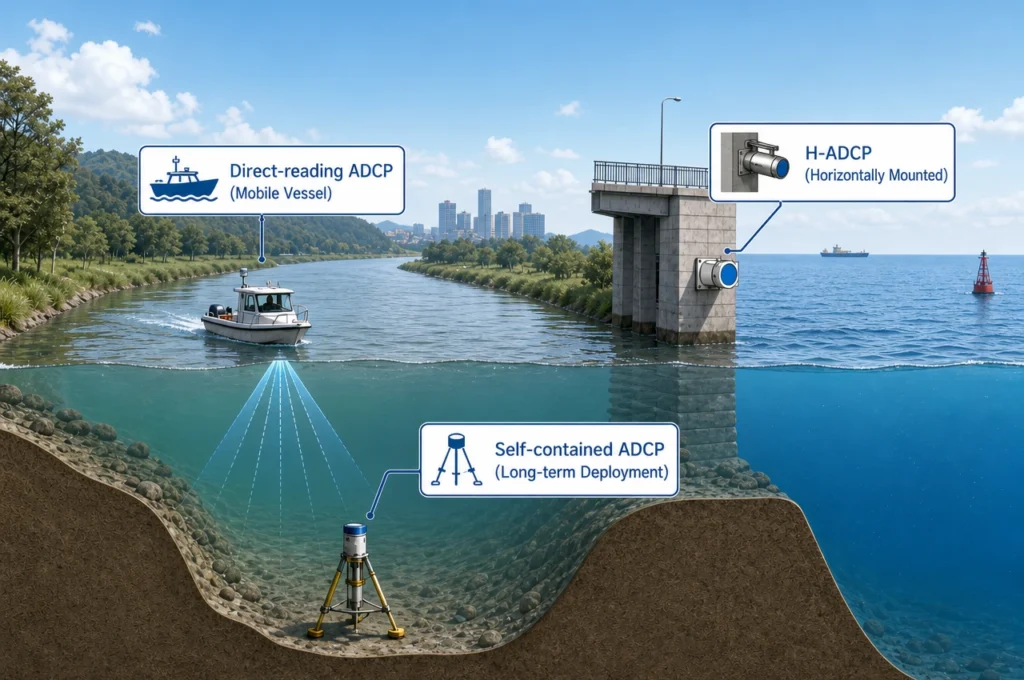
For permanent river gauging stations, a single-point current meter mounted horizontally near the riverbank — or on a bridge pier — provides a continuous index-velocity reading. This measured velocity correlates to the mean channel velocity through an established rating curve, enabling real-time discharge calculation without a full cross-section survey.
Hydrological agencies prefer single-point instruments for this application because:
- They are unobtrusive — no structure across the channel that could obstruct navigation or debris passage.
- A single measurement cell at the right lateral position is often sufficient when the channel cross-section geometry is stable.
- Lower cost per station means a monitoring network can afford more gauging points across a river basin.
3. Offshore Wind & Platform Construction Support
Shelf Depth · 10–200m
During the construction phase of an offshore wind farm or oil platform, operators need real-time current speed and direction at specific depths relevant to crane operations, ROV deployment, and pile-driving windows. A single-point current meter deployed at the critical working depth — often mid-water or near the seabed — feeds live data into the vessel’s dynamic positioning and operational decision loop.
Unlike a profiling ADCP, which generates more data than needed for a go/no-go operational call, a single-point meter delivers one number, one direction, refreshed every few seconds. That simplicity reduces the cognitive load on the ops team and integrates cleanly with platform SCADA or vessel telemetry.
4. Aquaculture Site Selection & Environmental Monitoring
Coastal · 5–50m
Before committing to a fish farm location, operators need to verify that current speeds fall within the optimal range — enough flow to flush waste and deliver oxygen, but not so strong that it stresses stock or damages net pens. A single-point current meter deployed at the planned cage depth for a 30–90 day survey provides the current distribution data needed to confirm site viability.
Post-installation, the same instrument type serves ongoing environmental compliance: demonstrating that waste dispersion stays within permitted limits and that the farm is not causing seabed accumulation beyond regulatory thresholds.
5. Port Approach & Navigational Channel Safety
Shallow · 2–30m
Strong cross-currents at a port entrance or along a narrow shipping channel are a direct hazard to vessel maneuvering. Port authorities install single-point current meters at strategic choke points — channel entrances, turning basins, and alongside berths — to provide real-time current data to harbor pilots and vessel traffic services (VTS).
In these installations, reliability and low maintenance are paramount. A single-point meter with no moving parts and a direct data output (RS-232, RS-422, or Ethernet) integrates into the port’s existing information display system and typically requires servicing only during scheduled maintenance intervals.
6. Tidal & Ocean Current Energy Resource Assessment
Variable · 10–500m
Before investing in a tidal turbine array, developers must characterize the current speed probability distribution at the exact hub height of the planned turbines. A single-point current meter deployed for 30–90 days at the candidate turbine depth logs the complete velocity record — mean speed, peak speed, directional consistency, and turbulence intensity.
The data feeds directly into energy yield models that determine project bankability. Because the deployment is temporary (weeks to months, not years), the instrument must be quick to mobilize, easy to recover, and capable of high-frequency sampling during peak-flow periods to capture the full velocity envelope.
At a Glance: Which Application Matches Your Needs?
| Application | Typical Depth | Duration | Key Requirement |
|---|---|---|---|
| Deep-ocean mooring | 500–5000m | 2–3 years | Ultra-low power, high pressure rating |
| River discharge | 0.5–2m | Permanent | Horizontal mounting, stable index velocity |
| Offshore construction | 10–200m | Weeks–months | Real-time output, simple data stream |
| Aquaculture | 5–50m | 30–90 days | Mid-water deployment, biofouling resistance |
| Port safety | 2–30m | Permanent | Low maintenance, direct telemetry |
| Tidal energy assessment | 10–500m | 30–90 days | High-frequency sampling, easy recovery |
Single-Point vs. Profiling: Making the Right Call
A single-point current meter is not a “budget ADCP.” It’s a different tool for a different job. When you need one depth, for a long time, with minimal power and maximum reliability, a single-point instrument is the right choice. When you need the full velocity profile — every depth bin from surface to seabed — an ADCP is the better fit.
For deep-ocean moorings, index-velocity gauging, and applications where years of autonomous operation matter more than vertical resolution, a purpose-built single-point current meter makes the deployment simpler, the data cleaner, and the lifetime cost lower.
Need a Single-Point Current Meter for Your Deployment?
The H3-OCEAN is a titanium-housed single-point acoustic current meter rated to 5000 meters, built for multi-year autonomous deployments. Standard protocols, open data formats, and in-stock availability.