Bay of Fundy, Minas Passage (FORCE)
Nova Scotia, Canada
Minas Passage in the Bay of Fundy is the most extreme tidal channel on Earth — 16 m of tide, flows above 5 m/s, and 14 billion tonnes of water moving through every tide. Since 2009, ADCPs have mapped it for the tidal-energy industry at a precision no other environment has ever demanded.
01 THE SETTING
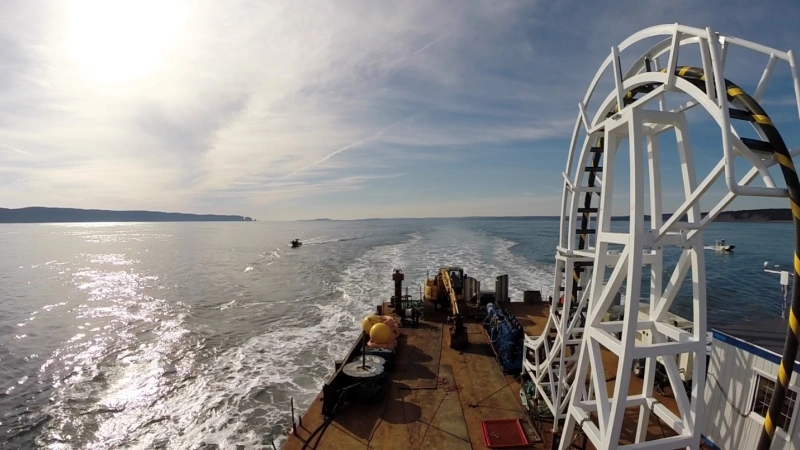
The Bay of Fundy's Minas Passage connects the bay's upper reaches to the wider Atlantic system, and the bay's famous funnel geometry concentrates the tide to its world-record 16 m range. The passage itself — a deep channel between Cape Split and Parrsboro, Nova Scotia — is the choke point where the flow accelerates to more than 5 m/s.
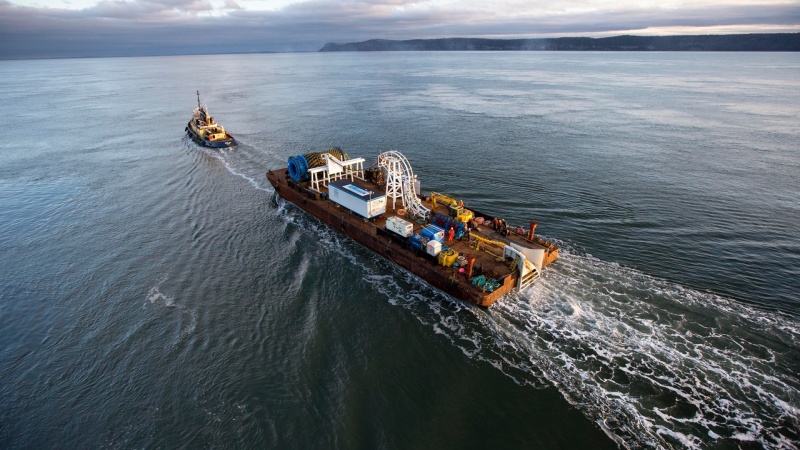
The FORCE (Fundy Ocean Research Center for Energy) test center was established there to turn that resource into electricity: a pre-approved berth area with subsea cable and grid connection where developers test tidal turbines, with research suggesting up to 2,500 MW could ultimately be extracted.
02 WHAT THE DATA SHOW
Published field data from the passage describe a flow field that punishes simple assumptions:
- Extreme peaks — flows above 5 m/s at spring tides, with devices seeing the full 16 m of vertical water-level change.
- High duty cycle — at 20 m above the seabed, speeds exceed 3 m/s about 5% of the time and sit between 2 and 2.5 m/s about 29% of the time — a serious current environment on most tides, not a rare event.
- Near-bed shear — speeds and kinetic power density drop sharply toward the seabed; published analysis shows generated power roughly doubles when a device is raised from 6.3 m to 16.5 m off the bottom.
- Turbulence and asymmetry — the passage's turbulence structure and ebb–flood asymmetry create large small-scale spatial variation; adjacent turbine berths can see materially different flows.
03 WHERE CURRENTS THREATEN OPERATIONS
Resource assessment precision
The 5%/29% duty-cycle statistics and near-bed shear decide whether a berth is bankable; getting them wrong by a meter of device height can halve projected revenue.
Device loading & survival
5 m/s flows with high turbulence impose load cases that test the entire engineering envelope — blades, structure, moorings and foundations.
Environmental monitoring
The Risk Assessment Program combines radar and ADCP data to build the passage's flow atlas and assess fish-encounter risk — the regulatory gate for deployment.
Deployment logistics
In 5 m/s flows, deployment and recovery are only practical near slack water — and at Fundy the slack is brief and unforgiving.
04 MEASUREMENT STRATEGY BY LAYER
FORCE's measurement program since 2009 is a case study in layered oceanographic instrumentation:
| Layer | Coverage | Approach |
|---|---|---|
| ADCP profiling since 2009 | Core environmental monitoring baseline | Acoustic Doppler current profiles alongside multibeam bathymetry and side-scan sonar |
| Risk Assessment Program (RAP) | The passage's first spatiotemporal flow atlas | High-resolution shore radar combined with mobile and stationary ADCPs |
| Model validation | Power-density maps at ~20 m resolution | FVCOM models validated against numerous ADCP measurements |
| 4D flow mapping | The complex, turbulent interior | Mobile ADCP campaigns where models and fixed instruments are insufficient |
05 THE OCEANTEK SOLUTION
Velocity headroom, low drag and frame-friendly form factors — instruments built for the world's strongest tidal flows:
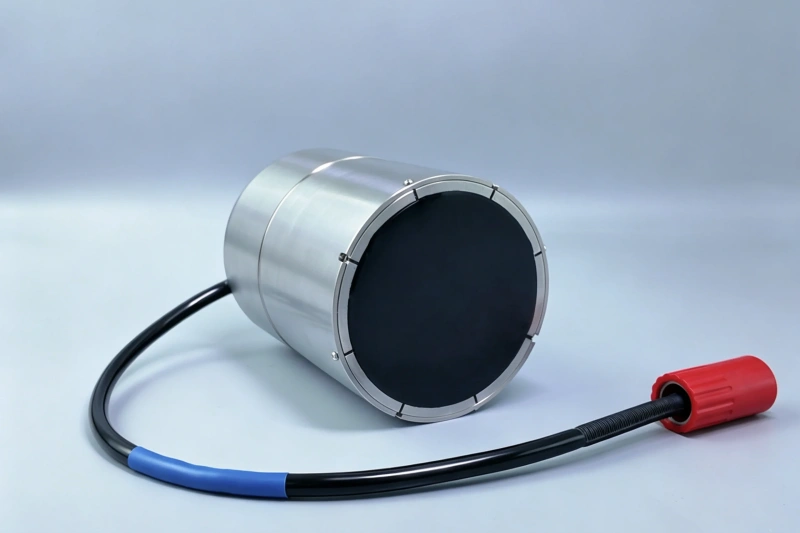
Ocean-ADCP-600-PA5
Ocean ADCP · 600 kHz phased array- 70 m profiling range
- ±20 m/s velocity range
- 1.8 kg · ≤5 W
- Titanium to 6000 m
Role: the strong-flow specialist — tiny drag footprint on buoys and frames, velocity headroom for turbulent bursts, low power for long deployments.
View product →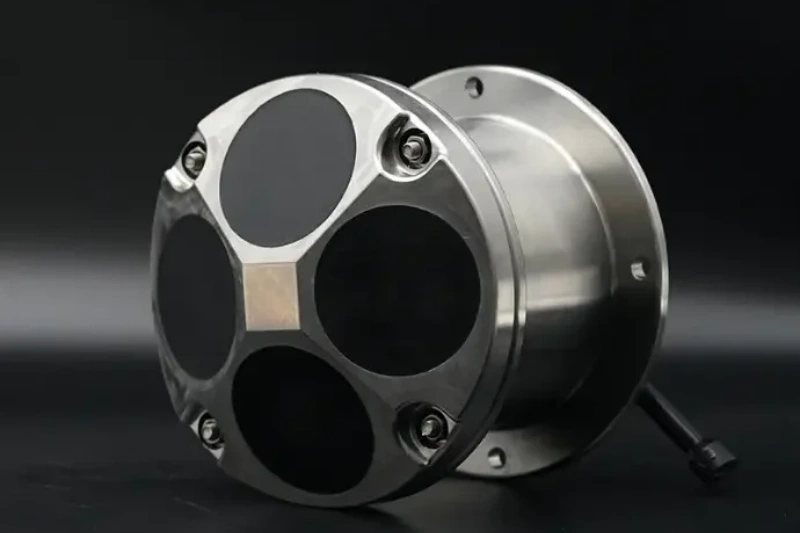
Ocean-ADCP-600-FA4
Ocean ADCP · 600 kHz- 70 m profiling range
- ±20 m/s velocity range
- Titanium · self-contained ≥100 days
- ±0.3% accuracy
Role: upward profiling from gravity frames in passage depths, capturing the near-bed shear that decides device height.
View product →
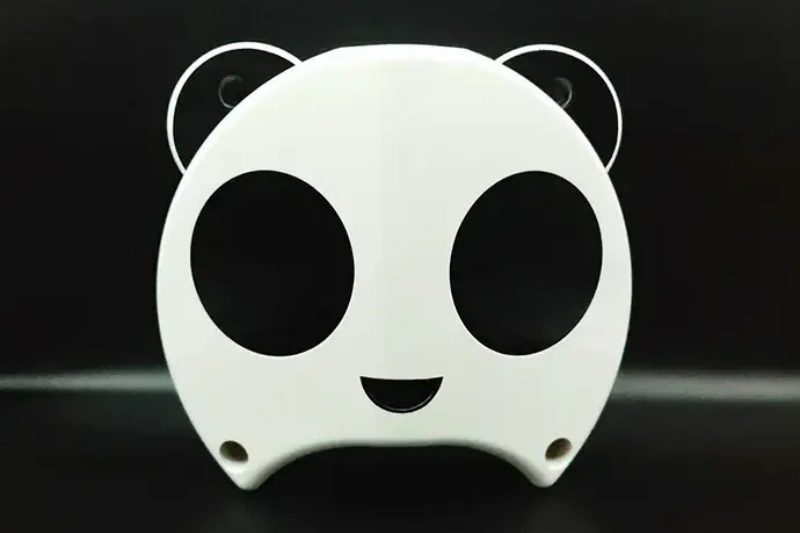
HADCP-600
Horizontal ADCP · 600 kHz- 90 m horizontal range
- ±20 m/s velocity range
- 20 m depth rating, wall mount
- 2 horizontal beams + 1 vertical
Role: side-looking from the channel wall: continuous cross-channel velocity without putting an instrument in the 5 m/s core.
View product →
06 FIELD NOTES
- Design every frame for drag and debris — in 5 m/s flows, mooring lines take enormous load and the passage carries everything from kelp to ice in season; heavy frames and low profiles are the difference between recovery and loss.
- Use slack windows ruthlessly — at Fundy the slack is brief; the 600-PA5's 1.8 kg mass matters when every minute of slack counts.
- Keep the instrument out of the core where possible — shore-mounted horizontal profiling measures the channel without living in it; the HADCP geometry is a maintenance-free complement to in-stream moorings.
- Expect asymmetric wear — ebb and flood are not symmetric in force or direction; frames and cables fatigue unevenly, so inspection schedules should follow the stronger phase, not the calendar.
🎯 Assessing a Tidal Energy Site?
Velocity headroom, low drag and frame-friendly form factors — instruments built for the world's strongest tidal flows.
🔍 Explore Ocean ADCP SeriesAlso see: HADCP-600 Horizontal ADCP · Questions? Contact our technical team