Executive summary
ISO 24578:2021 is the international standard for measuring open-channel flow with acoustic Doppler current profilers (ADCPs) from a moving boat. Published in March 2021 as the first edition and developed by ISO/TC 113 (Hydrometry), it gives field teams a complete, defensible method: principles, site selection, deployment procedures, moving-bed correction, maintenance checks and uncertainty. It supersedes the earlier technical specification ISO/TS 24154:2005 and complements ISO 748 for the ADCP case.
Contents
- What is ISO 24578:2021?
- Why ADCP needed its own standard
- The standard at a glance
- How the method works
- Determining flow: moving-bed methods
- Site selection and deployment
- Maintenance, checks and training
- Uncertainty
- ISO 24578 vs ISO 748 vs USGS TM 3-A22
- Working to ISO 24578: a practical checklist
- What this means for equipment
- FAQ
1.What is ISO 24578:2021?
ISO 24578:2021 — Hydrometry — Acoustic Doppler profiler — Method and application for measurement of flow in open channels from a moving boat — is the international standard for discharge measurement with boat-mounted ADCPs.
Its official abstract says it plainly: the document gives guidelines for the use of boat-mounted acoustic Doppler current profilers (ADCPs) for determining flow in open channels, describing a number of methods of deploying ADCPs to determine flow. Beyond flow itself, ADCPs covered by the standard can also be used to measure current or stream flow, water velocity fields and channel bathymetry.
The standard was prepared by ISO/TC 113, Hydrometry, the same technical committee responsible for ISO 748 and the wider family of hydrometric standards. Development drew on the operational experience of national hydrometric services — including the Public Works Research Institute in Japan, which was closely involved in bringing the ADCP moving-boat method to international standard status — and was published in March 2021.
You can view or purchase the official text directly from the ISO catalogue page for ISO 24578:2021.
2.Why ADCP needed its own standard
For decades, open-channel discharge measurement rested on the velocity-area philosophy of ISO 748: measure point velocities at defined positions across a section, then integrate. That approach works extremely well with mechanical and electromagnetic current meters, but a moving-boat ADCP works differently.
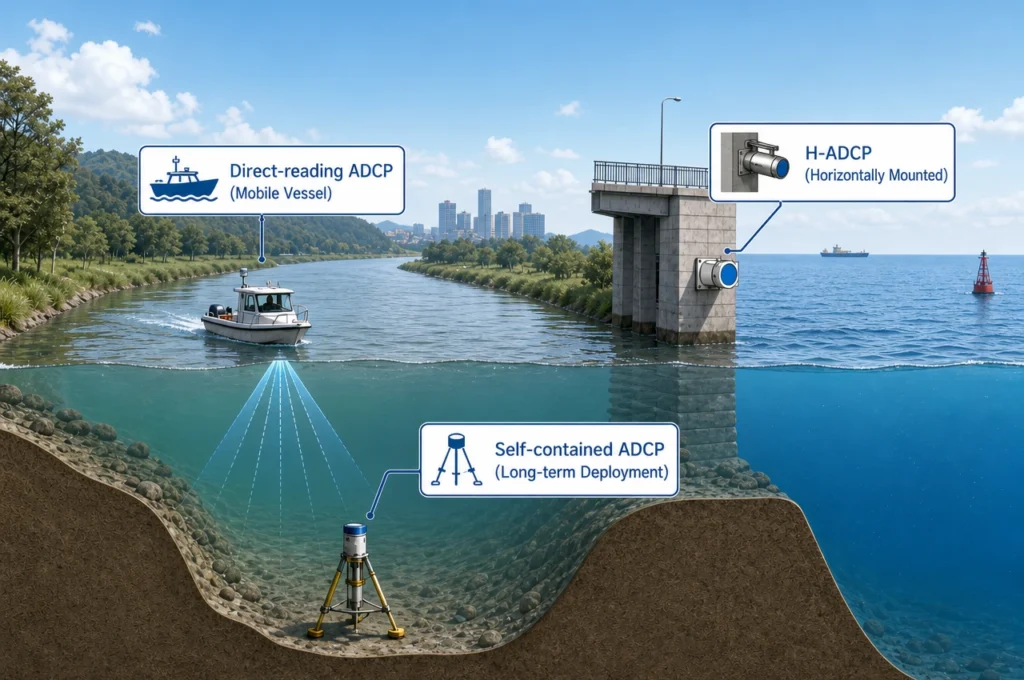
Instead of sampling at fixed points, a boat-mounted ADCP:
- profiles water velocity continuously in depth cells across the water column;
- measures its own motion over the bed (bottom-track) and/or by satellite navigation;
- combines the two to compute absolute water velocity and discharge while the boat moves across the section.
That raises method questions ISO 748 never had to answer: how fast can the boat travel? How do you handle a moving bed? What do you do about unmeasured zones near the surface, the bed and the banks? How do you estimate uncertainty for a continuous velocity field? Those questions are exactly what ISO 24578 answers.
The standard also formalises years of field practice. Before 2021, ADCP moving-boat gauging was guided mainly by the technical specification ISO/TS 24154:2005 and national manuals such as USGS TM 3-A22. ISO 24578:2021 elevated the method to a full international standard — important for tenders, cross-border projects and data comparability.
3.The standard at a glance
| Chapter | What it covers |
|---|---|
| 1–3 | Scope, normative references, and terms & definitions |
| 4 | Principles of the boat-mounted ADCP method — Doppler principle, signal-processing techniques, velocity-profile and boat-velocity measurement, near-boundary data, speed of sound |
| 5 | Flow determination — general method, measurement procedure, and five moving-bed correction methods |
| 6 | Site selection — criteria for choosing a suitable gauging section |
| 7 | ADCP deployment procedure — deployment techniques, boat operation, field procedures, ancillary equipment, edge distances, maintenance and checks, training |
| 8 | Uncertainty — definitions, sources and how to minimise them |
| Annex A | Velocity distribution theory and extrapolation of velocity profiles |
| Annex B | Determination of edge discharges |
| Annex C | Example of an equipment check list |
| Annex D | Example of ADCP gauging field sheets |
| Annex E | Beam alignment test |
| Annex F | Uncertainty evaluation methods |
4.How the method works
Chapter 4 sets out the physics and measurement principles behind the method:
- The Doppler principle applied to moving objects. The ADCP transmits acoustic pulses and measures the frequency shift of echoes from scatterers in the water to determine their velocity relative to the instrument.
- Three signal-processing techniques. The standard covers pulse-incoherent, pulse-to-pulse coherent and broadband (spread-spectrum) processing — the three families used by commercial ADCPs — and their trade-offs between range and resolution.
- Velocity-profile measurement. The ADCP measures water velocity relative to the boat in depth cells across the profile (4.4.2), and measures the boat’s own velocity over the bed using bottom-track or GNSS (4.4.3). Absolute water velocity is the difference.
- Near-boundary data collection. No profiler measures the entire water column: there is an unmeasured zone near the surface (the blank below the transducer), a side-lobe region near the bed, and unmeasured flow near the banks. Chapter 4 and Annex A explain how these zones are handled and extrapolated.
- Speed of sound. ADCP velocity measurements depend on the speed of sound in water, which varies with temperature, salinity and pressure. Correct sound-speed calibration is part of the method (4.5).
5.Determining flow: moving-bed methods
Chapter 5 covers the general method and the measurement procedure for computing discharge from moving-boat ADCP data. It then dedicates a full section (5.3) to moving-bed conditions — one of the most important practical topics in the standard.
| Method | Principle |
|---|---|
| Stationary moving-bed method | Measures bed velocity with the boat held stationary, then applies the correction to the traverse data. |
| Azimuth method | Uses stationary measurements at selected positions to estimate how bed velocity varies across the section. |
| Subsection correction method | Partitions the cross-section and corrects each subsection affected by the moving bed. |
| Loop method | A closed loop of transects reveals the boat-velocity bias introduced by the moving bed and compensates for it. |
| Mid-section method | Applies moving-bed corrections determined at the mid-section of the channel to the discharge computation. |
Each approach suits different river and bed conditions. The right choice depends on how uniform the bed movement is across the section — which is why the standard’s site-selection and field-procedure requirements matter as much as the correction mathematics.
6.Site selection and deployment
Chapter 6 sets out site-selection criteria: stable banks, uniform cross-section, measurable depths, manageable boat access and minimal flow disturbance. Chapter 7 then walks through the deployment procedure in detail:
- Deployment techniques (7.1) — manned boat-mounted, tethered boat, and deployment on a remote-control craft (USV), plus the data-retrieval modes for each.
- Boat operation (7.2) — how to steer the boat path across the section and how fast to move, balancing coverage against data quality.
- Field procedures (7.3) — pre-field preparation, field setup, reviewing ADCP data during the measurement, and post-measurement requirements.
- Ancillary equipment (7.4) — the supporting instruments and tools a compliant survey needs.
- Special conditions (7.5) — edge distances, depth measurements at high sediment concentrations, and the use of a GNSS compass for reliable heading and boat-velocity reference.
- Maintenance and checks (7.6) — covered in the next section.
- Training (7.7) — the standard is explicit that operators must be trained in the method.
7.Maintenance, checks and training
Reliable moving-boat data depends on instruments that are correctly maintained. ISO 24578’s maintenance and check requirements (7.6) include:
- built-in diagnostic checks before and during measurement;
- periodic major service by the manufacturer;
- periodic ADCP performance checks;
- physical maintenance of the instrument and mount;
- the beam-alignment test, documented in Annex E, which verifies the transducer geometry that velocity and discharge calculations depend on.
Annex C provides an example equipment check list and Annex D example field sheets, so field teams can document exactly what was measured and how.
8.Uncertainty
Chapter 8 covers measurement uncertainty — the quality statement that makes a discharge number defensible:
- Definitions (8.2) consistent with the ISO uncertainty framework.
- Sources of uncertainty (8.4) — instrument errors, deployment effects, moving-bed conditions, extrapolation of unmeasured zones, edge-discharge estimates and operator influence.
- Minimising uncertainty (8.5) — practical guidance on configuration, site selection and procedure.
- Evaluation methods (Annex F) — worked approaches for quantifying uncertainty in an ADCP gauging.
For teams working to ISO 25377 (HUG), ISO 24578’s uncertainty chapter slots directly into the broader hydrometric uncertainty framework.
9.ISO 24578 vs ISO 748 vs USGS TM 3-A22
| Document | Focus | Typical use |
|---|---|---|
| ISO 24578:2021 | Moving-boat ADCP discharge measurement in open channels | International reference for boat-mounted ADCP surveys |
| ISO 748:2021 | Velocity-area methods using point velocity measurements | Current-meter gauging (wading, bridge, cableway) |
| USGS TM 3-A22 | US field practice for moving-boat ADCP discharge measurement | USGS and US agency projects |
ISO 748 and ISO 24578 are complementary: ISO 748 frames the velocity-area approach, ISO 24578 adapts it to the ADCP moving-boat case. USGS TM 3-A22 and ISO 24578 are highly consistent in methodology — if you work with US agencies, follow TM 3-A22 as your field manual and cite ISO 24578 for international comparability.
Working to ISO 24578: a practical checklist
| Phase | Key actions |
|---|---|
| Pre-field | Select site against Chapter 6 criteria; verify instrument firmware and diagnostics; complete Annex C equipment checklist; confirm GNSS compass and bottom-track settings; check speed-of-sound inputs. |
| In-field | Follow the Chapter 7 deployment procedure; monitor data during measurement (7.3.3); check for moving-bed conditions and apply the appropriate 5.3 method; record edge distances and ancillary data. |
| Post-measurement | Review data (7.3.4); complete Annex D field sheets; compute discharge with documented edge and unmeasured-zone extrapolation; evaluate uncertainty per Chapter 8 and Annex F; keep records for audit. |
What this means for equipment
ISO 24578 describes a method, not a product certification. An ADCP is not “ISO 24578 certified” — compliance is achieved by deploying, configuring and processing correctly. What manufacturers can do is make compliant surveys practical:
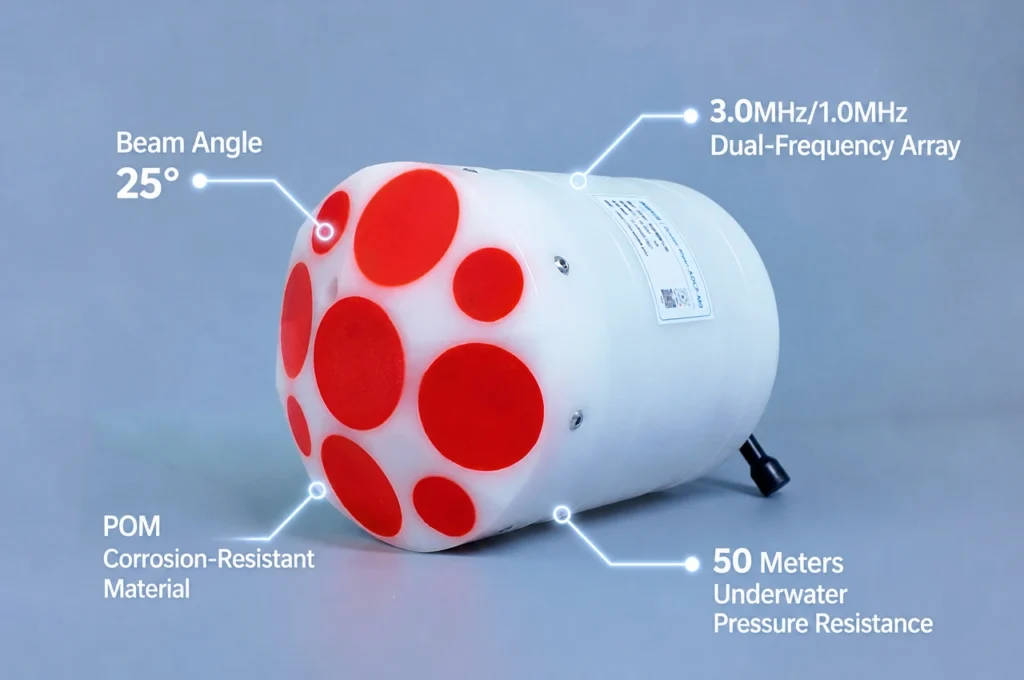
- beam configurations suited to moving-boat methods (for example, 4-, 5- and 9-beam systems);
- bottom-track and GNSS integration for boat-velocity and moving-bed detection;
- processing software that follows standard conventions and reports uncertainty;
- built-in diagnostics and documented beam-alignment checks.
At Oceantek we build ADCPs and DVLs with exactly this in mind. Our River ADCP M9 9-beam system and HADCP-600 are designed for standard-based river discharge work. You can also see the method in practice in our India National Hydrology Project case study, where ISO 24578-compliant thinking underpins a national ADCP rollout.
10.FAQ
What is ISO 24578:2021?
It is the international standard Hydrometry — Acoustic Doppler profiler — Method and application for measurement of flow in open channels from a moving boat. Published in March 2021 by ISO/TC 113, it gives guidelines for using boat-mounted ADCPs to determine open-channel flow.
Is ISO 24578 the same as ISO 748?
No. ISO 748 covers velocity-area methods using point velocity measurements, typically with current meters. ISO 24578 covers the moving-boat ADCP method, which profiles the full velocity field while the boat crosses the section.
What replaced ISO/TS 24154:2005?
ISO 24578:2021 supersedes ISO/TS 24154:2005, Hydrometry — Measuring river velocity and discharge with acoustic Doppler profilers, elevating the method from a technical specification to a full international standard.
What are the moving-bed correction methods in ISO 24578?
The standard describes five: the stationary moving-bed method, the azimuth method, the subsection correction method, the loop method and the mid-section method. Each suits different river and bed conditions.
Do US agencies use ISO 24578 or USGS TM 3-A22?
USGS and many US water-resource agencies follow USGS TM 3-A22 for moving-boat ADCP discharge measurement. The two documents are highly consistent; ISO 24578 is the international reference.
Disclosure:This guide is provided for general information and does not replace the official standard, which you should obtain from ISO and follow for any regulated or contractual measurement work.
© 2026 Ocean (Hangzhou) Technology Co., Ltd. All rights reserved. Last updated: August 24, 2026.