Introduction
Acoustic Doppler Current Profilers (ADCPs) are the backbone of modern hydrological measurement. Whether you‘re monitoring river discharge, mapping coastal currents, or assessing water resources for environmental impact studies, the ADCP you choose will directly determine the quality and reliability of your data. Yet with a growing array of products flooding the market — each boasting different specifications, frequencies, and feature sets — making an informed selection can feel overwhelming.
At Oceantek, we’ve spent years helping hydrologists, oceanographers, and environmental engineers match the right instrument to their unique project requirements. Through that experience, we‘ve identified five key parameters that consistently make the difference between a successful deployment and a frustrating one. This article walks you through each of these parameters in detail, explaining why they matter and how to evaluate them in the context of your specific application. Along the way, we’ll show you where Oceantek‘s ADCP solutions deliver particular value — because choosing the right tool shouldn’t be a guessing game.
1. Frequency & Beam Angle: The Foundation of ADCP Performance
1.1 Frequency: The Range-vs-Resolution Tradeoff
The first parameter every ADCP buyer faces is operating frequency. ADCPs commonly range from 75 kHz up to 1200 kHz, and the choice is fundamentally a tradeoff between profiling range and spatial resolution.
Lower-frequency instruments (75 kHz to 300 kHz) can profile to remarkable depths — the Teledyne RDI 38 kHz Ocean Surveyor, for instance, achieves profiling ranges beyond 1000 meters. But the tradeoff is that lower frequencies require larger range cells and deliver coarser spatial resolution.
Mid-range frequencies like 600 kHz strike a practical balance that works well for the majority of river and coastal applications. Teledyne’s Workhorse Sentinel 600 kHz, one of the most widely deployed ADCPs globally with thousands of units in operation across over 50 countries, offers a profiling range of up to 70 meters with excellent accuracy . Meanwhile, 1200 kHz instruments excel in shallow-water scenarios — the RiverPro 1200 delivers a 25-meter profiling range with the very highest accuracy bottom track and water profiling on a second-by-second basis, making it ideal for rivers where depth and velocity change constantly .
Oceantek‘s ADCP lineup directly addresses this range-vs-resolution dilemma. For shallow to medium-depth applications, Oceantek’s 600 kHz ADCP (model ADCP-600-DR-FA4) delivers a profiling range of 55m in broadband mode and 70m in narrowband mode, with bottom tracking capability from 0.8m to 120m — figures that place it squarely among the top performers in its frequency class . For truly deep-water applications, Oceantek‘s 75 kHz phased-array ADCP (model ADCP-75-DR-PA4) extends profiling range to an impressive 550m (broadband) and 650m (narrowband) .
1.2 Beam Angle: More Than Just Geometry
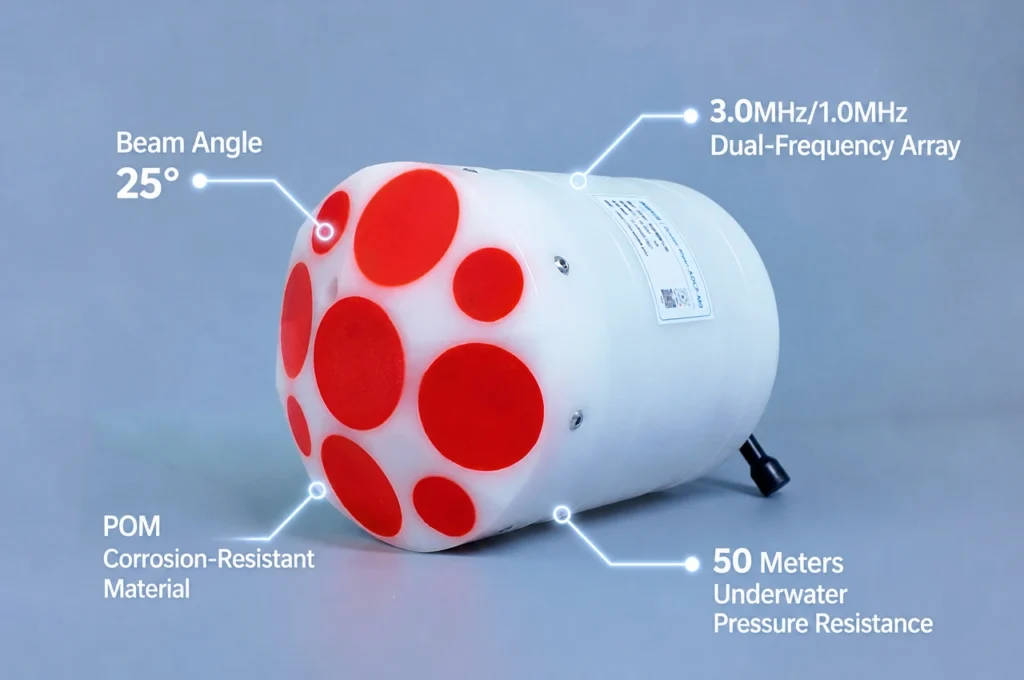
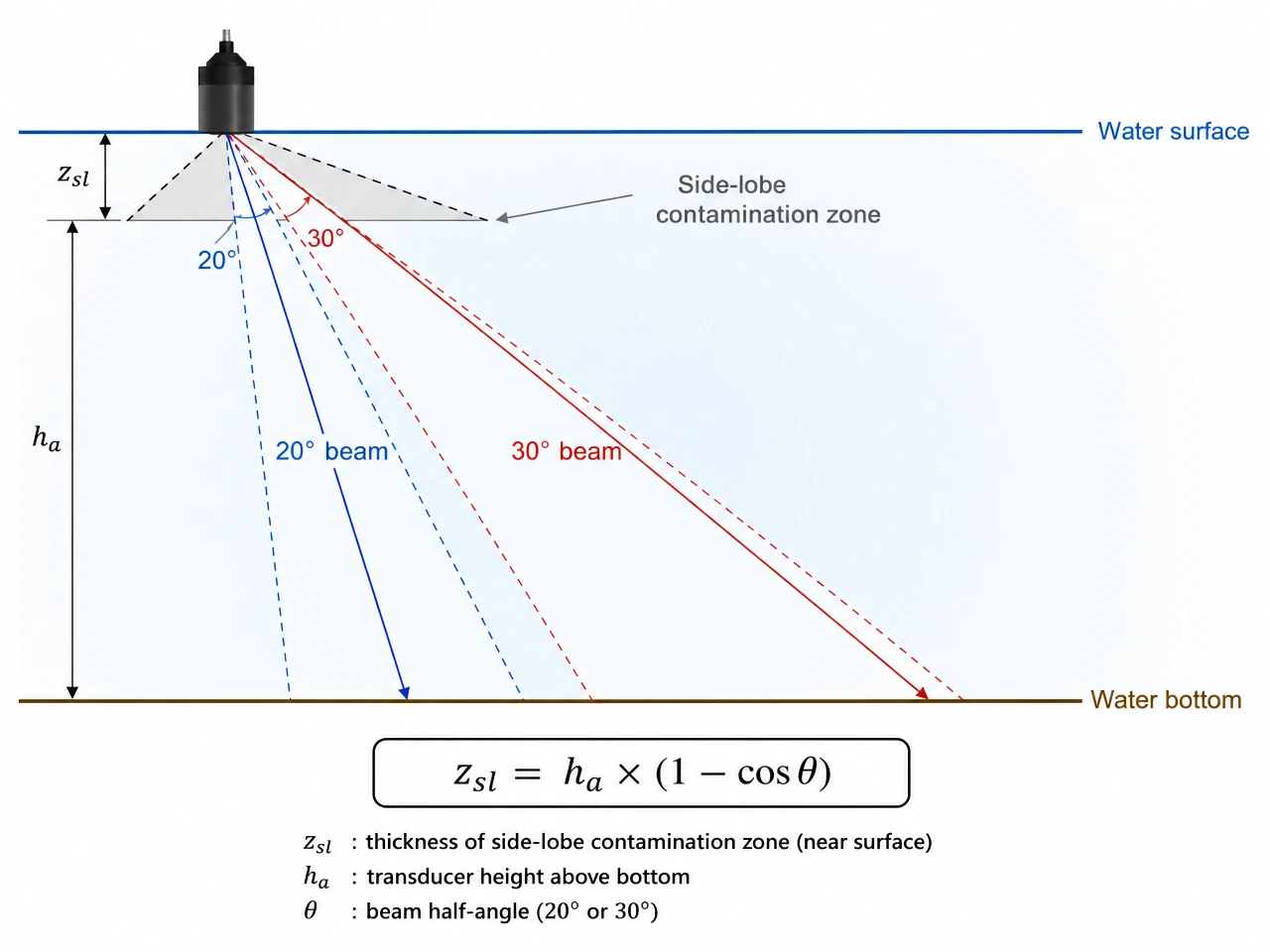
Beam angle — typically 20° or 30° — is often overlooked but has profound implications for measurement quality. The vertical velocity component is derived from projections of the along-beam velocities, so beam geometry directly affects uncertainty. More importantly, beam angle determines the severity of side-lobe contamination — a well-documented phenomenon in which acoustic reflections from boundaries contaminate Doppler velocity measurements near the surface or bottom .
A narrower 20° beam angle, as found in Teledyne RDI’s Workhorse II Mariner and RiverPro series, allows users to collect valid data closer to boundaries. The RiverPro specifically advertises this 20-degree beam as enabling data collection closer to the bottom . In contrast, 30° beam angles (common in the Ocean Surveyor series) increase the side-lobe contamination zone but can offer slightly better velocity precision per beam. Research confirms that the apparent depth of side-lobe contamination follows the formula zₛₗ = hₐ × (1 − cos(θ)), where hₐ is the distance to the surface and θ is the beam angle — a narrower angle reduces this contamination zone .
Oceantek‘s ADCP products use a 4-beam configuration with carefully optimized beam angles, and the 75 kHz model leverages phased-array transducer technology — the same approach used by top-tier deep-water ADCPs — to maintain compact form factor while achieving long-range profiling .
2. ADCP Velocity Measurement Range & Accuracy
2.1 Understanding Real-World Accuracy Specifications
Accuracy specifications can be confusing if you don’t read them carefully. Most ADCP manufacturers quote accuracy in the format “±X% of measured velocity ± Y mm/s” (or cm/s). The first component is a percentage error that scales with flow velocity, and the second is a fixed offset that dominates at low speeds.
For example, Teledyne‘s RiverRay ADCP (600 kHz) quotes an impressive ±0.25% ± 0.2 cm/s accuracy — among the best in the industry for river discharge measurement . The Workhorse II Mariner comes in at ±0.5% ± 0.5 cm/s , while the Ocean Surveyor series quotes ±1.0% ± 0.5 cm/s . These numbers reflect different design priorities: river instruments prioritize accuracy, while deep-water systems often prioritize range over precision.
But there’s an important nuance here: paper specifications don’t tell the whole story. An instrument‘s accuracy depends heavily on calibration quality, deployment configuration, and environmental conditions. EMSO (European Multidisciplinary Seafloor and water-column Observatory) researchers, in their 2025 best practices paper presented at the OCEANS conference, specifically highlight how calibration errors can significantly impact oceanographic data quality and emphasize the need for rigorous pre- and post-deployment calibration protocols .
2.2 Oceantek’s Competitive Edge in Accuracy
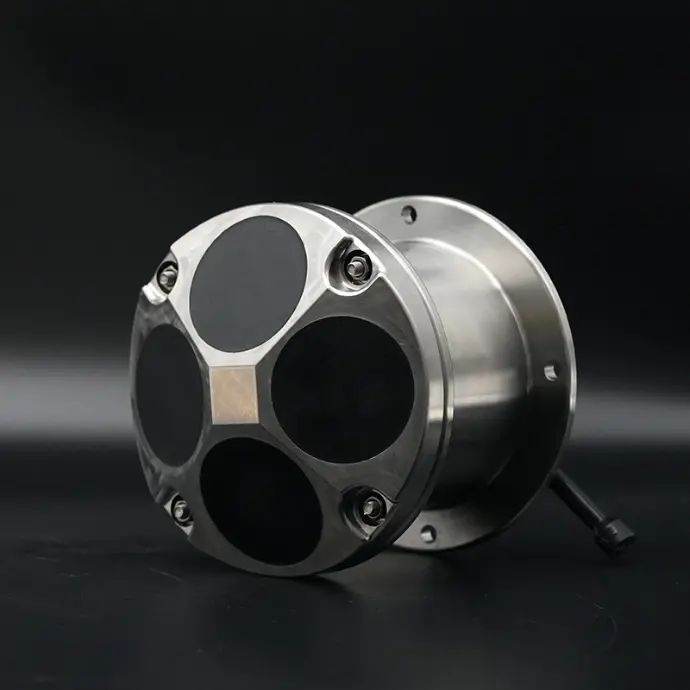
Oceantek‘s 600 kHz ADCP achieves a measurement accuracy of ±0.3% ± 3 mm/s, with a velocity resolution of 1 mm/s — specifications that directly compete with international instruments . The measurement range spans ±5.0 m/s default to ±20.0 m/s maximum, covering the full spectrum from slow-moving tidal flows to high-velocity flood events . For long-term monitoring applications, Oceantek’s self-contained ADCP models are designed for continuous operation of no less than 180 days, ensuring reliable data collection for extended deployments .
3. Depth Rating & Waterproof Grade
3.1 Matching Hardware to Environment
Depth rating is non-negotiable — exceed it and your instrument fails, possibly catastrophically. Standard ratings for river ADCPs are typically 100m to 200m, while deep-water instruments can be rated to 2000m or beyond. Teledyne‘s Pinnacle 45, for instance, is standard-rated to 2000m . The Workhorse Sentinel’s operating depth varies by configuration from 200m to 6000m .
But depth rating alone isn‘t the whole picture. Total Immersion time, pressure cycling, and housing material all contribute to long-term reliability. Titanium housings, while more expensive, offer superior corrosion resistance in saltwater environments compared to standard engineering plastics or aluminum.
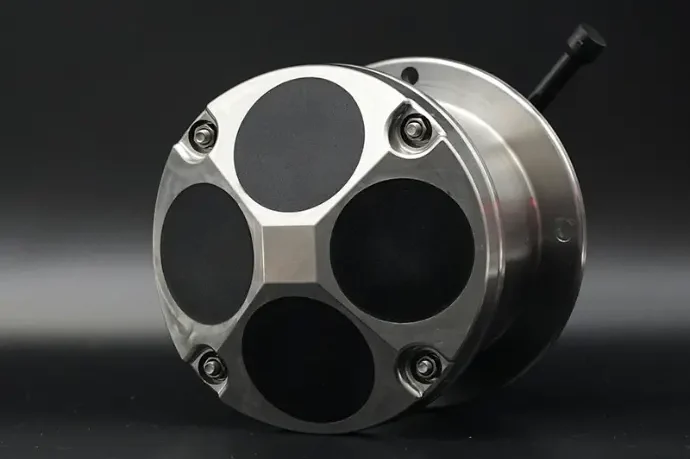
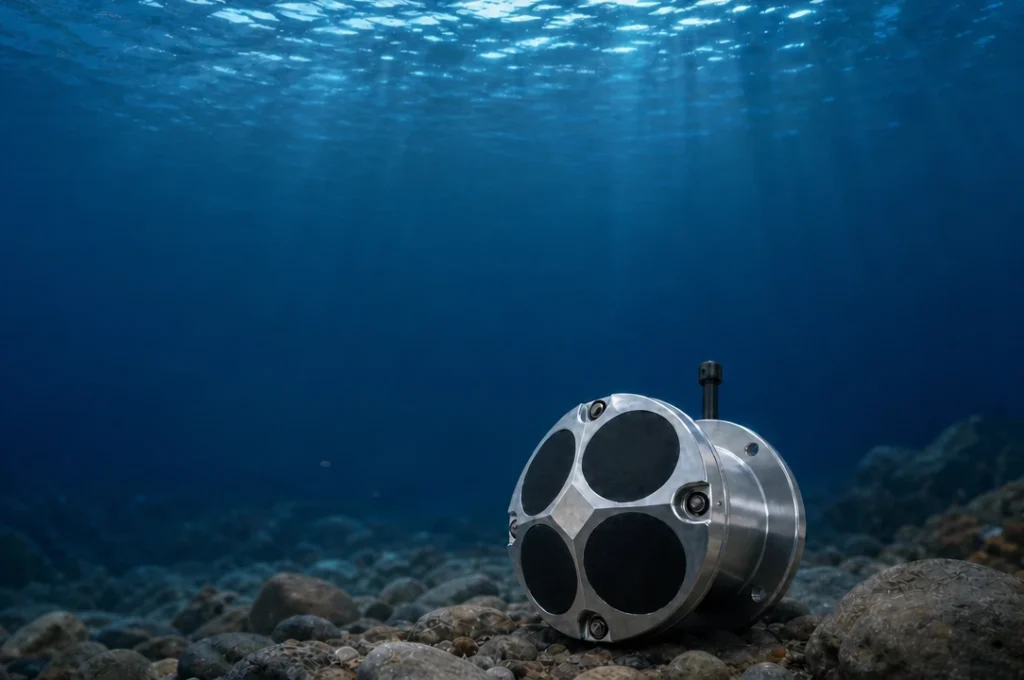
Oceantek takes an uncompromising approach here: all Oceantek ADCP models come standard with titanium alloy housings, eliminating the need for users to specify expensive material upgrades . This material choice provides inherent corrosion resistance across freshwater, brackish, and marine environments. Oceantek’s ADCP product line spans from shallow-water to deep-water depth ratings, including the 75 kHz model capable of operating at extended depths for oceanographic applications.
3.2 Waterproofing Beyond the Rating Number
A high depth rating is meaningless if connector seals, cable glands, or battery compartments fail. When evaluating waterproofing, look beyond the headline number and ask about:
- Connector type and sealing mechanism
- Pressure sensor integration (optional on many instruments but invaluable for depth-aware data processing)
- Housing maintenance requirements and O-ring replacement schedules
Oceantek‘s design philosophy emphasizes small form factor and integrated construction — the company’s ADCPs are significantly more compact than comparable instruments . This compactness reduces the number of seal points and potential failure modes, contributing to a cleaner, more reliable deployment experience.
4. Power Consumption & Working Lifetime
4.1 The Hidden Cost of Energy-Hungry Instruments
Power consumption is perhaps the most underestimated parameter in ADCP selection — especially for self-contained, long-duration deployments where the instrument must operate autonomously on batteries for months at a time. Every milliwatt counts when you’re deploying on a remote mooring with no access to shore power.
Power consumption varies significantly across instruments, influenced by frequency, ping rate, and signal processing mode. Typical power draw for 300 kHz instruments is around 11W, 600 kHz instruments around 7W, and 1200 kHz around 4W during active profiling . However, actual energy consumption depends heavily on your duty cycle — how often the instrument pings and how long it spends in low-power sleep mode between profiles.
The Workhorse Sentinel‘s design emphasizes “unbeatable precision, with unmatched low power consumption, allowing you to collect more data over an extended period” — a claim that highlights how power efficiency directly translates to longer deployments .
4.2 Smart Power Management in Modern ADCPs
Modern ADCPs employ increasingly sophisticated power management strategies:
- Burst sampling modes that concentrate measurements during periods of interest
- Adaptive ping rates that adjust sampling based on velocity variability
- Low-power standby states that minimize drain between profiles
Oceantek’s self-contained ADCP models are engineered specifically for autonomous long-term monitoring. The product literature emphasizes a minimum continuous working duration of 180 days, reflecting the system‘s ability to maintain reliable operation through extended autonomous deployments . For hydrological monitoring projects where instrument retrieval is logistically challenging or expensive, this power efficiency can translate into significant operational savings.
5. Matching with Project Environment
5.1 Site Selection: Where It All Begins
Even the best ADCP in the world will deliver poor data if deployed in the wrong location. As hydrologists at SonTek (a Xylem brand) emphasize, one of the most often overlooked sources of measurement errors is site selection. The ideal measurement section should be located at a straight channel reach, at least 5-10 channel widths upstream and downstream of any flow disturbances — bends, confluences, bridge piers, or vegetation — so that turbulence and eddies have sufficient distance to settle into uniform, steady flow .
Key site selection criteria include:
- Straight, uniform channel geometry (roughly parabolic, trapezoidal, or rectangular)
- Freedom from obstacles, inflows, and outflows
- Sufficient linear distance for flow to stabilize
- Representative cross-section of the channel’s overall characteristics
5.2 Instrument Selection: The Five-Parameter Checklist
Once the site is chosen, the instrument must match the specific conditions. Here‘s a practical framework based on deployment scenario:
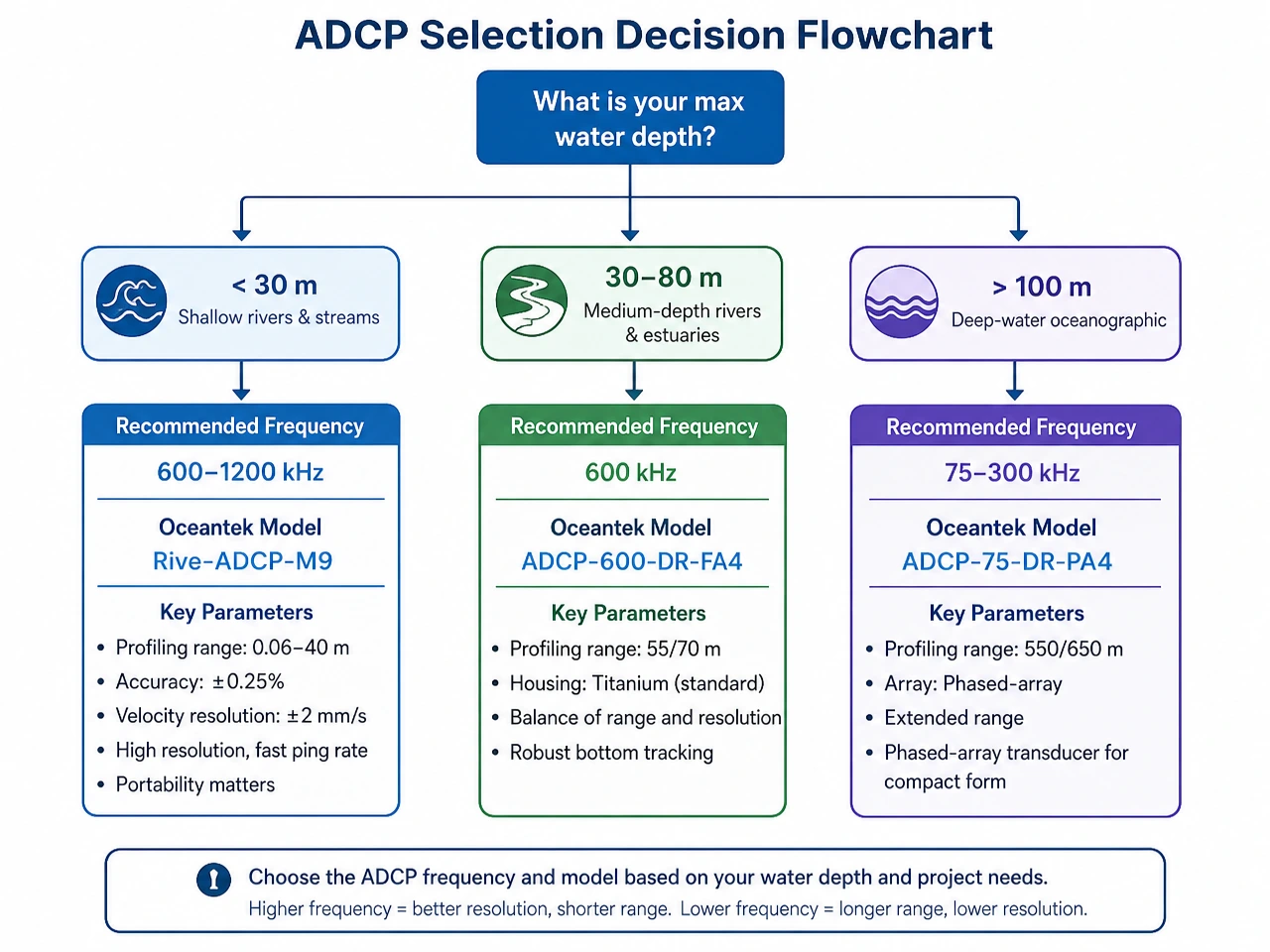
| Project Scenario | Recommended Frequency | Key Considerations | Oceantek Model Reference |
|---|---|---|---|
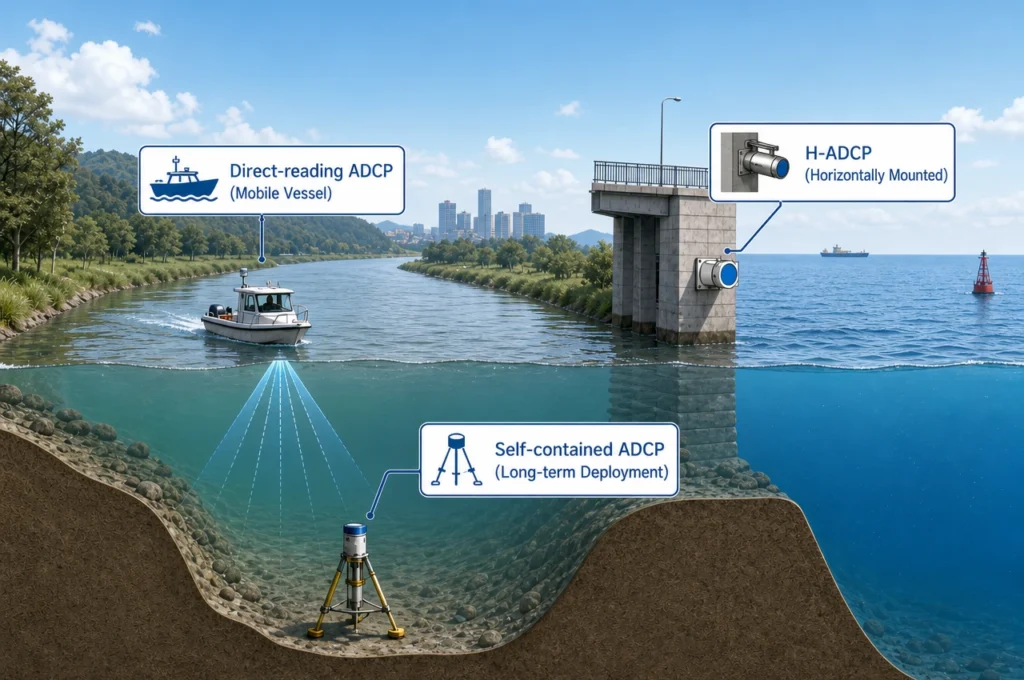
| Shallow rivers & streams (<30m) | 600-1200 kHz | High resolution, fast ping rate; portability matters | Rive-ADCP-M9 (profiling 0.06-40m, accuracy ±0.25% ± 2mm/s) |
| Medium-depth rivers & estuaries (30-80m) | 600 kHz | Balance of range and resolution; robust bottom tracking | ADCP-600-DR-FA4 (profiling 55/70m, titanium housing standard) |
| Deep-water oceanographic (>100m) | 75-300 kHz | Extended range; phased-array transducer for compact form | ADCP-75-DR-PA4 (profiling 550/650m, phased-array) |
| Long-term autonomous monitoring | 600 kHz | Power efficiency; self-logging; extended deployment endurance | Oceantek self-contained series (≥180 days continuous) |
5.3 The Oceantek Value Proposition for Hydrology Projects
When all five parameters are considered together, Oceantek‘s ADCP product line presents a compelling value proposition — particularly for hydrological projects where budget constraints must be balanced against performance requirements:
Comprehensive product coverage. From 75 kHz deep-water phased-array systems to 600 kHz river ADCPs, Oceantek’s lineup spans the most commonly requested frequency bands and deployment configurations .
Material quality by default. Titanium alloy construction across all models eliminates the need for premium housing upgrades — a cost that often catches buyers off guard with other manufacturers .
Competitive accuracy. The ±0.3% ± 3 mm/s accuracy specification of Oceantek‘s 600 kHz ADCP stands up well against the ±0.25% ± 0.2 cm/s of premium river ADCPs, while offering comparable velocity resolution and range .
Deployment reliability. With a minimum continuous operating duration of 180 days and compact form factor that simplifies handling and mounting, Oceantek’s instruments are built for the real-world demands of field hydrology .
Practical compatibility. Oceantek products feature broad protocol compatibility and straightforward operation modes — the instruments can be set to “power on and work” or to follow pre-programmed sampling schedules automatically .
Conclusion
Choosing the right ADCP doesn‘t need to be a complex exercise — but it does require systematic evaluation of the parameters that matter most for your specific deployment conditions. Frequency and beam angle determine the fundamental range-resolution tradeoff. Velocity accuracy specifications must be read carefully and contextualized against your required measurement tolerance. Depth rating and waterproofing protect your instrument investment. Power consumption directly governs how long you can leave the instrument unattended. And matching the ADCP to your actual project environment ties everything together.
Oceantek has built its ADCP portfolio around precisely these considerations, offering instruments that combine competitive technical specifications with practical deployment features and robust material quality. Whether you’re measuring discharge in a shallow river, profiling currents in a deep estuary, or running long-term autonomous monitoring in a remote location, there‘s an Oceantek ADCP engineered for the task.
For technical consultation or to discuss your specific project requirements, reach out to the Oceantek team at sales@oceanadcp.com or visit their website: https://oceanadcp.com/products/ to explore which ADCP configuration best fits your hydrology application.