Introduction
Whether you are gauging a river, surveying an estuary, or monitoring deep-ocean currents, understanding flow throughout the entire water column is critical. An Acoustic Doppler Current Profiler (ADCP) delivers that complete velocity profile in one deployment, without placing any moving parts directly in the flow. As a manufacturer specializing in advanced hydrological and oceanographic instruments, Oceantek designs ADCPs that make this technology accessible and reliable for field professionals.
1. What Is an ADCP?
An acoustic doppler current profiler measures water velocity at many depths simultaneously. It transmits short bursts of high-frequency sound, listens for echoes from suspended particles and plankton, then calculates speed and direction from the Doppler frequency shift in those returns.
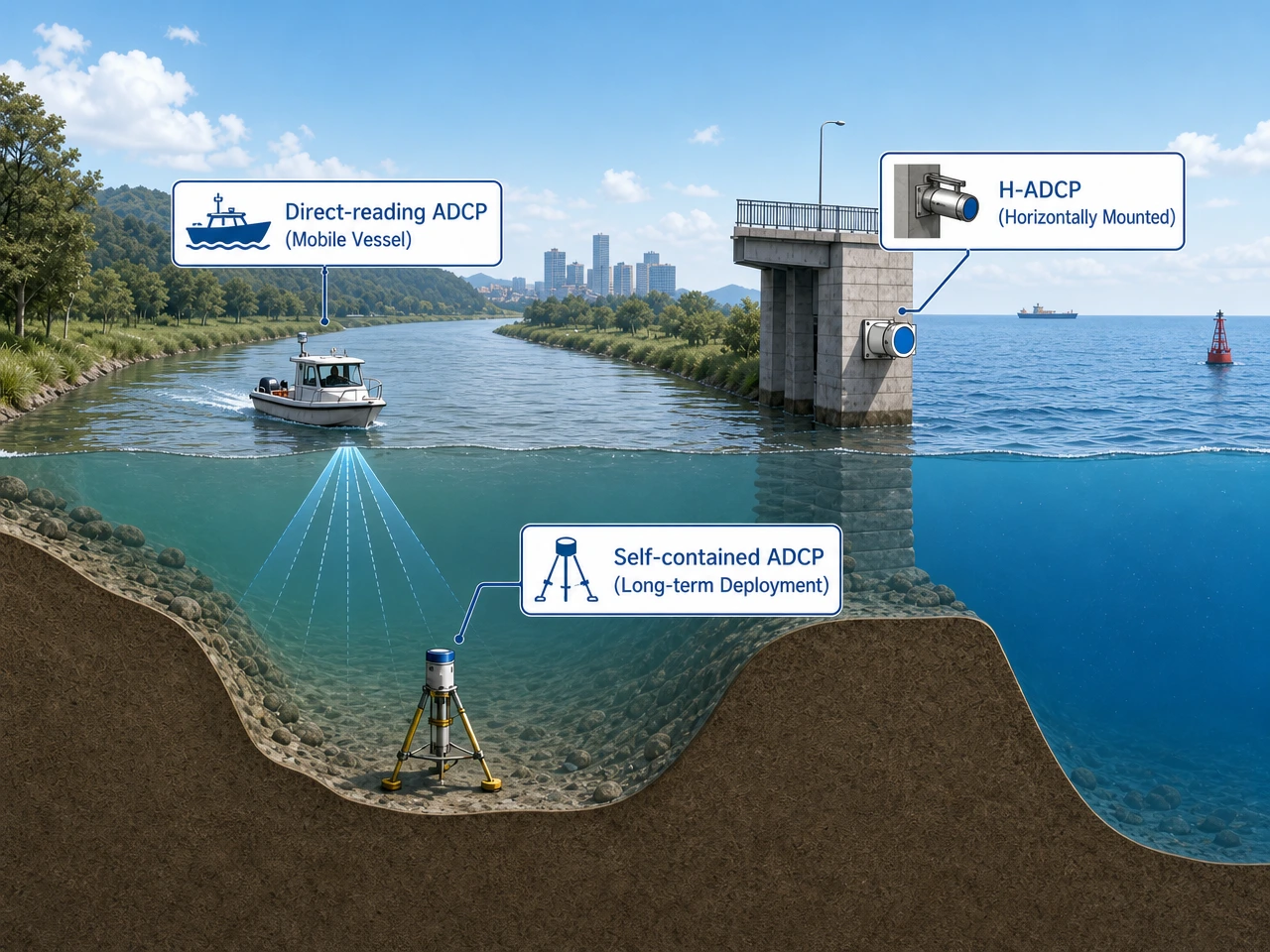
What sets an ADCP apart from a single-point current meter is that it produces a velocity profile—a continuous record of how currents change from the surface down to the bed. Depending on the frequency selected, Oceantek ADCPs can profile from a few meters to well over 1,000 m. They operate from vessels, moorings, buoys, or fixed riverbank installations, and are available in several core configurations: direct-reading (real-time) ADCPs , self-contained (autonomous) ADCPs , and river-type & horizontal (H-ADCP) models .
2. What Fundamentals Does the Acoustic Doppler Effect Include?
The measurement principle behind every ADCP is the same physics that shifts the pitch of a passing siren. When the instrument transmits a sound pulse at a known frequency and it reflects off a moving scatterer, the returned frequency is shifted—higher if the scatterer is moving toward the transducer, lower if moving away. The magnitude of this shift is directly proportional to the relative water speed along the beam path.
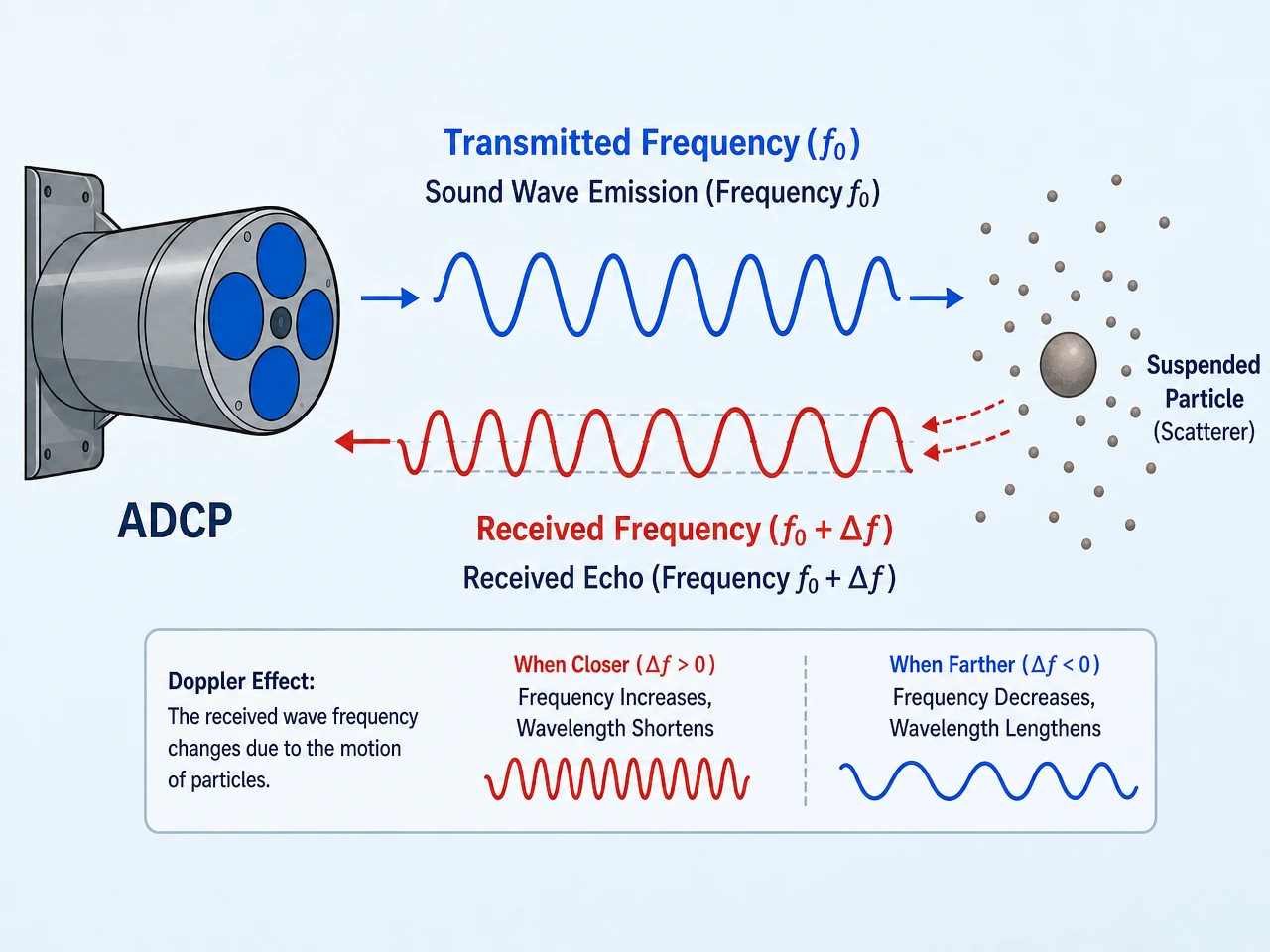
Three assumptions make the method work: the scatterers drift passively with the water, the flow is reasonably homogeneous across the beam footprint, and the local speed of sound is stable. While no natural environment perfectly satisfies all three, decades of field validation show that ADCP current measurements are robust enough for both scientific research and operational hydrology.
3. How ADCP Measures Velocity and Direction?
3.1 Beam Geometry and the Janus Configuration
A single acoustic beam only senses velocity along its axis. To reconstruct the full 3-D flow vector, an ADCP uses multiple beams pointing in different directions. Most ADCPs, including the Oceantek series, employ a Janus configuration with four beams arranged in two orthogonal pairs, each tilted 20° to 30° from the vertical.
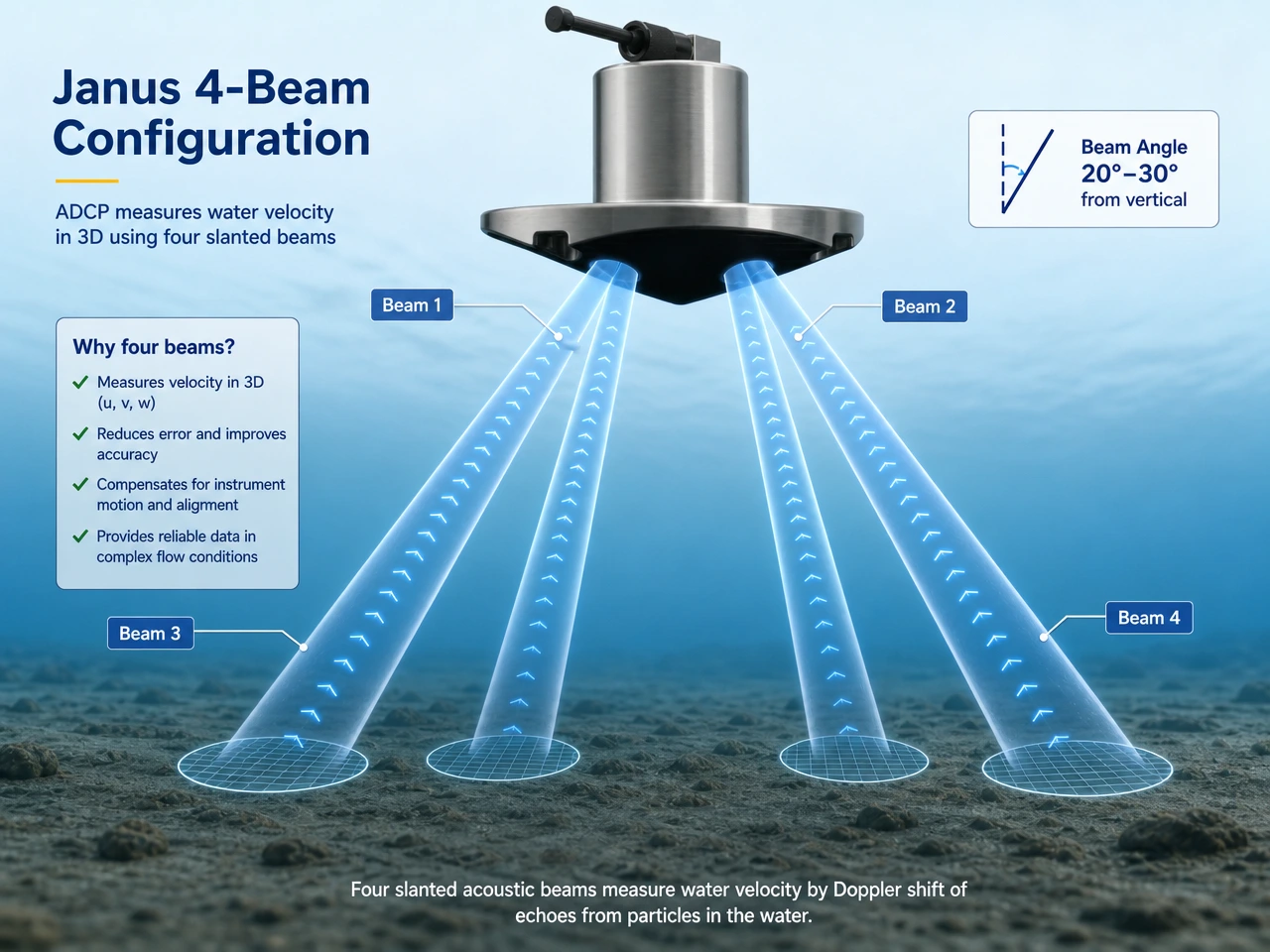
The symmetrical geometry cancels out errors caused by instrument tilt and motion, which is why high-quality profiles can be obtained even from a moving boat.
3.2 Range Gating and Depth Binning
After transmitting a short acoustic pulse, the ADCP listens to the returning echo and divides it into consecutive time windows. Because sound travels at a known speed (around 1,500 m/s), the arrival time of each portion of the echo corresponds to a specific distance from the transducer. By processing the Doppler shift inside each time gate separately, the instrument isolates velocity measurements at discrete depth bins.
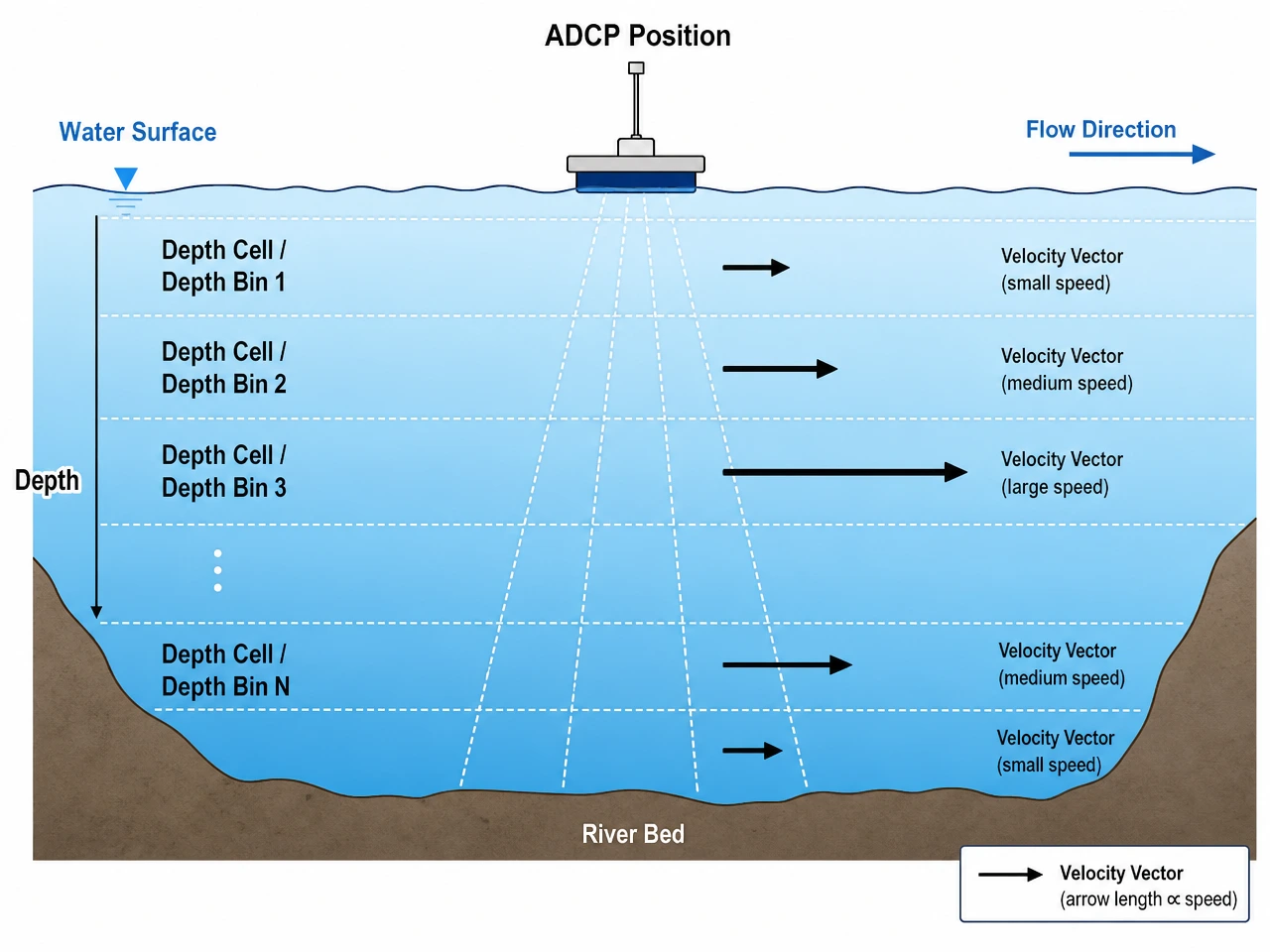
Operators can adjust the depth cell size—from a few centimeters in shallow water to several meters in deep profiling—to match the application. The result is a complete current velocity profile from near the transducer face out to the maximum range.
3.3 Coordinating Reference Frames
Radial velocities from all four beams are converted into Earth-coordinates (east, north, up) using trigonometric calculations and readings from the internal tilt and compass sensors. For vessel-mounted surveys, GPS and heading data subtract the boat’s motion, giving absolute current speeds. Individual pings are inherently noisy, so many successive pings are averaged into ensembles lasting one to ten minutes, yielding accuracy that easily resolves tidal and sub-tidal variations.
4. What are the Main Components of an ADCP?
An ADCP integrates several subsystems into a single submersible housing:
Piezoelectric Transducers: Ceramic elements that generate and detect sound waves. Each beam in the Janus array has its own dedicated transducer, with the ceramic geometry tailored to the operating frequency and beam angle.
Electronic Signal Processor: Handles waveform timing, sampling, and the extraction of Doppler frequency shifts. Modern ADCPs, including Oceantek’s, use broadband coding and phase-encoded pulses to dramatically lower measurement noise while keeping power consumption low.
Auxiliary Sensors: A pressure sensor measures instrument depth and captures tidal variations. Temperature thermistor and conductivity assumptions provide the sound speed needed for accurate range calculation. Tilt and compass sensors record orientation, essential for mapping beam coordinates into real-world currents.
Housing and Power: Housings use hard-anodized aluminum or titanium alloy depending on depth rating. Instruments are available as direct-reading ADCPs that stream data to a surface computer in real time, or as self-contained ADCPs with internal batteries and memory for long-term autonomous deployment.
5. What Application Scenarios Does Hydrology Have?
River Discharge Measurement. A moving-boat ADCP has become the standard tool for gauging stations worldwide. The instrument is taken across a river transect while profiling velocity and depth, calculating total discharge on the fly. Oceantek’s river-type ADCP systems are designed specifically for this work, with streamlined hardware and software that simplify field operations.
Fixed Horizontal Monitoring (H-ADCP). When continuous discharge records are needed—for flood warning, dam operation, or irrigation management—a horizontal ADCP (H-ADCP) is permanently installed on a riverbank or bridge pier. It beams across the channel to measure an index velocity that is correlated to the cross-sectional mean, providing 24-hour real-time data. Oceantek offers dedicated H-ADCP models for these long-term fixed installations, and they are among our most recommended solutions alongside direct-reading systems for station maintenance-free operation.
Estuary and Coastal Hydrology. Bottom-mounted, upward-looking ADCPs record currents over months, capturing tidal asymmetry, saltwater intrusion, and sediment transport. Data from these deployments informs dredging, ecosystem modeling, and pollution dispersal forecasts.
Infrastructure Support. Offshore engineers use vessel-mounted ADCP profiles to design pipelines, cables, and renewable energy foundations. The three-dimensional flow field captured by an ADCP reveals local current features critical to installation safety.
6. Why Choosing an Oceantek ADCP?
Selecting the right ADCP depends primarily on water depth, spatial resolution, and deployment style. Oceantek’s standard product family covers the full range:
- Direct-reading ADCPs: Ideal for real-time surveys or systems requiring constant data access. They communicate via cable with surface units, making them perfect for moving-boat discharge measurements and vessel-mounted profiling.
- Self-contained ADCPs: Built for autonomous long-term deployments on moorings or seabed frames. Internal batteries and large memory capacity allow worry-free operation for up to a year or more.
- River and Horizontal ADCPs: Our river-type solutions include the River-ADCP-M9 , a highly versatile multi-frequency instrument that combines a 4-beam 3,000 kHz array, a 4-beam 1,000 kHz array, and a single 500 kHz vertical beam. This configuration adapts automatically to changing depth and suspended sediment conditions, delivering reliable discharge data across a wide range of river sizes. The horizontal ADCP (H-ADCP) is engineered specifically for fixed riverbank installations, providing continuous, real-time index velocity for discharge monitoring.
Frequency options across our range include 75 kHz, 300 kHz, and 600 kHz transducers, allowing you to match the profiling range to your environment—from shallow streams to full-ocean depths beyond 1,000 m.
If you need to compare specifications, velocity accuracy, and maximum profiling ranges, visit the product pages at https://oceanadcp.com/products/. Our team can assist you in selecting the best direct-reading, self-contained, or horizontal ADCP for your field program.