
HADCP — Fixed-Station, Side-Looking
Discharge Monitoring
Horizontal Acoustic Doppler Current Profilers for permanent or semi-permanent installation on riverbanks, bridge piers, and channel walls. Measure full cross-section discharge without a boat, without a crew, 24/7 — in real time or autonomous logging mode. Built for hydrological agencies, flood warning systems, and irrigation canal management.
Technology
What Is a Horizontal ADCP?
Unlike vertical ADCPs that profile down through the water column, HADCPs look sideways
across the channel.
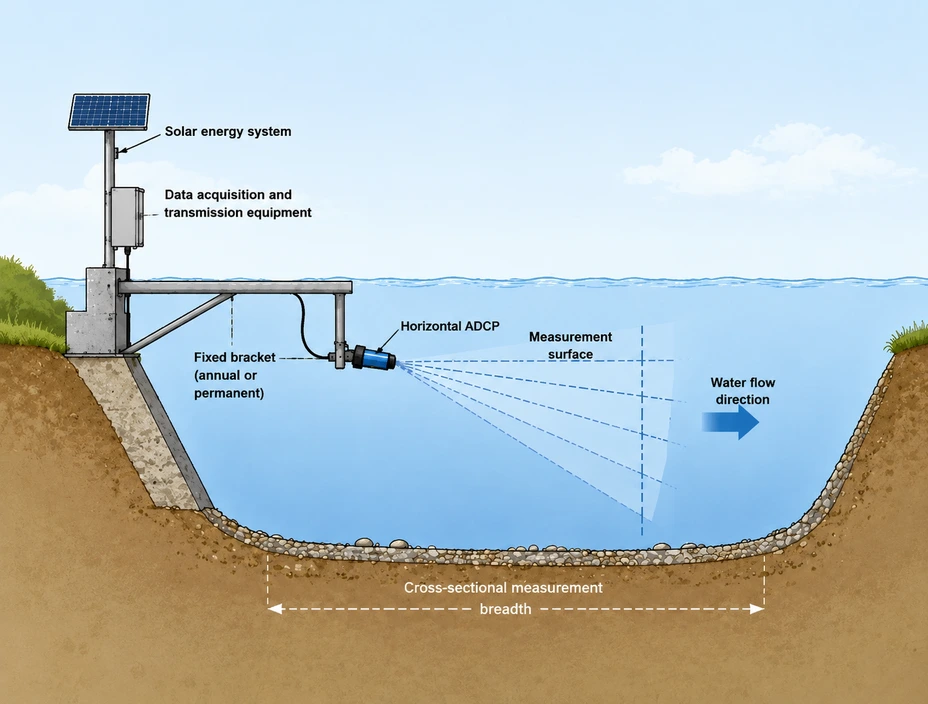
Side-Looking. Always On. No Boat Required.
A traditional ADCP is lowered from a boat and profiles vertically — you get a snapshot when someone is on site. A Horizontal ADCP (HADCP) is fixed to one bank, sending acoustic beams horizontally across the channel. It measures a continuous velocity profile along the beam path, 24 hours a day, 365 days a year.
Combine the velocity data with a stage (water level) sensor and channel geometry, and you get continuous, real-time discharge — the gold standard for hydrological monitoring stations.
Horizontal Beam Path
Measures velocity across the channel, not vertically through the water column.
Index Velocity Method
HADCP velocity correlated with occasional boat-ADCP surveys for rated discharge.
Fixed Infrastructure
Permanent mount on a bank, bridge pier, or concrete plinth — no moving parts.
Real-Time Telemetry
Direct-Reading configuration feeds data to SCADA, web dashboards, or flood warning systems.
Comparson
How HADCP Differs from Vertical ADCP
Different tools for different jobs. Here’s where each excels.
| HADCP (Horizontal) | Vertical ADCP | |
|---|---|---|
| Beam Direction | Sideways across channel | Downward through water column |
| Deployment | Fixed on bank / bridge / wall | Boat-mounted, mooring, or handheld |
| Measurement Mode | Continuous, unattended, 24/7 | Survey-based: episodic or campaign |
| Primary Output | Continuous discharge (m³/s) via index velocity | Vertical current profile & boat discharge |
| Data Delivery | Real-time telemetry / autonomous log | Real-time (DR) or post-recovery (SC) |
| Best For | Hydrological stations, flood warning, canal monitoring | Oceanography, offshore surveys, river gauging campaigns |
| Typical Installation | Permanent — years in place | Temporary — hours to months |
| View HADCP Products → | Explore Vertical ADCP → |
HADCP — Horizontal ADCP Models
Each model supports Direct-Reading and Self-Contained configurations.
Click through for full specifications.

HADCP-600
600kHz0.3%±3mm/sSide-Looking3 Beams
600kHz horizontal ADCP for permanent riverbank or bridge-pier installation. Continuous velocity profiling across channel widths up to 90m. Designed for index-velocity discharge monitoring in hydrological stations.
Where HADCP Is Deployed
Fixed-station horizontal ADCPs serve these core hydrological monitoring scenarios.
National Hydrological Networks
Continuous discharge monitoring stations for national/regional water resource agencies. Index-velocity rating with periodic boat-ADCP validation surveys.
Flood Early Warning
Real-time discharge data fed into flood forecasting models. Critical for urban flood defense, dam release management, and emergency response coordination.
Irrigation & Canal Management
Continuous flow monitoring in irrigation canals and water diversion projects. Accurate water accounting for agricultural and inter-basin transfer schemes.
How a HADCP Station Is Built
A HADCP is not just an instrument — it’s part of a monitoring station. Here’s what a typical installation involves.
Mounting Structure
Concrete plinth, steel bracket on bridge pier, or bank-retaining wall. Must be rigid and vibration-free.
Stage Sensor
Companion water-level sensor (radar, bubbler, or pressure transducer) — required for discharge calculation.
Power & Comms
Solar panel + battery, or mains power. Cellular / satellite telemetry for real-time data transmission.
Data Platform
On-site datalogger or cloud platform for processing, QA/QC, and dashboard visualization.
Frequently Asked Questions
What is the difference between HADCP and a regular (vertical) ADCP?
How does HADCP measure discharge without moving across the river?
What channel widths can HADCP cover?
Can I retrofit a HADCP into an existing gauging station?
Yes. HADCP can be installed alongside existing infrastructure — on the same bridge pier, bank wall, or concrete plinth. It complements traditional stage-only gauges by adding velocity data for a full discharge record. We provide site assessment guidance to determine the optimal mounting location.
What maintenance does a HADCP require?
Planning a Fixed-Station Monitoring Project?
Tell us about your site and we’ll recommend the right HADCP configuration.
Explore other product lines